




How to Choose a Domestic Violence Lawyer in Northern Virginia (2026)
Choosing the right domestic violence lawyer in Northern Virginia comes down mostly to trial experience. That experience is what gives the defense leverage, and many defense attorneys have very little of it. The number of years an attorney is licensed tells you little about that attorney’s trial experience. A strong candidate is an attorney who regularly handles domestic assault and battery cases, understands how Virginia protective orders work, and screens from the first meeting for the consequences that set these cases apart from an ordinary misdemeanor: firearm restrictions, immigration exposure, security clearance risk, and effects on custody.
At The Leiva Law Firm, our criminal defense work is built on more than 25 years of trial experience and an AV Preeminent rating from Martindale-Hubbell, the highest peer-review rating an attorney can hold. Manuel Leiva began his career as an Assistant Public Defender in Fairfax County, handling serious cases from the start. Clients work directly with him, not a junior associate. The guide below walks through the criteria that should drive your decision, the questions to ask before you sign anything, and the warning signs worth taking seriously.
Trial Experience Matters More Than Years Licensed
The most important thing to look for is jury trial experience. A long career and a deep record of trial work are not the same thing, and the difference matters most in a case that could actually go in front of a jury.
As Manuel Leiva puts it: “You shouldn’t judge on who you’re going to hire as a lawyer by the number of years they’ve been a lawyer. It’s the experience they have in that particular field, but more importantly, the trial experience they have.”
He is blunt about how common the gap is: “There are plenty of lawyers walking out here who have 20, 30 years experience and have maybe one or two jury trials if that. If you believe your case is one that’s going to go to trial, you need someone with jury trial experience.”
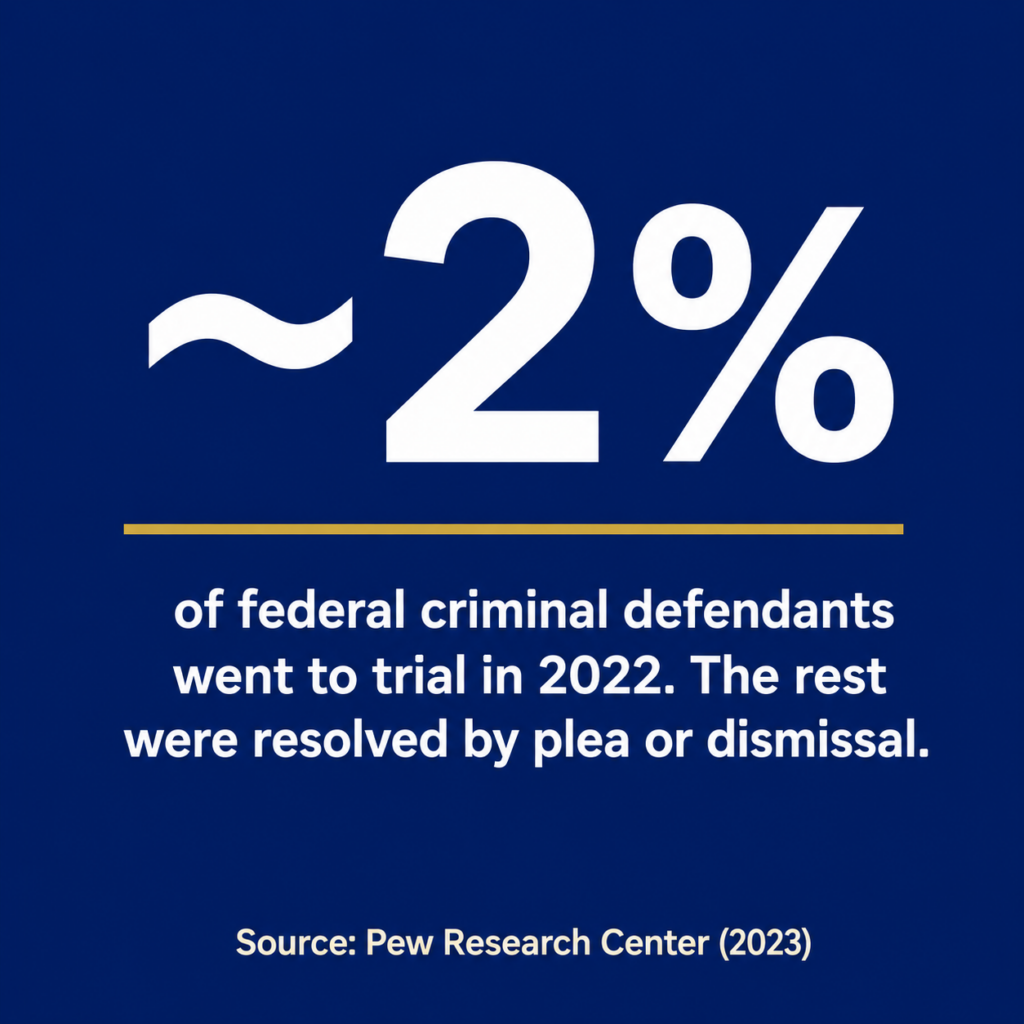
There is a reason this experience is scarce. The vast majority of criminal cases never reach a jury. Pew Research Center analysis found that only about 2% of federal defendants went to trial in 2022, with the rest resolved by plea or dismissal. State courts show a similar pattern. Many defense attorneys have built their practices almost entirely on plea negotiations and have handled very few contested jury trials. For a minor matter, that may be fine. For a domestic assault and battery charge, where the resolution can follow you for the rest of your life, it is a real limitation.
Manuel Leiva uses a simple comparison. You can hire a surgeon with the best grades from the best medical school to operate on you or someone you love, or do you want the surgeon who has actually performed the procedure many times, not the one who only read about it. The same logic applies to a trial lawyer.
Why Trial Experience Creates Leverage
Trial readiness helps even in cases that never reach a trial. As Manuel Leiva explains: “In criminal defense, trial experience is leverage. Prosecutors know which attorneys will push back and which ones are just looking to get a plea deal.”
A prosecutor’s time and docket are limited. When the attorney across the table is prepared to try a difficult case in front of a jury, the calculus shifts. That credible willingness to litigate is often what moves the Commonwealth toward a better resolution, a reduced or amended charge, or a decision to seek a nolle prosequi when the evidence is weak. A lawyer who never tries cases gives up that leverage before negotiations even begin.
When you evaluate trial experience, look past the marketing and ask to see a track record. Manuel Leiva’s attorney background and our case results show the kind of detail a serious answer should include.
Look for Real Experience With Domestic Assault and Battery Charges
Domestic violence is not a single charge. In Virginia, the offense is assault and battery against a family or household member under Va. Code § 18.2-57.2, and it has its own statute, its own court, and its own consequences. A first or second offense is a Class 1 misdemeanor, punishable by up to twelve months in jail and a fine of up to $2,500. A third offense within twenty years can be charged as a Class 6 felony.

The definition of “family or household member” is broad. It reaches current and former spouses, parents, children, siblings, grandparents, anyone you share a child with, and anyone you have lived with in the past twelve months. An argument with a roommate from six months ago, or a co-parent you never lived with, can be charged under this statute rather than as a simple assault, which pulls in the harsher consequences attached to domestic cases.
The right question is more specific than “do you handle criminal defense.” Ask whether the lawyer regularly handles assault and battery against a family or household member, along with the protective orders that almost always come with it. A lawyer who concentrates on these cases will recognize, for example, when the relationship may not meet the statutory definition, an issue that can change the charge entirely.
Domestic allegations almost always trigger a parallel protective order proceeding, and those orders carry their own restrictions and deadlines. Make sure your lawyer handles both. You can read more about our work on domestic violence defense and the underlying assault and battery charge to see how the two connect.
Make Sure the Lawyer Screens for Collateral Consequences From Day One
For most clients, the jail exposure is not the worst part of a domestic violence charge. The lasting damage comes from the collateral consequences, and the best lawyers screen for them at the first meeting, before any conversation about how the case might resolve. In our practice, this is where we start, because a resolution that avoids jail but costs you your gun rights, your job, your children, or your immigration status is not a good outcome.
The table below shows the consequences that most often catch clients by surprise and what a prepared lawyer does about each.
| Consequence | Why it matters in a domestic violence case | What a prepared lawyer does early |
| Firearm rights | Under federal law, a conviction for a misdemeanor crime of domestic violence carries a firearm prohibition, and an active protective order independently restricts possession under Virginia law. | Raises it before any plea discussion and weighs whether the charge can be challenged or amended to an offense that does not trigger the ban. |
| Immigration status | A conviction for a crime of domestic violence can make a non-citizen deportable, even with no jail time. | Coordinates the defense so that any resolution accounts for immigration exposure from the outset. |
| Security clearance | Clearance adjudicators weigh the underlying conduct and judgment, not just the court outcome, so even an arrest can trigger review. | Builds a parallel record of mitigation alongside the criminal defense. |
| Protective orders and custody | A protective order can restrict where you live, your contact with your children, and your access to shared property. | Treats the protective order hearing as part of the defense, not a side issue, and contests it where the facts allow. |
Federal firearm law is especially unforgiving here. Under the ATF’s definition of a misdemeanor crime of domestic violence, certain state outcomes can count as a conviction even when Virginia later dismisses the charge. A lawyer who pushes you toward the quickest resolution without explaining this is doing you a disservice. Ask directly how a given outcome would affect each of these areas. The protective order side carries enough weight to deserve its own attention, which you can read about on our protective orders page.
Confirm They Know the Local Courts
Domestic violence cases in Virginia are not heard in the General District Court where most misdemeanors land. They fall under the jurisdiction of the Juvenile and Domestic Relations (JDR) District Court, which has its own procedures, a different judicial culture, and a stronger focus on counseling and family dynamics. An attorney who rarely appears there is at a disadvantage.
Local knowledge extends to the prosecutors. The Commonwealth’s Attorneys in Fairfax, Arlington, Alexandria, Loudoun, and Prince William each have their own charging preferences and plea practices, and Stafford is part of the broader area we serve. A lawyer who regularly works in these courtrooms understands how a particular office tends to handle these cases, which informs strategy from the first appearance. Ask whether the attorney appears in your jurisdiction’s JDR court on a regular basis. Our Northern Virginia criminal defense practice covers these courts directly.
Understand Who Actually Controls the Case
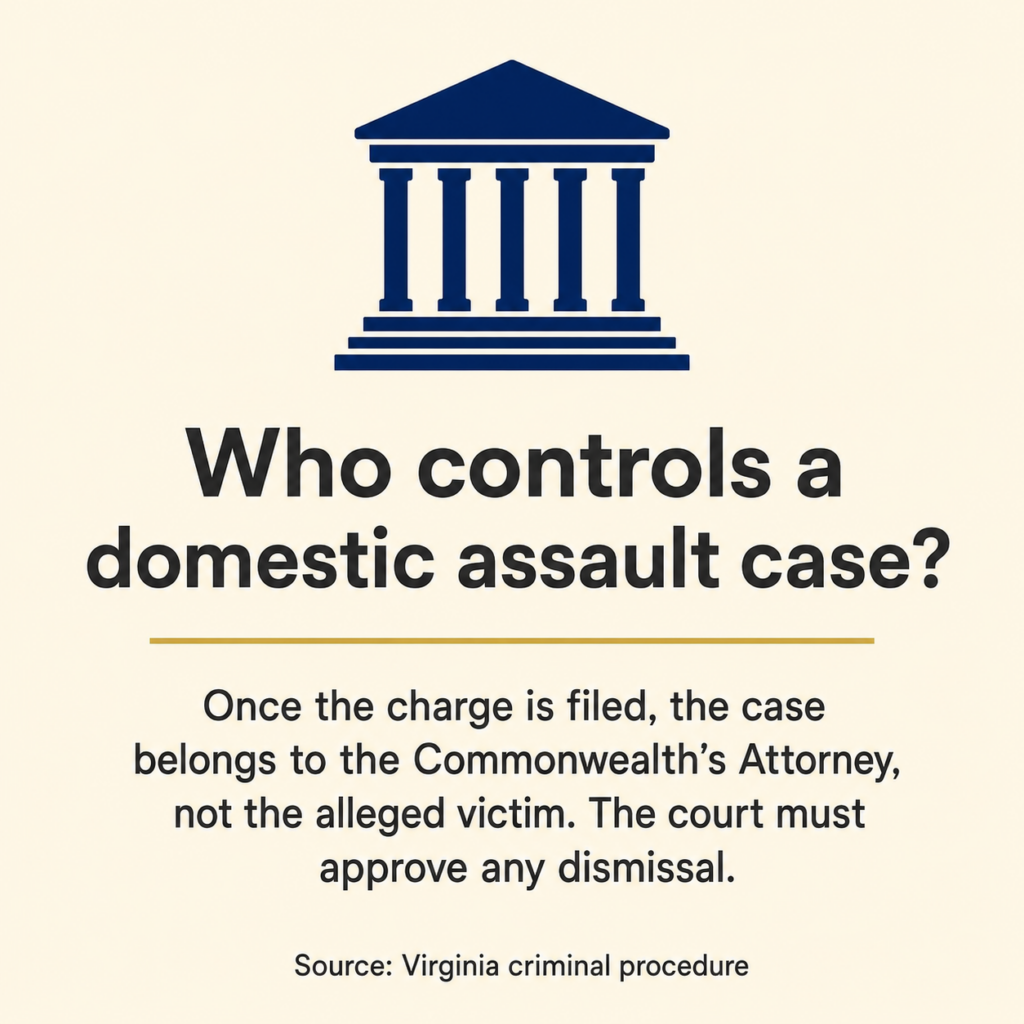
One of the most common and most dangerous misconceptions is that the alleged victim can simply “drop the charges.” In Virginia, that is not how it works. Once a domestic assault and battery charge is filed, the case belongs to the Commonwealth’s Attorney. The complaining witness becomes a witness, not a party. They can decline to cooperate or ask the prosecutor not to go forward, but the prosecutor decides whether to proceed, and the court must approve any dismissal.
Many Northern Virginia prosecutors pursue these cases even when the witness is reluctant. They build the case on independent evidence: 911 recordings, body camera footage, photographs, medical records, and the responding officer’s testimony. Virginia law even sets aside the usual spousal privilege in these prosecutions, so under Va. Code § 19.2-271.2 a spouse can be compelled to testify against the accused.
This is exactly why trial experience is required. You cannot count on a case quietly going away. You need a lawyer prepared to challenge the evidence the Commonwealth has built, whether that happens in negotiation or at trial.
Watch for the Warning Signs
Some of the most useful information comes from what a lawyer says in the first conversation. A few signals deserve real attention.
A Lawyer Who Guarantees the Outcome
No honest attorney can promise a result before studying the case. As Manuel Leiva sees it, a lawyer who guarantees an acquittal or a dismissal at the outset is not being straight with you. A good lawyer lays out the strengths and weaknesses and gives you an honest, realistic assessment. The American Bar Association makes the same point: be wary of any attorney who guarantees a win.
Pressure to Take the First Plea
Manuel Leiva’s advice is direct: “If you’re facing criminal charges and feel like your attorney is pushing you toward a plea deal, you should pause.” We regularly meet clients whose previous attorney urged them to accept the first offer before reviewing the evidence, filing motions, or explaining the long-term consequences. A lawyer who wants to get in and out quickly is a flag.
High-Pressure Sales Tactics
Manuel Leiva again: “Don’t ever succumb to any high pressure sales tactic. It’s very rare the case that you need to hire a lawyer on the spot. Take 24 hours to think about it. Call the lawyer back if you have any questions.”
None of this means a strong lawyer will sound discouraging. It means they will be honest. Defenses in these cases are framed as challenges that can be raised, not as guaranteed results.
Weigh Communication, Responsiveness, and Fit
The working relationship matters more than most people expect, because it carries through the entire case. Manuel Leiva puts it plainly: “What’s really important is how you get along with that lawyer. The feeling you get with that lawyer. That relationship is going to be very important because it’s going to carry on through the litigation.” His advice on the search itself is just as simple: “Interview lawyers and go with whoever you feel comfortable with.”
Responsiveness is a fair thing to test. In Manuel Leiva’s experience, most of the distrust people feel toward lawyers comes from poor communication, not poor lawyering. We return phone calls and emails within 24 hours, and you can reasonably ask any attorney how quickly they respond and who you will actually be speaking with.
Cost deserves a clear-eyed look. Do not assume a strong lawyer is automatically out of your range, and do not choose on price alone. You tend to get what you pay for, but the relationship and the fit should carry real weight in your decision.
Bilingual Representation, When It Matters
For Spanish-speaking clients, having an attorney who can communicate directly in Spanish removes a barrier that affects everything from the initial consultation to testimony. Manuel Leiva is fluent in Spanish and handles cases in both English and Spanish, which matters for a meaningful share of Northern Virginia families facing these charges.
Understand the Fee Structure Before You Hire
Get the fee in writing before you commit. The Virginia State Bar recommends a clear, written fee agreement and advises clients to understand exactly what they are paying for and what additional costs, such as investigators or expert witnesses, they may be responsible for.
For criminal defense, representation is typically handled on a flat fee, which gives you cost certainty from the start rather than an open-ended hourly bill. For serious charges, expect to pay for an in-depth consultation, where the attorney reviews the case in detail and gives you an honest assessment. That structure is deliberate. It buys you a real conversation about your situation instead of a rushed sales pitch. Ask up front how the fee is structured and what it covers.
Questions to Ask Before You Hire a Domestic Violence Lawyer
The right questions cut through the marketing quickly. Manuel Leiva’s framing is a good template: “Of course, you’re going to ask how many years experience do you have, but that question should be followed up with how many jury trials have you had. What kind of jury trials have you had? How often do you go to trial?”
Bring these questions to any consultation:
- How many jury trials have you handled, and how many involved assault and battery against a family or household member?
- How often do you actually go to trial, rather than resolving cases by plea?
- Do you regularly appear in Northern Virginia Juvenile and Domestic Relations District Courts?
- How would a conviction or a protective order affect my gun rights, immigration status, security clearance, or custody arrangements?
- What is your honest assessment of the strengths and weaknesses of my case?
- What is your fee, and will you put it in writing?
- Will I work directly with you, or will my case be passed to another attorney?
Can the alleged victim drop a domestic violence charge in Virginia?
No. Once the charge is filed, the case belongs to the Commonwealth’s Attorney, not the alleged victim. The complaining witness can decline to cooperate, but the prosecutor decides whether to go forward, seek a nolle prosequi, or take the case to trial, and the court must approve any dismissal.
Is domestic assault a felony or a misdemeanor in Virginia?
A first or second charge of assault and battery against a family or household member is a Class 1 misdemeanor under Va. Code § 18.2-57.2, carrying up to twelve months in jail and a fine of up to $2,500. A third offense within twenty years can be charged as a Class 6 felony.
Does a domestic violence conviction affect gun rights?
Yes. Under federal law, a conviction for a misdemeanor crime of domestic violence carries a firearm prohibition, and an active protective order independently restricts firearm possession under Virginia law. This is one reason how a case resolves matters as much as whether you avoid jail.
Talk to a Northern Virginia Domestic Violence Lawyer
A domestic assault and battery charge moves quickly, and the decisions you make in the first days can shape the outcome and the consequences that follow. If you are facing a charge or a protective order in Fairfax, Arlington, Alexandria, Loudoun, Prince William, or Stafford, we can review your situation and give you an honest assessment of where you stand. At The Leiva Law Firm, you work directly with Manuel Leiva in English or Spanish, with more than 25 years of trial experience behind your defense. Contact us to schedule a consultation.

