




What to Do If You’re Under Investigation for a Crime in Virginia (2026)
If you think you are under investigation for a crime in Virginia, the most consequential decision you will make happens before any charge is filed: whether to talk to police on your own. The part most people are missing is that officers are legally allowed to lie to you about the evidence they claim to have. That single fact is why “I’ll just go explain my side” so often makes things worse. The safer path is to use your right to stay silent, contact a criminal defense attorney, and let the two of you decide together whether you should give a statement.
At the Leiva Law Firm, we have handled criminal matters in Northern Virginia for more than 25 years, starting with Manuel Leiva‘s years as an Assistant Public Defender in Fairfax County. We treat criminal inquiries as emergencies and return calls within 24 hours, often within hours, because what happens during the investigation tends to shape everything that follows. This guide explains how to tell whether you are actually under investigation, the rights that protect you, and the steps that give you and your attorney the most room to work.
What being under investigation means in Virginia
Being under investigation means law enforcement is gathering evidence to decide whether to charge you, but no charge has been filed yet. This is the pre-arrest, pre-indictment phase. State, local, or federal agents may be collecting records, interviewing witnesses, or running surveillance to build probable cause against a specific person.
This phase works very differently from what comes after an arrest. Once a case is charged, you get formal discovery, hearings, and a defined timeline. During an investigation, the government holds most of the information and you often have none. Many people do not even know they are a suspect until officers show up with a warrant or a grand jury hands down an indictment. The decisions you make in this window carry outsized weight precisely because you are making them with so little information.
Signs you may be under criminal investigation in Virginia
Investigations rarely announce themselves. They tend to surface through specific actions rather than a formal notice. Common signs that you may be under criminal investigation in Virginia include:
- An officer calls, leaves a card, or comes to your home or work asking you to “clear something up” or “tell your side.” These consensual encounters, sometimes called a knock-and-talk, feel low-stakes, but anything you say can be used against you and an officer is not required to provide you with Miranda warnings.
- Detectives interview your family, friends, coworkers, or neighbors. In financial and federal matters, subpoenas may go to your bank, employer, or your phone and internet providers, often without notifying you.
- Police execute a search warrant on your home, car, business, or phone. A judge signs a warrant only after officers show probable cause, so this is clear confirmation that you are a focus of the investigation.
- You or someone close to you receives a grand jury subpoena demanding testimony or records. This signals a mature investigation, particularly in federal court.
- You notice sustained surveillance, a tracking device, or signs of a wiretap. These tools show up most often in narcotics, organized crime, and complex white-collar investigations.
- You get contacted, including online, by an acquaintance asking pointed questions or by someone tied to an incident. These are referred to as “phone stings.” During a phone sting, police recruit someone you know to call you and ask you questions while they listen and record the call.
Police are allowed to lie about the evidence they have
In Virginia, police are legally permitted to lie to you and to exaggerate the evidence they claim to have. An officer can tell you that a co-defendant already named you, that your DNA or video puts you at the scene, or that they have proof they do not possess. The U.S. Supreme Court permitted this kind of deception in Frazier v. Cupp, and Virginia courts apply the same rule. A confession or admission is not thrown out simply because an officer lied about the evidence.
This is exactly why trying to talk your way out tends to backfire. You are responding to claims of evidence that may be completely false. While you think you are clearing things up, you are confirming a timeline, placing yourself at a location, or admitting a smaller point that hands the police the piece they were missing. As Manuel Leiva puts it, “You are under no legal obligation to talk to the police.”

You do not need to treat every officer as hostile to protect yourself. An unrecorded, unrepresented conversation is simply a poor place to decide anything about your own case. You are under no obligation to answer questions, anything you say voluntarily can be used against you, and whether to give a statement at all is a decision to make with a defense attorney, not alone and on the spot.
Your rights during a criminal investigation
You hold several constitutional rights during an investigation, even before any arrest. Knowing where each one starts and stops keeps you from relying on a protection that has not yet kicked in.
The Fifth Amendment right to stay silent
The Fifth Amendment lets you decline to answer questions that could incriminate you, and it applies during an investigation. One common misunderstanding involves Miranda warnings. Police only have to read Miranda rights before a custodial interrogation, which means two things have to be true at once: you are in custody, with your freedom restrained the way an arrest restrains it, and you are being questioned. If you voluntarily talk to officers in your living room, or walk into the station on your own, courts usually treat that as non-custodial. No Miranda warning is required, and your statements still count. The burden is on you to clearly state that you are invoking your right to remain silent and that you want a lawyer.

The Fourth Amendment right to refuse a search
The Fourth Amendment protects you from unreasonable searches. During an investigation, officers often ask for consent to search you, your home, car, or phone because consent lets them skip the work of getting a warrant. You have the right to decline that request when they do not have a warrant. Consent also matters later: if you allow a search, you generally give up the ability to challenge it down the road, even if it was not supported by probable cause. One wrinkle to know is that a roommate, spouse, or family member who shares access to a space can sometimes consent to a search of common areas, which can reach your belongings.
The right to counsel and when it applies
The right to a lawyer is widely misunderstood. The Sixth Amendment right to counsel does not attach until formal proceedings begin, such as a formal charge, preliminary hearing, indictment, or arraignment. Under Virginia law, even being arrested is not by itself the kind of formal charge that triggers it. That sounds discouraging, but two things still protect you. You have a Fifth Amendment right to have a lawyer present during any custodial interrogation. And nothing stops you from hiring a criminal defense attorney right now to represent you, to deal with police on your behalf, and put the government on notice that you will not be answering questions.
What to do if you’re under investigation in Virginia
The instinct in this situation is to do something that fixes it fast. Most of the useful steps are about protecting your rights and avoiding new problems while you get advice. Each one below is a matter of what the law allows and what it costs you. The judgment calls belong to your attorney.
Decide about giving a statement with an attorney, not on your own
You can decline to answer questions, and you can do it politely. Tell the officer you are not going to answer questions and that you want to speak with a lawyer first. This is not an admission of guilt. After you have talked with an attorney, the two of you can decide together whether a statement helps you. The mistake is not staying silent. The mistake is talking first, alone, before anyone has looked at the evidence.
Know that you can decline a search without a warrant
If officers ask to search your home, car, or phone and do not have a warrant, you can say no. If they had enough to get a warrant, they generally would. Asking for consent is often a sign they do not yet have what a judge requires. If you do consent, you usually lose the chance to challenge that search later. Whether to allow any search is another decision worth making with an attorney rather than under pressure at your door.
Do not destroy, delete, or alter evidence
This one is a hard legal rule, not a strategy call. Under Virginia Code § 18.2-462, willfully concealing, altering, or destroying physical evidence to hinder a felony investigation is a Class 6 felony. Deleting texts or wiping a device rarely works the way people hope. Forensic tools can recover deleted data, and the act of deleting it can be used in court as evidence that you knew you were in trouble. That can hurt you more than the original material would have.
Be careful what you say to other people
Conversations with friends, coworkers, or anyone tied to the situation are not protected the way a conversation with your attorney is. Those statements can be repeated in court. Asking a witness to change their story, stay quiet, or avoid police can amount to obstruction of justice and witness tampering under Virginia law, which carries its own charges on top of whatever is being investigated.
Contact a criminal defense attorney early
The single step that gives you the most options is getting a defense lawyer involved while the matter is still an investigation. Counsel can take over contact with police, advise you on each decision, and start protecting you before charges are ever decided. Earlier is better, because the room to influence the outcome shrinks once a charge is filed.
Is lying to the police a crime in Virginia?
Not in the broad way the internet often claims. A lot of online advice says lying to police is automatically a separate crime. That comes from federal law, where 18 U.S.C. § 1001 makes almost any material lie to a federal agent a crime. Virginia has no single statute that sweeping. Instead, Virginia law targets specific kinds of false statements, and each one has its own required elements.
| Virginia statute | What it covers | Penalty |
| § 19.2-82.1 | Giving a false identity to an officer after you have been lawfully detained and asked to identify yourself | Class 1 misdemeanor |
| § 18.2-461 | Knowingly making a false report that a crime occurred, intending to mislead police | Class 1 misdemeanor (Class 6 felony if bias-motivated) |
| § 18.2-460(D) | Knowingly making a materially false statement about a crime committed by another person during an investigation | Class 1 misdemeanor |
A few things stand out. Falsely giving your name only becomes a crime once you have been lawfully detained and asked to identify yourself; a casual untruth when you are free to leave does not fit the statute. Filing a false report is about inventing a crime that did not happen, like falsely claiming your car was stolen, not denying your own conduct. And Virginia’s closest thing to a general false-statement law applies to lies about someone else’s crime, not a simple denial of your own guilt, the old idea of the “exculpatory no.”
None of this is a green light to lie to police. Giving a false alibi that points at an innocent person, or steering officers toward someone else, can trigger real charges. The clean and lawful option is the one Manuel Leiva describes: you do not have to answer at all. Declining to speak is a right, and it is not a crime.
A criminal charge reaches beyond your record
People often walk in focused only on the court date or the specific charge. The consequences usually run wider than that. Depending on the offense, a criminal charge or conviction in Virginia can affect:
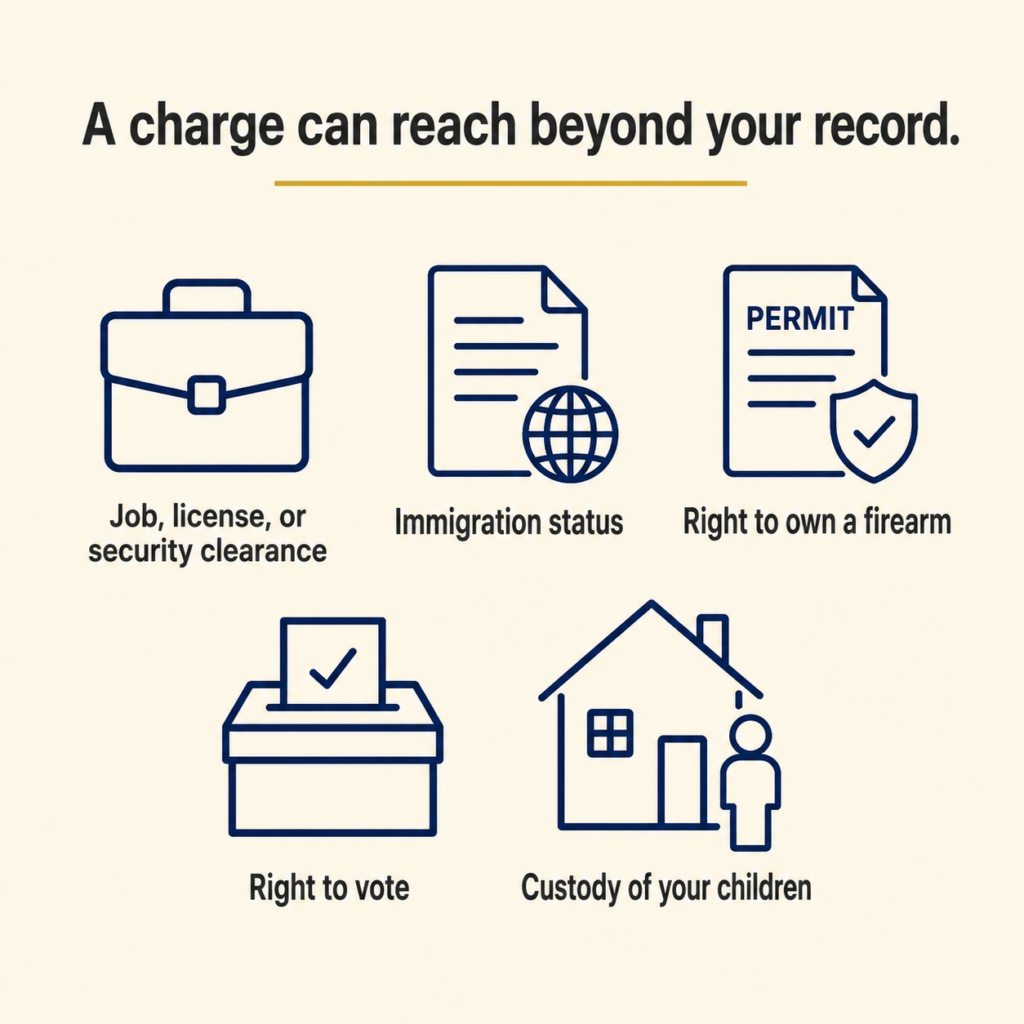
- Your job, professional license, or security clearance
- Your immigration status, including the risk of removal for non-citizens
- Your right to own a firearm
- Your right to vote
- In some situations, your ability to see or have custody of your children
These collateral effects are a big reason to take an investigation seriously from the start, even when the underlying charge sounds minor. The earlier a defense attorney can weigh in, the more of these consequences can be factored into the strategy.
How a criminal defense attorney helps during an investigation
Bringing in counsel before charges are filed changes the dynamic of an investigation. Hiring a lawyer is not a sign of guilt; officers see it as a routine assertion of your rights. Through our Fairfax criminal defense practice, here is what early representation does.
A formal barrier between you and investigators
Once we notify the law enforcement agency and the prosecutor that you are represented, we assert your rights in writing and become the point of contact. From that point, officers generally cannot keep approaching you directly to ask questions or push for a waiver. That alone removes the pressure that leads to the conversations people regret.
Independent investigation while memories are fresh
The government runs its investigation to build a case. We run our own at the same time. That can mean locating and interviewing favorable witnesses before their memories fade, and preserving evidence that helps you. Doing this early means we are ready to push back the moment a charge is filed, instead of starting from behind.
Talking to the prosecutor before charges are decided
Police investigate, but prosecutors decide what to charge. An experienced defense attorney can take evidence or legal problems straight to the prosecutor during the investigation. In some situations that leads a prosecutor to decline to file charges at all, though no lawyer can promise that result. We have also taken over cases after charges were filed, challenged the evidence through pretrial motions, and seen charges reduced or dismissed even when the first plea offer looked routine. You can see examples on our case results page.
An orderly surrender if an arrest is coming
When charges are unavoidable, early representation still helps. Rather than a public arrest at your home or workplace, we can often arrange a planned surrender and have a bond motion ready, so you spend as little time in custody as possible.
Are there times cooperating helps?
Sometimes, yes, but only through a lawyer. In certain cases, especially multi-defendant federal matters, the first person to cooperate can receive the most leniency. A defense attorney can negotiate a written proffer or cooperation agreement that controls how your statements are used. This is delicate work. Police cannot bind the government to any deal or guarantee leniency, so cooperating on your own, without those protections in writing, usually means full prosecution without the benefit you were hoping for.
Federal investigations in the Eastern District of Virginia
Federal investigations work differently, and they move fast. The Eastern District of Virginia, known as the “Rocket Docket” for its quick trial schedule, handles major fraud, cybercrime, large narcotics matters, and other drug charges. If you believe you are under federal investigation, a few features matter.
Federal felony charges require an indictment from a grand jury, which has broad power to subpoena testimony and documents, often without you knowing. The Justice Manual, the Department of Justice’s own policy guide, sorts the people involved into three categories, and where you fall changes everything.
| Status | What it means | Why it matters |
| Target | Prosecutors have substantial evidence linking you to a crime and see you as a likely defendant | Indictment is a real near-term risk |
| Subject | Your conduct is within the scope of the grand jury’s investigation | Your status can move up to target or down to witness as evidence develops |
| Witness | You have relevant information but are not currently suspected | You may have to comply with a subpoena, but careful handling keeps you from becoming a subject |
When prosecutors are close to charging, they often send a target letter stating that you are the focus of the investigation and advising you of your rights. A target letter is a serious signal, usually an invitation to testify or to have your attorney contact the Assistant U.S. Attorney in charge of your case. Your lawyer cannot enter the grand jury room with you to object, which is why people who receive one generally talk to a defense attorney before deciding whether and how to respond. At the Leiva Law Firm, we represent individuals under federal investigation and individuals charged with federal offenses in the Eastern District of Virginia, including large narcotics matters.
Frequently asked questions
Does being under investigation mean I will be charged?
No. An investigation means police are gathering evidence to decide whether to charge you. Some investigations end with no charge, especially when a defense attorney gets involved early and raises problems with the case before a prosecutor commits.
Can police lie to you during an investigation in Virginia?
Yes. Officers are legally allowed to misstate or exaggerate the evidence against you, including claiming a co-defendant confessed or that they have proof they do not have. This is why answering questions without a lawyer is risky.
Should I talk to the police without a lawyer?
You are under no legal obligation to answer police questions, and anything you say voluntarily can be used against you. Whether to give a statement is a decision to make with a criminal defense attorney after they have reviewed your situation, not on your own during questioning.
Can I refuse to let police search my phone in Virginia?
Yes, if they do not have a warrant. You can decline a search request, and that refusal cannot be used as proof of guilt. If officers have probable cause, they can seek a warrant from a judge to confiscate your phone.
What is a target letter?
A target letter is a notice from federal prosecutors telling you that you are the focus of a federal investigation and that an indictment may be coming. If you receive one, it is a strong signal to contact a federal defense attorney before doing anything else.
Talk to a Northern Virginia criminal defense lawyer
If you think you are under investigation in Virginia, what you do now matters more than almost anything that comes later. You have the right to stay silent, the right to refuse a search without a warrant, and the right to a lawyer who can step between you and investigators. At the Leiva Law Firm, you work directly with Manuel Leiva, who began his career as a Fairfax County public defender and has more than 25 years of trial experience across state and federal courts, in English and Spanish. We represent people throughout Northern Virginia, including Fairfax, Arlington, Alexandria, Loudoun, and Prince William, with offices in Fairfax and Reston. We treat these matters as emergencies. To talk through what you are facing, contact us.

