




Hit-and-Run Charges in Virginia: Penalties for Leaving the Scene (2026)
n Virginia, leaving the scene of an accident is a crime, and the penalties are more serious than most people expect. Depending on the circumstances, a hit-and-run can be charged as a misdemeanor or a felony. It can reach felony level even when no one is injured, based only on the dollar value of the damage to the damaged property. At The Leiva Law Firm, we have defended traffic and criminal charges across Northern Virginia for more than 25 years, and we see the same thing repeatedly: a case that started as a minor collision gets charged as a felony because of how Virginia writes its leaving-the-scene laws.
Here is the short version. A driver who leaves the scene of an accident involving injury, death, or more than $1,000 in damage to attended property can be charged with a Class 5 felony. If the property damage is $1,000 or less, the same conduct is a Class 1 misdemeanor. Separate rules and lower penalties apply when the property is unattended, such as a parked car or a guardrail. Passengers can also be charged. Below, we break down each tier, the license and DMV consequences, and the parts of these cases the Commonwealth actually has to prove.
What Counts as a Hit-and-Run in Virginia?
Virginia does not use the phrase “hit-and-run” in its main statute. The offense is leaving the scene of an accident, and the core duty comes from Va. Code § 46.2-894. Any driver involved in an accident that injures or kills someone, or that damages an attended vehicle or other attended property, has to do three things.
- Stop immediately as close to the scene as possible without blocking traffic.
- Report their name, address, driver’s license number, and vehicle registration number to law enforcement and to the person struck, the other driver or occupant, or the custodian of the damaged property.
- Render reasonable assistance to anyone injured, including arranging transport to a hospital if medical treatment is needed or requested.
The law does account for a driver who cannot do these things at the scene because of their own injuries. In that situation, the driver has to make the required reports and a reasonable effort to reach the other parties as soon as possible. This is a narrow exception, and courts look closely at whether a driver was truly unable to comply or simply left.
A leaving-the-scene charge often arrives alongside other charges, such as reckless driving or DWI/DUI, which raises the overall exposure in the case.
Hit-and-Run Penalties in Virginia
The penalty depends on who or what was involved, how much damage occurred, and whether the property was attended. The table below shows how the charges break down under Virginia law.
| Who and what was involved | Damage or injury level | Offense | Sentencing range |
|---|---|---|---|
| Driver, attended property or a person (§ 46.2-894) | Injury, death, or damage over $1,000 | Class 5 felony | 1 to 10 years in prison, or at the court’s or jury’s discretion up to 12 months in jail and a fine up to $2,500 |
| Driver, attended property (§ 46.2-894) | Damage of $1,000 or less | Class 1 misdemeanor | Up to 12 months in jail and a fine up to $2,500 |
| Driver, unattended property (§ 46.2-896, penalties under § 46.2-900) | Damage of $250 or more | Class 1 misdemeanor | Up to 12 months in jail and a fine up to $2,500 |
| Driver, unattended property (§ 46.2-896, penalties under § 46.2-900) | Damage under $250 | Class 4 misdemeanor | Fine up to $250, no jail |
| Passenger age 16 or older who fails to report (§§ 46.2-895, 46.2-897) | Injury or death | Class 6 felony | 1 to 5 years in prison, or at the court’s or jury’s discretion up to 12 months in jail and a fine up to $2,500 |
Virginia classifies Class 5 and Class 6 offenses as felonies, but the sentencing statutes give the court or jury room to treat them more like misdemeanors. For a Class 5 felony, the punishment can be as little as up to 12 months in jail and a fine, rather than a prison term. That discretion is one of the reasons the outcome of a felony hit-and-run case depends heavily on how the case is presented.
When Is a Hit-and-Run a Felony in Virginia?
A hit-and-run becomes a Class 5 felony under § 46.2-894 in three situations: the accident injured someone, the accident killed someone, or the accident caused more than $1,000 in damage to attended property. Most people expect the injury and death triggers a felony, it does not. The property damage threshold is the one that catches them off guard.
The felony line for property damage sits at $1,001. On modern vehicles, that figure is easy to cross. A single damaged bumper, quarter panel, or headlight assembly can exceed $1,000 in repair costs. That means a driver who leaves after a collision that hurt no one can still face a felony purely because of the estimated repair bill. This is why we tell people that a collision they consider a minor “fender bender” can still be prosecuted as a felony, with the lasting consequences a felony conviction carries, including the loss of firearm rights.

While a Class 5 felony authorizes up to 10 years in prison, actual sentences are shaped by the Virginia Criminal Sentencing Guidelines and a defendant’s record. A first-time offender with no prior record often faces a very different practical outcome than the statutory maximum suggests, and sorting out that gap is one of the first things we do when a charge lands.
Leaving the Scene After Hitting a Parked Car or Unattended Property
Hitting a parked car, a mailbox, a guardrail, or a utility pole falls under a separate statute, Va. Code § 46.2-896. When no one is injured and the property is unattended, the driver still cannot simply drive off. The law requires a specific sequence.
- Make a reasonable effort to find the owner or custodian of the property and give them the standard identifying information.
- If the owner cannot be found, leave a note in a conspicuous place at the scene with your identifying and contact information.
- Report the accident in writing to the State Police or local law enforcement within 24 hours, including the date, time, place, and a description of the damage.
The penalties for these cases are lower than for attended-property or injury cases, but they are still criminal. Under § 46.2-900, damaging unattended property and failing to meet these duties is a Class 1 misdemeanor if the damage is $250 or more, and a Class 4 misdemeanor if the damage is under $250. A driver convicted of the Class 4 version is also automatically assigned three demerit points by the DMV.
One practical point matters here. A note left on a windshield can blow away or be removed, and it can be hard to prove after the fact. The 24-hour written report to law enforcement is the part of the duty that creates a clear record. When a driver leaves a note but files no report, the claim that a note existed becomes much harder to defend.
Can a Passenger Be Charged With Hit-and-Run in Virginia?
Yes. Virginia is unusual in placing an independent legal duty on passengers, not just the driver. Under Va. Code §§ 46.2-895 and 46.2-897, if the driver fails to stop and report, every person age 16 or older in the vehicle who knows about the accident has a duty to make sure a report reaches the State Police or local law enforcement within 24 hours.

The penalties for a passenger comes from § 46.2-900. If the accident involved injury or death, the passenger can be charged with a Class 6 felony. If it involved only property damage, the charge is a Class 1 misdemeanor, or a Class 4 misdemeanor when the unattended-property damage is under $250.
The key element in these cases is knowledge. The Commonwealth has to prove the passenger actually knew an accident occurred. A passenger who was asleep, or who genuinely did not realize there had been a collision, is in a very different position from one who watched it happen and did nothing. The statute also only requires a passenger to report the information within their knowledge, so a passenger who did not know the driver’s identity, such as someone in a rideshare, cannot be penalized for failing to provide details they never had.
License Suspension, DMV Points, and Other Consequences
Jail and fines are only part of the exposure in a hit-and-run case. A conviction carries administrative consequences that often affect a person’s daily life and job more directly than anything else.
- Discretionary license suspension. Under Va. Code § 46.2-901, a court can suspend driving privileges for up to six months when a leaving-the-scene conviction involved property damage over $500. This is on top of any jail time or fine.
- Mandatory revocation for injury or death. When the conviction is a felony hit-and-run involving injury or death, the DMV is required to revoke the driver’s license for one year.
- Commercial license disqualification. Leaving the scene of a crash is treated as a major offense for commercial drivers. It can disqualify a commercial driver’s license even if the driver was in a personal vehicle at the time.
Virginia also adds demerit points to the driving record and keeps the conviction on file for years. The table below reflects the Virginia DMV point and record-retention structure for these convictions.
| Severity | Conviction | Demerit points | Time on driving record |
|---|---|---|---|
| Major | Failure to stop, injury or death | 6 points | 11 years |
| Major | Failure to stop, property damage of $1,000 or more | 6 points | 11 years |
| Moderate | Failure to stop, attended property damage | 4 points | 3 years |
| Minor | Failure to stop, unattended property | 3 points | 3 years |
The 11-year record for a serious hit-and-run is worth pausing on. Insurance carriers and employers that review driving records see that conviction for more than a decade, which affects premiums and, for anyone who drives for work, job prospects.
Does Virginia’s Hit-and-Run Law Apply in Parking Lots and on Private Property?
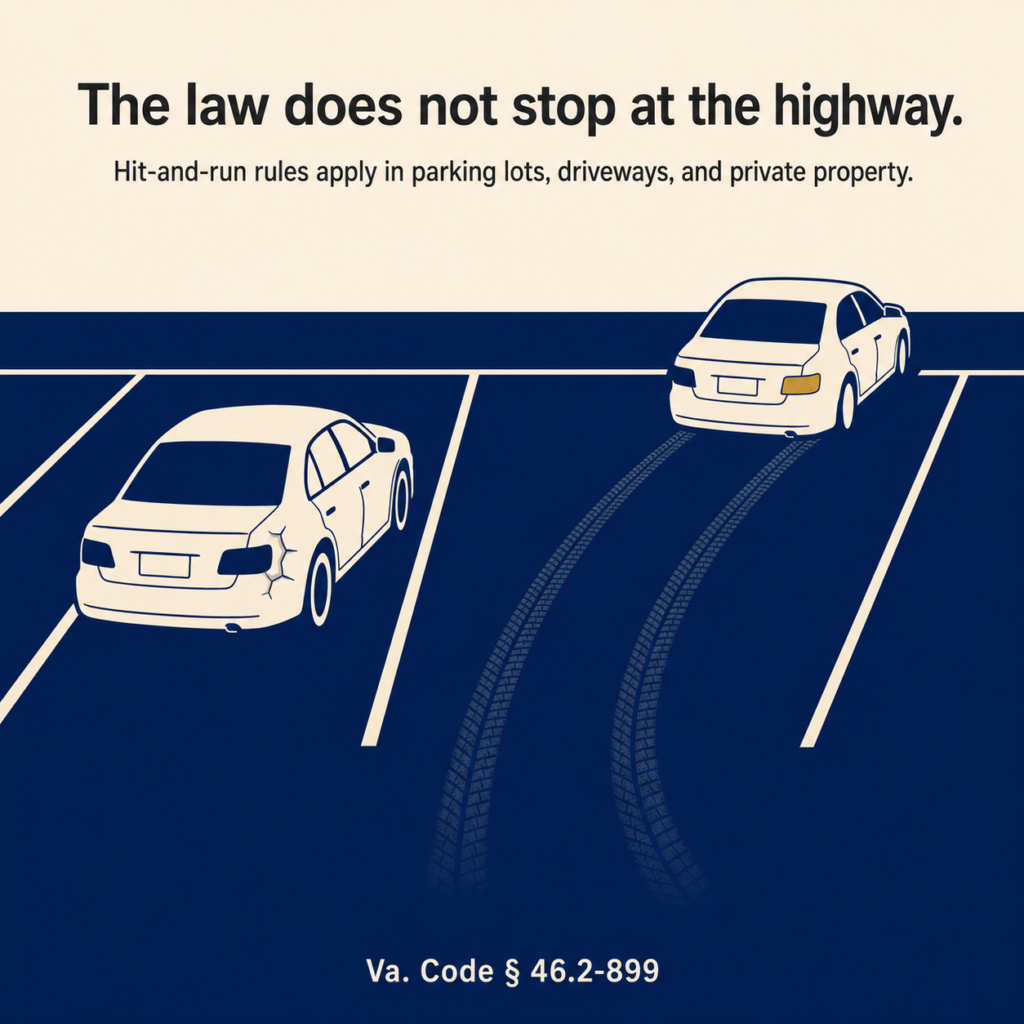
Yes. Under Va. Code § 46.2-899, the accident-reporting duties apply whether the accident happens on a public street or highway or on private property. Parking lot collisions, driveway accidents, and crashes inside private garages are all covered. A driver who backs into another car in a shopping center lot and leaves has the same legal obligations as a driver on the interstate.
How Hit-and-Run Charges Are Defended in Virginia
To convict someone of leaving the scene, the Commonwealth has to prove several elements beyond a reasonable doubt. Those elements are where a defense is built.
- Identity. The Commonwealth must prove the defendant was actually driving at the time of the collision. Ownership of the vehicle is not enough. When a car is found abandoned near a crash, proving who was behind the wheel can be a real hurdle for the prosecution.
- Involvement. The vehicle has to have been part of a qualifying accident.
- Knowledge. The driver must have known an accident happened and that it caused injury or damage. In a minor sideswipe, or for the driver of a large truck, a person may not realize contact occurred at all.
- Failure of duty. The driver must have failed to stop, failed to give the required information, or failed to render assistance.
In our experience defending traffic charges in Northern Virginia, identity and knowledge are the two elements that most often decide these cases. We examine the physical evidence of the impact, the bodycam and dashcam footage, the police report, and any witness statements to test what the Commonwealth can actually prove. There is a limit to the knowledge argument. When an impact was severe enough to deploy airbags or cause major structural damage, a court is less likely to accept that the driver did not notice. The strength of that defense depends on the facts of the crash.
Manuel Leiva has jury trial experience across the full range of criminal charges, and that matters in a hit-and-run case. Because the top tier is a felony, the Commonwealth knows whether the attorney on the other side is prepared to try the case. That affects the offers a prosecutor is willing to make. We prepare every criminal defense case as if it will go to trial, in courts throughout Fairfax, Arlington, Alexandria, Loudoun, and Prince William.
What If You Were Injured by a Hit-and-Run Driver?
Not everyone reading this is the person charged. If a hit-and-run driver injured you, you may have a claim for your medical bills, lost wages, and other losses, sometimes through your own uninsured motorist coverage even if the driver is never found. As of 2026, Virginia law under Va. Code § 8.01-44.5:1 also allows injured victims to seek punitive damages in civil cases arising from a felony violation of the leaving-the-scene statute, which increases what a fleeing driver can be held responsible for.
Because we handle both sides of these situations, we can look at a hit-and-run from the injured person’s perspective as well. Our personal injury consultations are free, and there is no fee unless we recover compensation for you.
Frequently Asked Questions About Hit-and-Run Charges in Virginia
Is a hit-and-run a felony in Virginia?
It can be. Leaving the scene is a Class 5 felony when the accident caused injury, death, or more than $1,000 in damage to attended property. When attended-property damage is $1,000 or less, it is a Class 1 misdemeanor.
What happens if you hit a parked car and drive away in Virginia?
You are required to make a reasonable effort to find the owner, leave a note with your information if you cannot, and report the accident to police in writing within 24 hours. Failing to do so is a Class 1 misdemeanor if the damage is $250 or more, and a Class 4 misdemeanor if it is under $250.
How long does a hit-and-run stay on your record in Virginia?
A serious hit-and-run conviction that carries six demerit points, such as one involving injury, death, or property damage of $1,000 or more, stays on your Virginia driving record for 11 years. Lower-level convictions that carry three or four points remain for three years. The criminal conviction itself is separate and does not automatically disappear.
Can you go to jail for leaving the scene of an accident in Virginia?
Yes. A Class 1 misdemeanor carries up to 12 months in jail, and a Class 5 felony authorizes 1 to 10 years in prison, though a court or jury can reduce a felony to a jail sentence and fine. Actual outcomes depend on the facts and the defendant’s record.
Contact The Leiva Law Firm
If you are facing a hit-and-run or leaving-the-scene charge in Fairfax, Arlington, Alexandria, Loudoun, or Prince William, the details of your case matter, and so does what the Commonwealth can prove. We can walk you through your options and what to expect. Contact The Leiva Law Firm to discuss your case directly with Manuel Leiva.

