



Virginia treats firearms offenses seriously. A weapons charge in Fairfax County can mean mandatory prison time, a permanent felony record, and the loss of your right to possess firearms in the future. The consequences depend on the specific charge, your criminal history, and whether the firearm was connected to another offense.
Manuel Leiva has over 25 years of trial experience defending individuals charged with weapons and firearms violations throughout Northern Virginia, including concealed carry violations, felon in possession charges, and cases involving the use of a firearm during the commission of a felony. He handles firearms cases personally and is available for consultations in both English and Spanish.
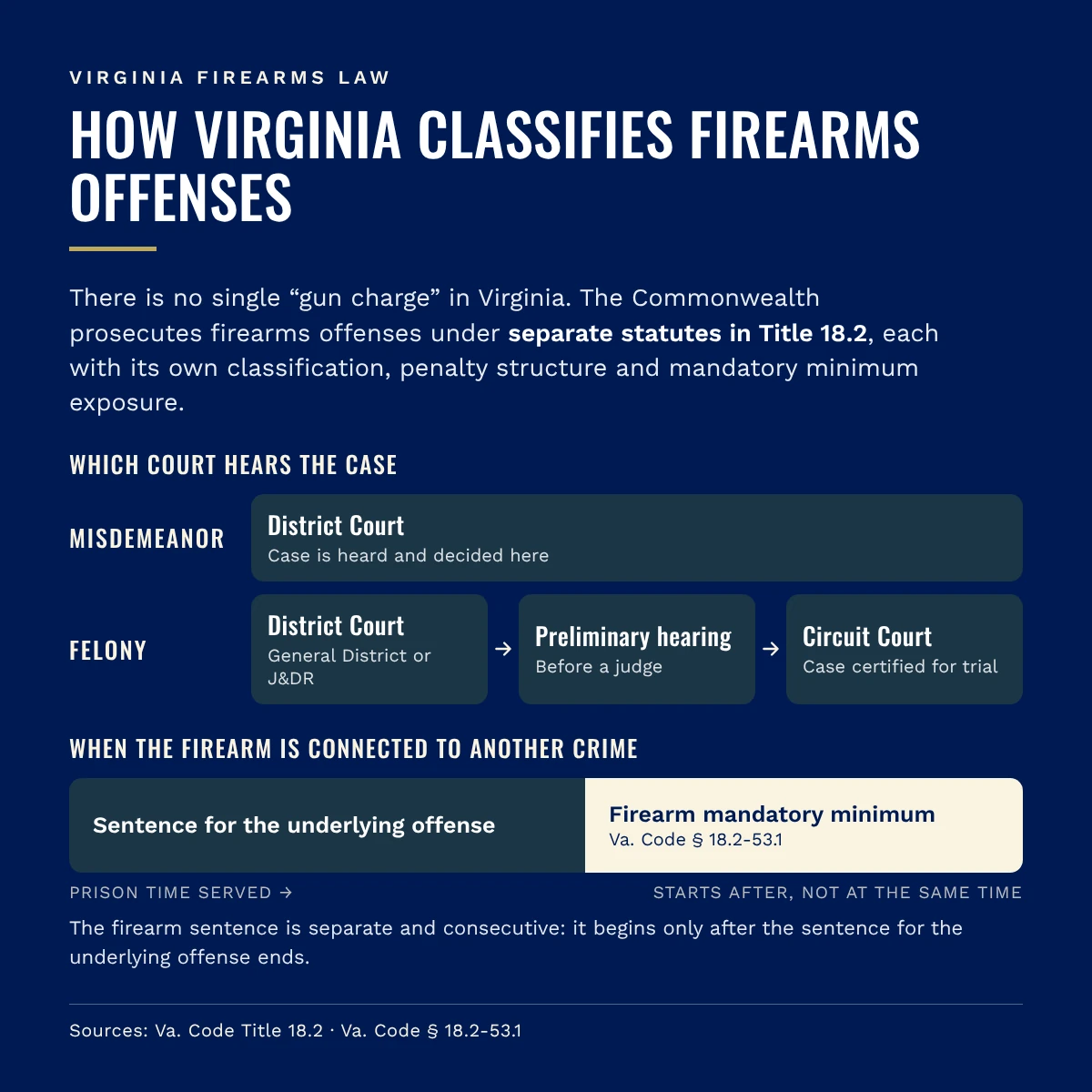
Virginia’s weapons laws are scattered across multiple statutes in Title 18.2 of the Virginia Code. There is no single “gun charge” in Virginia. Instead, the Commonwealth prosecutes firearms offenses under a range of statutes, each carrying its own classification, penalty structure, and mandatory minimum exposure.
What makes Virginia’s approach particularly consequential is how firearms charges stack. A weapons offense connected to another crime often triggers a separate, consecutive mandatory minimum sentence under Va. Code § 18.2-53.1. That means you start serving your prison time for the weapon’s charge after the sentence for the underlying offense, not at the same time.
The courts that hear these cases depend on the classification. Misdemeanor firearms charges are heard in the District Courts. Felony firearms charges begin in the District Courts, either the General District Court or the Juvenile & Domestic Relations District Court, where a judge holds a preliminary hearing before the case is certified to Circuit Court for trial.
Virginia categorizes firearms offenses by the conduct involved and the defendant’s history. The difference between a misdemeanor and a felony often turns on one factor: whether you have a prior conviction, whether the incident occurred in a restricted location, or whether the firearm was connected to another crime.
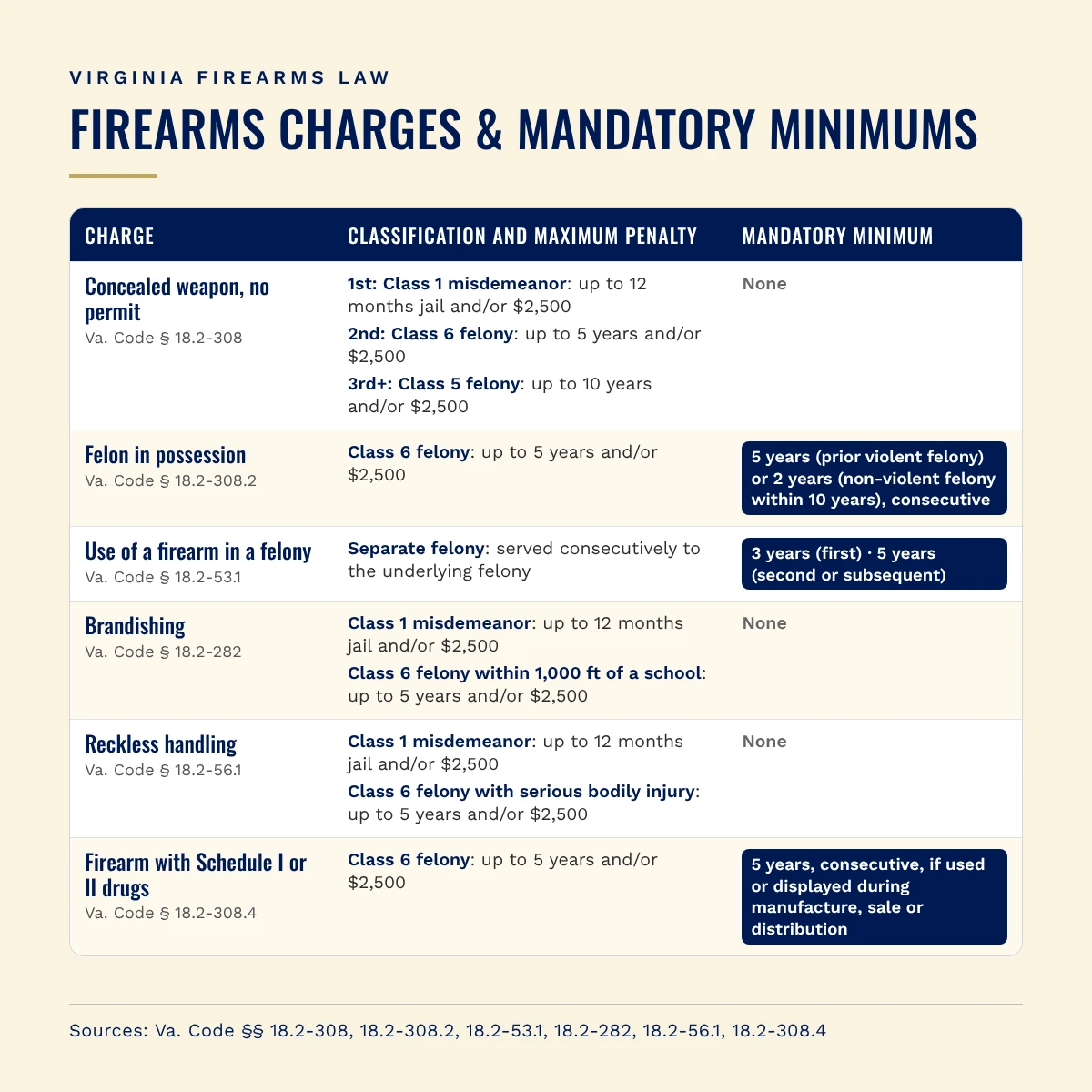
| Offense | Statute | Classification | Maximum Penalty | Mandatory Minimum |
|---|---|---|---|---|
| Concealed weapon without a permit, first offense | Va. Code § 18.2-308 | Class 1 misdemeanor | Up to 12 months in jail and/or a fine of up to $2,500 | None |
| Concealed weapon without a permit, second offense | Va. Code § 18.2-308 | Class 6 felony | Up to five years in prison and/or a fine of up to $2,500 | None |
| Concealed weapon without a permit, third or subsequent offense | Va. Code § 18.2-308 | Class 5 felony | Up to 10 years in prison and/or a fine of up to $2,500 | None |
| Felon in possession of a firearm | Va. Code § 18.2-308.2 | Class 6 felony | Up to five years in prison and/or a fine of up to $2,500 | Five years (prior violent felony); two years (non-violent felony within 10 years); consecutive |
| Use of a firearm in commission of a felony | Va. Code § 18.2-53.1 | Separate felony | Three years (first); five years (second or subsequent), consecutive to the underlying felony | Three years (first); five years (second or subsequent) |
| Brandishing a firearm | Va. Code § 18.2-282 | Class 1 misdemeanor | Up to 12 months in jail and/or a fine of up to $2,500 | None |
| Brandishing on or within 1,000 feet of a school | Va. Code § 18.2-282 | Class 6 felony | Up to five years in prison and/or a fine of up to $2,500 | None |
| Reckless handling of a firearm | Va. Code § 18.2-56.1 | Class 1 misdemeanor | Up to 12 months in jail and/or a fine of up to $2,500 | None |
| Reckless handling causing serious bodily injury | Va. Code § 18.2-56.1 | Class 6 felony | Up to five years in prison and/or a fine of up to $2,500 | None |
| Firearm while possessing a Schedule I or II substance | Va. Code § 18.2-308.4 | Class 6 felony | Up to five years in prison and/or a fine of up to $2,500 | Five years, consecutive, if used or displayed during manufacture, sale, or distribution |
Under Va. Code § 18.2-308, it is a crime to carry a concealed weapon “about the person” and “hidden from common observation” without a valid concealed handgun permit. The statute covers firearms and other weapons, including knives, machetes, and metal knucks.
A first offense is a Class 1 misdemeanor, punishable by up to 12 months in jail and/or a fine of up to $2,500. A second offense is a Class 6 felony, carrying up to five years in prison and/or a fine of up to $2,500. A third or subsequent offense is a Class 5 felony, punishable by up to 10 years in prison and/or a fine of up to $2,500.
A key element the Commonwealth must prove is that the weapon was “about the person” and “hidden from common observation.” Whether a weapon was truly concealed, and whether the accused had lawful authority to carry it, are questions the defense examines closely.
Va. Code § 18.2-308.2 prohibits any person convicted of a felony from knowingly and intentionally possessing or transporting a firearm, ammunition, stun weapon, or explosive material. The charge is a Class 6 felony, punishable by up to five years in prison and/or a fine of up to $2,500.
The mandatory minimum exposure depends on the defendant’s criminal history:
The Commonwealth must prove that the defendant knowingly and intentionally possessed the firearm and that the defendant had a prior felony conviction. Constructive possession, where the firearm is not on the defendant’s person but is in a location the defendant controls, is frequently contested.
Va. Code § 18.2-53.1 makes it unlawful to use, attempt to use, or display a firearm in a threatening manner while committing or attempting to commit certain felonies: murder, rape, forcible sodomy, robbery, carjacking, burglary, malicious wounding, aggravated malicious wounding, malicious wounding by mob, malicious bodily injury to a law enforcement officer, or abduction.
This is a separate and distinct felony. A first conviction carries a mandatory minimum sentence of three years in prison. A second or subsequent conviction carries a mandatory minimum sentence of five years. The sentence runs consecutively with the punishment for the underlying felony.
This is one of the most consequential firearms charges in Virginia because it adds years of prison time on top of whatever sentence the defendant receives for the primary offense.
Under Va. Code § 18.2-282, it is a crime to point, hold, or brandish a firearm or an object similar in appearance in a manner that reasonably induces fear in another person. The statute applies whether or not the weapon is capable of being fired.
Brandishing is a Class 1 misdemeanor, punishable by up to 12 months in jail and/or a fine of up to $2,500. If the violation occurs on or within 1,000 feet of a public, private, or religious elementary, middle, or high school, the offense is elevated to a Class 6 felony, punishable by up to five years in prison and/or a fine of up to $2,500.
A self-defense exception exists: the statute does not apply to a person engaged in excusable or justifiable self-defense.
Va. Code § 18.2-56.1 makes it a crime to handle a firearm recklessly in a manner that endangers the life, limb, or property of any person. This is a Class 1 misdemeanor, punishable by up to 12 months in jail and/or a fine of up to $2,500.
If the handling is so gross, wanton, and culpable as to show a reckless disregard for human life and causes serious bodily injury resulting in permanent and significant physical impairment, the offense is a Class 6 felony, punishable by up to five years in prison and/or a fine of up to $2,500. A conviction does not require that the firearm was discharged or that anyone was actually injured at the misdemeanor level.
Va. Code § 18.2-308.4 makes it unlawful to possess a firearm while simultaneously possessing a Schedule I or Schedule II controlled substance. This is a Class 6 felony. If the firearm is used, attempted to be used, or displayed in a threatening manner while committing or attempting to commit the manufacture, sale, or distribution of a Schedule I or II substance, the charge carries a mandatory minimum sentence of five years in prison, served consecutively with any other sentence.
This statute frequently arises in drug cases where a firearm is found during a search of the defendant’s person, vehicle, or residence. The Fairfax drug lawyer page covers the underlying drug charges in detail.
01
You have the right to remain silent under the Fifth Amendment to the United States Constitution. Officers are not required to provide Miranda warnings during consensual encounters, voluntary interviews, or the initial stop. Do not answer questions about the firearm, how you obtained it, or where you were going. Tell the officers you are invoking your right to remain silent and that you want to speak with an attorney.
02
If officers ask for consent to search you, your vehicle, your home, or your phone, you have the right to decline. A consent search waives constitutional protections that your attorney could otherwise challenge. Whether the officer had reasonable articulable suspicion for the stop or probable cause for a search warrant is often the central issue in firearms cases.
03
Write down everything you remember about the encounter as soon as possible: what the officers said, where they found the firearm, who was present, and whether a warrant was presented. If the arrest occurred at a traffic stop, note the reason the officer gave for the stop. If bodycam or dashcam footage exists, your attorney can request it through discovery.
04
Criminal cases in Fairfax County move on a timeline. An attorney who begins work early can file pre-trial motions to suppress evidence obtained through an unlawful search, subpoena relevant bodycam footage and police reports, and begin building the factual record before the preliminary hearing.
05
Do not discuss the facts of your case on the phone, by text, or on social media. Statements made to friends, family, or online can be used as evidence. The only person you should discuss the details with is your attorney.
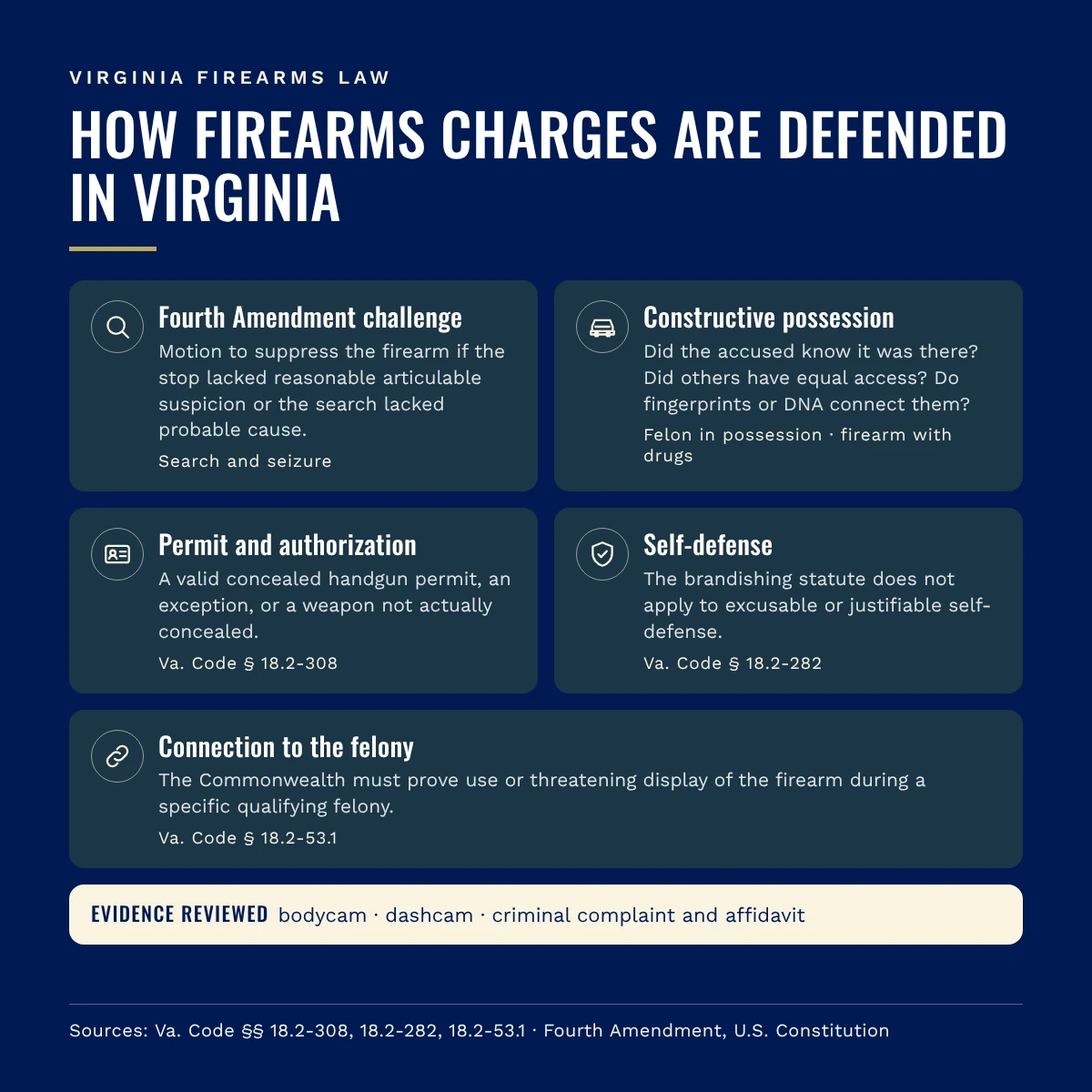
The defense strategy in a firearms case depends on which statute is charged, how the firearm was discovered, and what the Commonwealth needs to prove. Several categories of defense apply across the most common weapons charges.
The most frequent defense in firearms cases is a motion to suppress the firearm itself. If the officer lacked reasonable articulable suspicion for the initial stop, or lacked probable cause to search the defendant, the vehicle, or the residence, the evidence obtained from that search can be excluded. The court examines the officer's stated basis for the stop, the scope of the search, and whether consent was truly voluntary. Bodycam footage, dashcam footage, and the officer's criminal complaint and affidavit are central to this analysis.
In felon-in-possession cases and drug-and-firearm cases, the Commonwealth often relies on constructive possession, arguing that the defendant had dominion and control over a firearm found in a vehicle, a shared residence, or a common area. The defense examines whether the defendant actually knew about the firearm, whether other people had equal access to the location, and whether any physical evidence (fingerprints, DNA) connects the defendant to the weapon.
For concealed carry charges under Va. Code § 18.2-308, the defense examines whether the defendant held a valid concealed handgun permit, whether an exception applied (active duty military, law enforcement), or whether the weapon was actually concealed from common observation.
Va. Code § 18.2-282 explicitly exempts excusable or justifiable self-defense from the brandishing statute. The defense reviews the circumstances to determine whether the defendant's actions were a reasonable response to a perceived threat.
For charges under Va. Code § 18.2-53.1, the Commonwealth must prove that the defendant used, attempted to use, or displayed a firearm in a threatening manner during the commission of a specific qualifying felony. The defense examines whether the firearm was connected to the alleged felony conduct, whether the display was threatening, and whether the qualifying felony itself can be sustained.
Firearms cases in Virginia carry mandatory minimum sentences that a judge cannot suspend. Once a conviction is entered under Va. Code § 18.2-53.1 or Va. Code § 18.2-308.2 with the applicable criminal history, the prison time is locked in. That makes what happens before trial critical: the quality of the suppression motion, the strength of the factual investigation, and the credibility the attorney brings to plea negotiations.
The attorney you choose is important for a specific reason. If you hire an attorney with little or no trial experience, the prosecutor will expect that your attorney is not going to try the case, and the plea offer will reflect that expectation. Manuel Leiva has 25 years of jury trial experience, including murder cases and other serious felonies. That trial record changes how the Commonwealth’s Attorney evaluates the case and what they are willing to offer.
Manuel Leiva has tried firearms and weapons cases in courts across Fairfax, Arlington, Alexandria, Loudoun, and Prince William counties throughout his career. He handles cases personally, and consultations are available in both English and Spanish.
Manuel Leiva has been a licensed attorney in Virginia since 1998. He began his career as an Assistant Public Defender in Fairfax County, where he defended individuals facing serious criminal charges. He then moved into private practice, expanding his experience to civil litigation before founding The Leiva Law Firm. His trial experience spans the full range of criminal case types, from traffic offenses through murder.
Services are available in English and Spanish, with a certified interpreter for Spanish-language document preparation and communication.
For individuals facing firearms charges, Manuel Leiva offers an in-depth consultation for $300 to $400. That fee covers a full hour with the attorney: a review of the charges, the evidence, and an honest assessment of the defense options and realistic outcomes. This is a substantive legal analysis of your case, not a brief intake call.
If you retain the firm after the consultation, criminal defense representation is provided on a flat fee basis. A flat fee means you pay one agreed-upon amount for the full scope of representation, with no surprise charges as the case progresses. Online payments are accepted through the firm’s website.
01
When you call (703) 352-6400, Manuel Leiva's assistant collects preliminary information about your case.
02
Manuel Leiva calls you back directly, typically within hours.
03
For felony firearms charges, a one-hour paid consultation is scheduled.
04
If you decide to retain the firm, a flat-fee agreement is signed and representation begins immediately.
A first offense under Va. Code § 18.2-308 is a Class 1 misdemeanor, carrying up to 12 months in jail and/or a fine of up to $2,500. A second offense is a Class 6 felony (up to five years in prison and/or a $2,500 fine). A third or subsequent offense is a Class 5 felony (up to 10 years in prison and/or a $2,500 fine). The statute covers firearms and a range of other weapons carried concealed without a valid permit.
Yes. Virginia recognizes constructive possession, which means the Commonwealth can charge you if you had knowledge of the firearm and exercised dominion and control over the area where it was found. In felon-in-possession cases under Va. Code § 18.2-308.2, constructive possession of a firearm in a vehicle is one of the most commonly litigated issues. The defense examines whether you actually knew the firearm was there and whether other people had access to the vehicle.
Several Virginia firearms statutes carry mandatory minimum sentences. Under Va. Code § 18.2-53.1, use of a firearm during the commission of a qualifying felony carries a mandatory minimum sentence of three years for a first offense and five years for a second offense. Under Va. Code § 18.2-308.2, a convicted felon who possesses a firearm and has a prior violent felony faces a mandatory minimum sentence of five years. These mandatory minimums run consecutively with the sentence for any underlying offense, meaning the judge cannot run them concurrently.
Yes. A valid concealed handgun permit does not protect against all weapons charges. Under Va. Code § 18.2-308.012, it is a Class 1 misdemeanor to carry a concealed handgun in a public place while under the influence of alcohol or drugs, even with a valid permit. Consuming alcohol while carrying a concealed handgun on the premises of a restaurant or bar is a Class 2 misdemeanor. A conviction results in a five-year bar on applying for a new permit.
This situation triggers Va. Code § 18.2-308.4, which makes it a Class 6 felony to possess a firearm while simultaneously possessing a Schedule I or II controlled substance. If the firearm was used or displayed in a threatening manner during the manufacture, sale, or distribution of the substance, the charge carries a mandatory minimum sentence of five years served consecutively with any drug conviction. These cases are prosecuted in courts throughout Fairfax, Arlington, Alexandria, Loudoun, and Prince William counties.
If the search that produced the firearm violated your Fourth Amendment rights, the firearm and any related evidence can be suppressed, meaning the court excludes it from trial. The defense examines whether the officer had reasonable articulable suspicion for the initial stop, whether probable cause existed for the search, and whether any consent given was voluntary. Suppression of the firearm often results in the dismissal of the weapons charge entirely.
Virginia law provides a process for restoration of firearm rights. Under Va. Code § 18.2-308.2, a person convicted of a felony can petition the Circuit Court for an order restoring the right to possess and transport a firearm. The petition process, eligibility requirements, and factors the court considers vary depending on the nature of the felony and how much time has passed since the conviction. Federal law imposes separate restrictions that a state court order does not override.
A firearms conviction, whether misdemeanor or felony, is reported in background checks used for security clearance adjudication. Northern Virginia’s proximity to federal agencies and defense contractors means that many clients facing weapons charges hold or are seeking clearances. The impact depends on the specific charge, the classification, the outcome, and the adjudicative guidelines. This is one reason why the defense strategy and the final disposition of the charge matter significantly beyond the immediate criminal penalties.
Manuel Leiva defends individuals charged with firearms and weapons offenses in courts throughout Northern Virginia, including the General District Courts, Circuit Courts, and Juvenile & Domestic Relations District Courts in each jurisdiction.
For federal firearms charges, the firm represents individuals in the Eastern District Court of Virginia.
Firearms cases in Virginia operate on a timeline, and early representation affects the outcome. Filing pre-trial motions, obtaining bodycam and dashcam footage through discovery, and building the factual record before the preliminary hearing are steps that require an attorney working on the case from the start. Call (703) 352-6400 to schedule a consultation with Manuel Leiva.
LEIVA LAW FIRM
N/a
 +1 (703) 352-6400
 +1 (703) 352-6400
 Named a Top Criminal Defense Lawyer by Northern Virginia Magazine (2021-2025) and Washingtonian Magazine (2017-present).