




Felony vs. Misdemeanor in Virginia: How Charges Are Classified and Why It Matters
In Virginia, a felony is a crime that can be punished with time in state prison, and every other crime is a misdemeanor. A misdemeanor carries at most 12 months in jail and/or a fine of up to $2,500. A felony can carry a prison sentence anywhere from 1 year to life. How serious a charge is depends on its class, which is the label Virginia law gives the offense, such as “Class 1 misdemeanor” or “Class 6 felony.” The class decides the range of possible punishment, which court hears the case, and what a conviction takes away after the case is over.
At The Leiva Law Firm, we represent people in Northern Virginia charged with everything from traffic offenses and misdemeanors to the most serious felonies. In Virginia, a felony charge can be amended to a misdemeanor before the case ends. Amending the charge lowers the possible sentence and keeps a felony conviction off your record.
What Is the Difference Between a Felony and a Misdemeanor in Virginia?
Virginia law defines a felony and a misdemeanor this way: offenses “punishable with confinement in a state correctional facility are felonies; all other offenses are misdemeanors.” A state correctional facility is a state prison. Virginia law does not treat a traffic infraction as a crime, so a traffic infraction is neither a felony nor a misdemeanor and does not count as a criminal conviction.
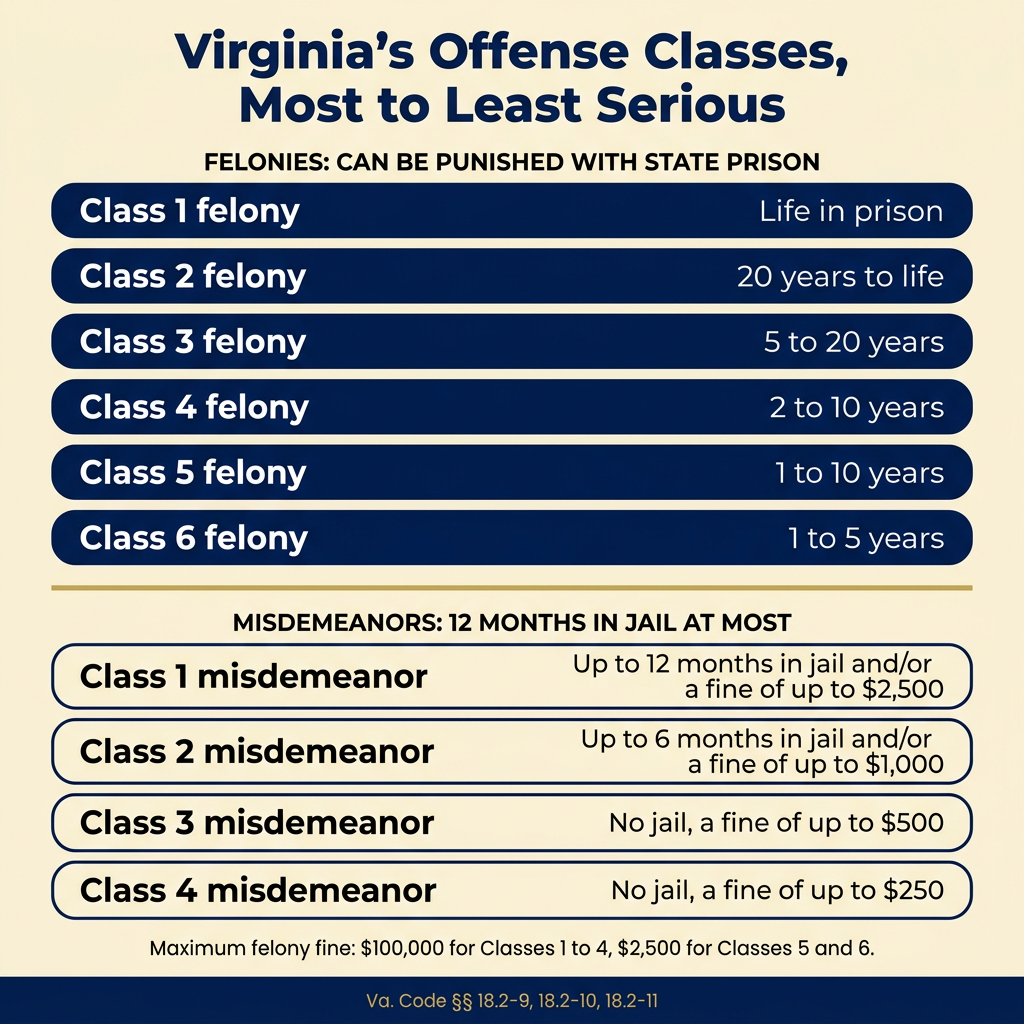
Virginia sorts felonies into six classes, Class 1 through Class 6, and misdemeanors into four classes, Class 1 through Class 4. In both groups, Class 1 is the most serious.
Virginia Felony Classes and Penalties
Virginia law sets a prison range and a maximum fine for each felony class. A Class 6 felony carries 1 to 5 years in prison, and a Class 1 felony carries life in prison. For Classes 1 through 4, a fine can be added to the prison sentence, but the fine cannot take the place of prison.
| Felony class | Prison range | Maximum fine | Jail instead of prison | Example offense |
|---|---|---|---|---|
| Class 1 | Life in prison | $100,000 | Not available | Aggravated murder (§ 18.2-31) |
| Class 2 | 20 years to life | $100,000 | Not available | First-degree murder (§ 18.2-32) |
| Class 3 | 5 to 20 years | $100,000 | Not available | Malicious wounding (§ 18.2-51) |
| Class 4 | 2 to 10 years | $100,000 | Not available | Maliciously shooting into an occupied building (§ 18.2-279) |
| Class 5 | 1 to 10 years | $2,500 | Up to 12 months in jail and/or a fine of up to $2,500 | Involuntary manslaughter (§ 18.2-36) |
| Class 6 | 1 to 5 years | $2,500 | Up to 12 months in jail and/or a fine of up to $2,500 | Unlawful wounding (§ 18.2-51) |
Some felonies have no class. For those, the law that creates the crime sets its own range. Grand larceny carries 1 to 20 years in prison, or up to 12 months in jail and/or a fine of up to $2,500. Second-degree murder carries 5 to 40 years in prison.
The ranges in the table are the limits on a sentence, and your actual sentence is set inside those limits. The judge sets the sentence, unless your case is tried by a jury and you ask the jury to sentence you. The judge can suspend part or all of the sentence and place you on probation under conditions the judge sets. The exception is a mandatory minimum sentence. The law requires the judge to impose a mandatory minimum sentence in full, and the judge cannot suspend any part of that sentence. The judge must also consider Virginia’s sentencing guidelines, which recommend a sentence for the case, but the judge does not have to follow them.
Can a Felony Be Punished Like a Misdemeanor?
A Class 5 or Class 6 felony can be punished like a misdemeanor, but the conviction is still a felony conviction. For those two classes, the judge, or the jury when it sets the sentence, can choose jail instead of prison. The jail option carries up to 12 months in jail and/or a fine of up to $2,500, the same maximum penalty as a Class 1 misdemeanor. The conviction stays a felony because Virginia’s definition of a felony depends on whether the offense is “punishable” with prison, not on the sentence you actually receive. Every Class 5 and Class 6 felony is punishable with prison.
Virginia Misdemeanor Classes and Penalties
Virginia has four misdemeanor classes, and only Class 1 and Class 2 misdemeanors can carry jail time. Va. Code § 18.2-11 sets the penalties for each class. For a Class 1 or Class 2 misdemeanor, the judge can impose jail time and/or a fine.
| Misdemeanor class | Maximum jail | Maximum fine | Example offense |
|---|---|---|---|
| Class 1 | Up to 12 months in jail and/or a fine | A fine of up to $2,500 | Assault and battery (§ 18.2-57) |
| Class 2 | Up to 6 months in jail and/or a fine | A fine of up to $1,000 | Aggressive driving (§ 46.2-868.1) |
| Class 3 | No jail | A fine of up to $500 | Unlawfully (but not maliciously) damaging another person’s property (§ 18.2-137(A)) |
| Class 4 | No jail | A fine of up to $250 | Public intoxication (§ 18.2-388) |
What Is the Difference Between Jail and Prison in Virginia?
Jail is a local facility, and prison is a state correctional facility. If you are sentenced for a misdemeanor, you serve the sentence in jail, and no misdemeanor carries more than 12 months. If you are convicted of a felony, the length of the sentence decides where you serve it. A felony sentence of a year or more is served in the custody of the Virginia Department of Corrections, which runs the state prisons. A felony sentence of less than a year is served in the local jail.
When Does the Same Offense Become a Felony in Virginia?
For some offenses, a dollar amount or a record of prior offenses decides whether the charge is a misdemeanor or a felony.
- Larceny. Stealing property worth less than $1,000 is petit larceny, a Class 1 misdemeanor. Stealing property worth $1,000 or more, or stealing any firearm, is grand larceny, a felony. If the property is taken directly from a person, stealing less than $5 is petit larceny, and stealing $5 or more is grand larceny.
- DWI/DUI. A first DWI/DUI is a Class 1 misdemeanor, and a second offense is also a misdemeanor. A third offense within 10 years is a Class 6 felony.
Where Is a Felony Case Heard vs. a Misdemeanor Case?
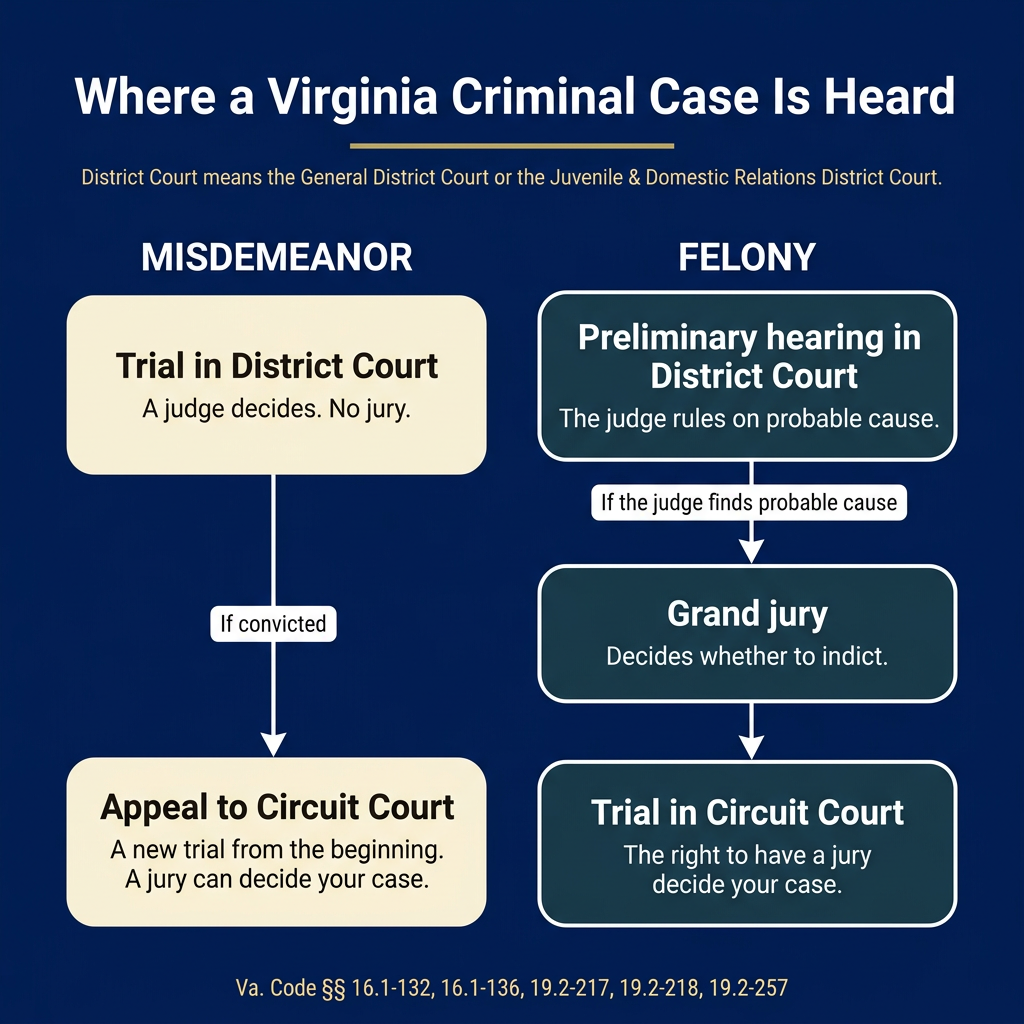
A misdemeanor case is tried in a District Court. A felony case starts in a District Court, but the trial takes place in the Circuit Court. Virginia has two kinds of District Courts that hear criminal cases: the General District Court and the Juvenile & Domestic Relations District Court, called the J&DR District Court.
Misdemeanor Cases
Most misdemeanors are tried in the General District Court. If the alleged victim is a member of your family or household, the case is tried in the J&DR District Court instead. In either court, a judge decides your case, and there is no jury at the District Court level.
If you are convicted, you have the right to appeal to the Circuit Court. The appeal is a new trial, and you can have a jury decide your case in that trial.
Felony Cases
A felony charge starts in the General District Court, or in the J&DR District Court if the alleged victim is a member of your family or household. The District Court cannot try you for the felony. Instead, it holds a preliminary hearing. At the preliminary hearing, the judge rules on whether there is probable cause, meaning a reasonable ground to believe you committed the offense.
If the judge finds probable cause, your case goes to a grand jury. The grand jury decides whether to indict you, which means issuing the formal charge your trial will be based on. Your trial then takes place in the Circuit Court, where you have the right to have a jury decide your case.
Before the preliminary hearing, we request discovery, which means asking the prosecution for copies of its evidence, such as any witness statements, bodycam footage, any statements you made to law enforcement, and any your criminal record. In Virginia, the prosecution is called the Commonwealth. At the preliminary hearing, Manuel E. Leiva, our founding attorney, cross-examines the Commonwealth’s witnesses under oath. Their answers become sworn testimony on the record. If a witness tells a different story at trial, the earlier testimony can be used to challenge the new version.
How Does a Felony Conviction Affect me in Virginia?
A felony conviction carries consequences that continue after the sentence is over, and several of them do not apply to a misdemeanor conviction.
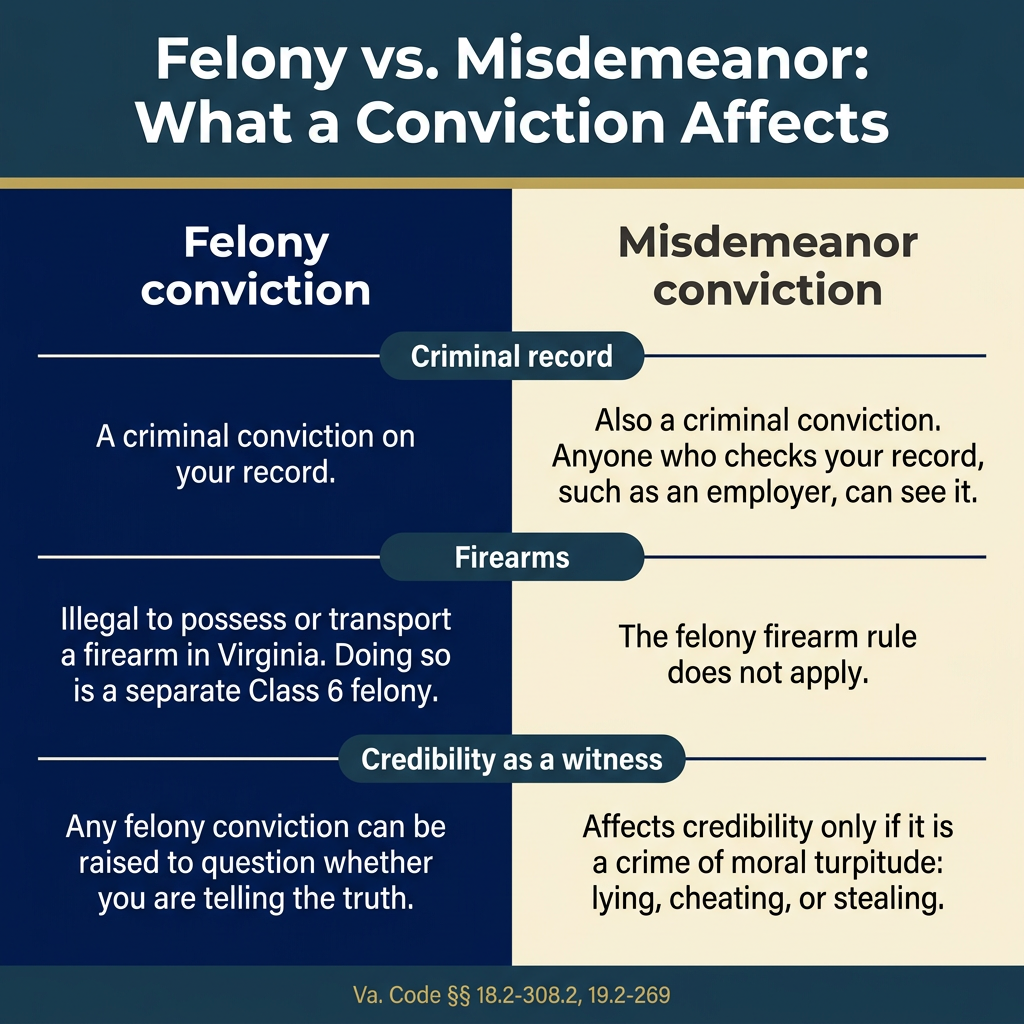
- Firearms. If you are convicted of a felony, it is illegal for you to possess or transport a firearm in Virginia. Doing so is a separate Class 6 felony.
- Credibility as a witness. If you testify in any later case, including as a witness in someone else’s case, the other side can raise a felony conviction to attack your credibility. Any felony conviction counts, whatever the offense.
- Voting. A federal court order has narrowed the Virginia rule that any felony conviction takes away the right to vote. Under current Department of Elections guidance, a conviction for any felony other than murder, voluntary manslaughter, or involuntary manslaughter takes away the right to vote only while you are incarcerated, and your right to register returns automatically when you are released.
A misdemeanor conviction is also a criminal conviction, and anyone who checks your criminal record, such as an employer, can see it. The firearm rule for felony convictions does not apply to a misdemeanor conviction. A misdemeanor affects your credibility as a witness only if it is a crime of moral turpitude, which Virginia courts limit to crimes involving lying, cheating, or stealing.
Petit larceny and grand larceny are both crimes of moral turpitude. That means a larceny conviction at either level can be used to question your credibility any time you testify, even though petit larceny is a misdemeanor. A larceny conviction can also affect immigration status, professional licensing, and employment screening.
Can a Felony Charge Be Reduced to a Misdemeanor in Virginia?
Yes, a felony charge can be reduced to a misdemeanor in Virginia. The prosecutor can agree to amend the charge to a misdemeanor. A District Court judge can also reduce the charge at the preliminary hearing when the evidence supports only a misdemeanor.
A prosecutor amends a felony charge to a misdemeanor as part of a plea agreement, which your defense attorney negotiates with the prosecutor. The judge then decides whether to accept the agreement.
If the evidence at the preliminary hearing supports only a misdemeanor, the District Court judge must try you for that misdemeanor instead of sending the felony charge to the grand jury.
Your attorney’s trial experience matters when the prosecutor makes a plea offer. The prosecution decides what to offer partly by considering what would happen if the case went to trial. If your attorney has little or no trial experience, the prosecutor can expect the case to end in a plea, which gives the prosecutor less reason to offer a misdemeanor or a lighter sentence. Manuel Leiva has tried cases ranging from traffic offenses to murder. If a plea offer is not adequate, we are prepared to try the case.
In one of our cases, a client was charged with felony drug offenses, including distribution. The case ended with a misdemeanor instead of a felony conviction. The client avoided mandatory minimum jail time and a permanent felony record. Past results do not guarantee future outcomes, as every case depends on its own facts and circumstances.
Frequently Asked Questions
Is reckless driving a misdemeanor or a felony in Virginia?
Reckless driving is a Class 1 misdemeanor in Virginia under § 46.2-868. A conviction carries up to 12 months in jail and/or a fine of up to $2,500. The judge can also suspend your driver’s license for up to 6 months under § 46.2-392. Reckless driving is a crime in Virginia, not a traffic infraction. A reckless driving conviction is a criminal conviction, and it becomes part of your criminal record.
What is the statute of limitations for a misdemeanor vs. a felony in Virginia?
In Virginia, a misdemeanor prosecution must begin within one year after the offense, and there is no general time limit for prosecuting a felony. The one-year rule has exceptions. For example, a petit larceny prosecution can begin up to five years after the offense.
Charged With a Felony or Misdemeanor in Northern Virginia?
If you or a family member has been charged in Northern Virginia, we can review the charge with you, explain what its class means for the case, and discuss the options for defending it. Manuel E. Leiva began practicing law in the Fairfax County Public Defender’s Office and has been licensed in Virginia since 1998. Our criminal defense practice represents clients in the courts of Fairfax, Arlington, Alexandria, Loudoun, Prince William, Falls Church, and Stafford. To schedule a consultation to discuss your case, call us at (703) 352-6400 or contact us online.

