




Can an Assault & Battery Charge Be Dropped in Virginia?
Yes, an assault and battery charge can be dropped in Virginia, but not by the person you might expect. Only the Commonwealth’s Attorney (the prosecutor) can request that an assault and battery charge be dismissed, and only a judge can approve that request. The victim cannot drop the charge, even if they no longer want to go forward with it.
At The Leiva Law Firm, Manuel Leiva has handled assault and battery cases across Northern Virginia courts for over 25 years. One of the most common questions we hear from clients and their families is some version of “the other person doesn’t want to press charges anymore, so the case is over, right?” It is not that simple. Virginia’s criminal justice system treats assault and battery as a crime against the state, not a private dispute between two people. Once a charge is filed, the case belongs to the prosecutor.
That said, there are several legal pathways that can lead to an assault and battery charge being dismissed. Understanding how each one works is the first step toward building a defense strategy.
Who Has the Authority to Drop Assault Charges?
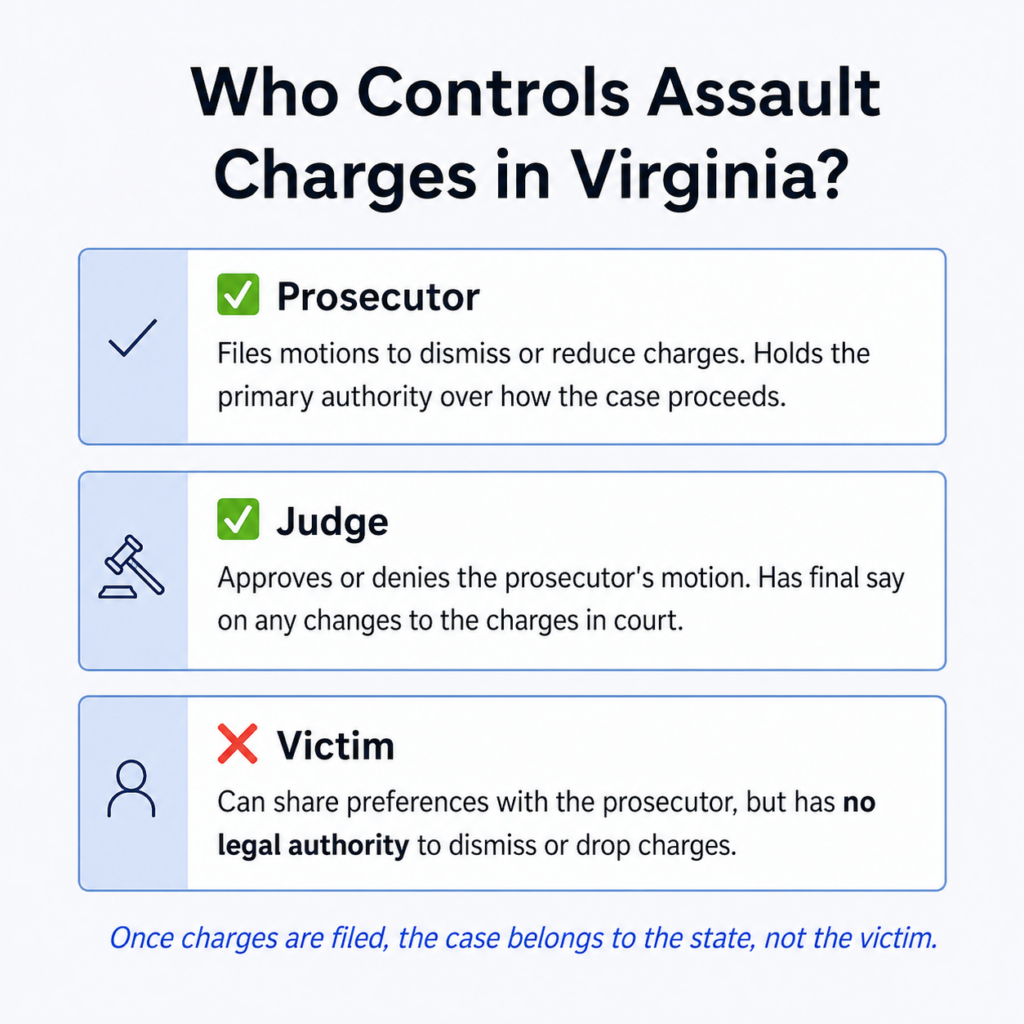
In Virginia, criminal charges are prosecuted by the Commonwealth’s Attorney on behalf of the state. Once an assault and battery charge is filed, the prosecutor decides whether to move forward, reduce the charges, or seek dismissal. The victim’s role shifts to that of a witness. They can share their preferences with the prosecutor, but they have no legal authority to withdraw or dismiss the case.
This is true regardless of how the charges originated. Even if the victim personally obtained a warrant through a magistrate, the Commonwealth’s Attorney takes over once the case enters the court system.
The judge also plays a role. A prosecutor cannot simply dismiss the charges. They must formally request a nolle prosequi/dismissal in court, and the judge must approve it. Virginia law sets specific conditions for different types of dismissal, which we cover below.
Can the Victim Drop Assault Charges in Virginia?
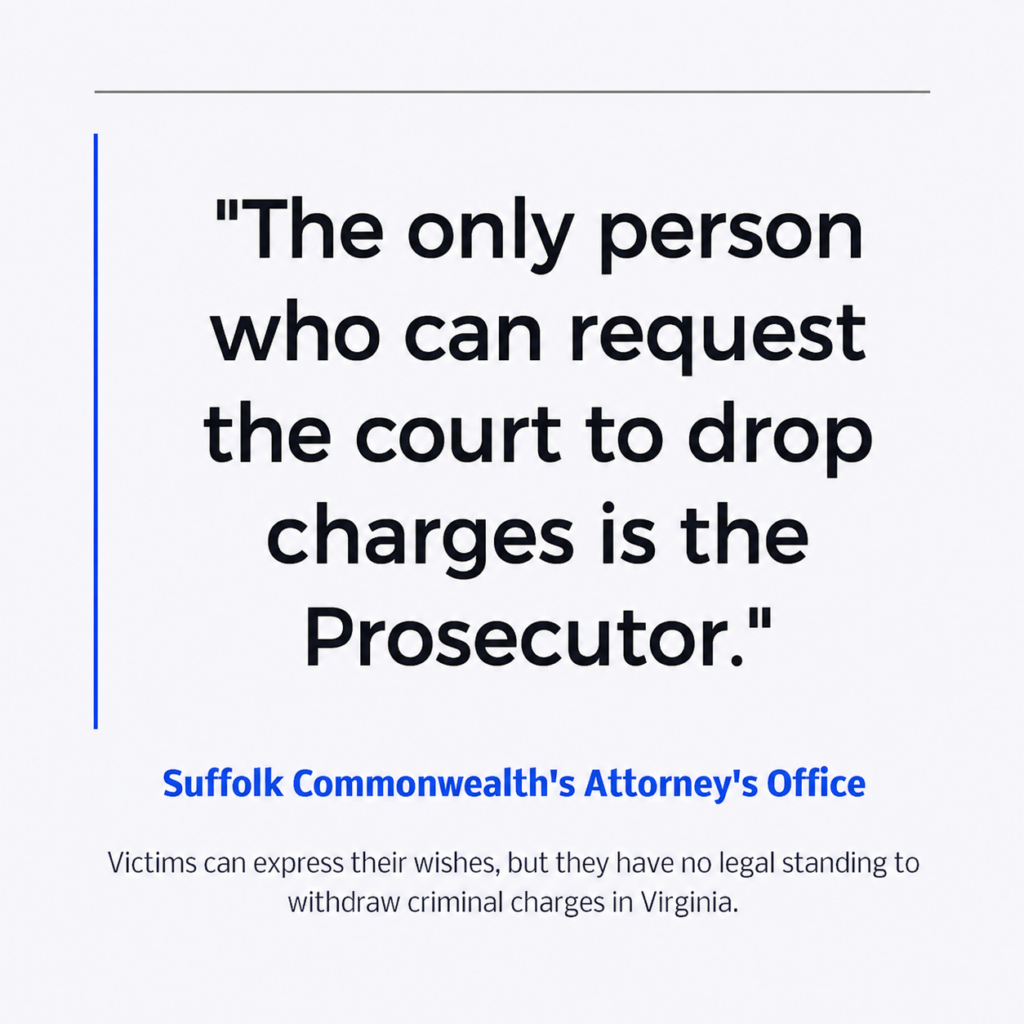
No. This is one of the most widely misunderstood aspects of Virginia criminal law. Victims cannot unilaterally drop criminal charges. As the Suffolk Commonwealth’s Attorney’s office states plainly: “The only person who can request the court to drop charges is the Prosecutor.”
Even if the victim recants their statement, reconciles with the accused, or tells the prosecutor they no longer wish to cooperate, the case can still proceed. If the evidence supports the charge, the prosecutor may continue without the victim’s participation, especially if the defendant admitted to the assault and battery.
This is especially true in domestic violence cases. Virginia operates under what is effectively a “no-drop” policy for domestic assault. Many Commonwealth’s Attorney offices will prosecute domestic assault cases even when the victim asks them not to. The reasoning is straightforward: domestic violence cases carry a high risk of coercion and recantation, and prosecutors have a public safety mandate that goes beyond any individual victim’s stated preference.
How an Assault & Battery Charge Gets Dismissed in Virginia
While only the prosecutor and court can dismiss assault charges, Virginia law provides several distinct mechanisms for doing so. Each has its own requirements, limitations, and consequences.
Nolle Prosequi (Va. Code §19.2-265.3)
A nolle prosequi is the most common way prosecutors drop criminal charges in Virginia. The term means “unwilling to pursue.” Under Va. Code §19.2-265.3, the Commonwealth can move to enter a nolle prosequi, but the court will only grant it “upon motion of the Commonwealth with good cause shown.”
In practice, prosecutors seek a nolle prosequi when the evidence is insufficient to secure a conviction, a key witness is unavailable, or other circumstances make prosecution impractical. The judge reviews the motion and decides whether the stated reasons are adequate.
One important detail: a nolle prosequi is a dismissal without prejudice. That means the Commonwealth can refile the same charge later. It is not an acquittal, and it does not permanently resolve the case. However, in many situations, once a charge is nolle prossed, it stays that way.
Court-Ordered Dismissal with Defendant’s Consent (Va. Code §19.2-265.6)
Under Va. Code §19.2-265.6, the Commonwealth can move to dismiss charges when the defendant consents. If both sides agree, the court “shall grant” the motion unless there is evidence that the dismissal resulted from bribery or would prejudice the victim.
This provision adds a layer of judicial oversight. Even when the prosecutor and defendant agree that dismissal is appropriate, the judge must confirm that the agreement is legitimate and not the product of improper influence.
A dismissal under this statute can be entered with or without prejudice, depending on the court’s order. If the order does not specify, the default is without prejudice, meaning the charges could theoretically be refiled.
Accord and Satisfaction (Va. Code §19.2-151)
Virginia has a unique statutory mechanism that allows certain misdemeanor assault and battery charges to be dismissed when the victim has been “made whole.” Under Va. Code §19.2-151, if the person charged with assault provides restitution (such as paying medical bills) and the victim acknowledges in writing that they have received satisfaction for the injury, the court may dismiss the prosecution.
There are significant limitations on when accord and satisfaction applies:
- It is only available for misdemeanor assault and battery charges
- It does not apply to domestic assault and battery
- It does not apply to assault and battery on law enforcement officers
- It does not apply to felony charges
- The defendant must also pay court costs
When it does apply, accord and satisfaction can be an effective resolution. The victim receives compensation, and the defendant avoids a criminal conviction. But the statutory restrictions mean it is unavailable in many of the assault and battery cases we see in Northern Virginia courts.
Deferred Disposition for First-Time Domestic Assault (Va. Code §18.2-57.3)
For individuals charged with a first offense of simple assault and battery against a family or household member (domestic assault and battery), Virginia offers a deferred disposition option under Va. Code §18.2-57.3.
Under this provision, the court can defer the proceedings after the defendant enters a guilty or no contest plea. The defendant is then placed on probation and may be required to complete conditions such as:
- A batterer’s intervention or anger management program
- Community service
- Good behavior for a specified period (typically two years)
If the defendant successfully completes all conditions, the court discharges the case and dismisses the proceedings without a finding of guilt. This is a meaningful outcome because it avoids a permanent conviction on the defendant’s record.
However, there is a catch. For purposes of future bail hearings and certain background checks, the deferred disposition still counts as a prior offense. And this option is only available once. A second domestic assault charge would not qualify. Also, a dismissal under Va. Code §18.2-57.3 is not expungeable.
Plea Negotiations
Assault and battery charges can be resolved through plea bargaining rather than outright dismissal or a trial. In a typical plea agreement, the defendant agrees to plead guilty to an amended charge (such as disorderly conduct or trespassing), or some type of deferred disposition is agreed to, which allows the charge to eventually be dismissed.
The strength of the evidence, the circumstances of the incident, and the defendant’s criminal history all factor into what kind of deal the prosecutor is willing to offer. A defense attorney’s ability to identify weaknesses in the prosecution’s case and present mitigating evidence directly influences the outcome of these negotiations.
Comparing the Dismissal Methods
| Method | Who Initiates | Key Requirements | Result |
| Nolle Prosequi (§19.2-265.3) | Prosecutor | Good cause shown; court approval | Dismissed without prejudice (can be refiled) |
| Dismissal with Consent (§19.2-265.6) | Prosecutor (with defendant’s consent) | No bribery or prejudice to victim | Dismissed with or without prejudice per court order |
| Accord and Satisfaction (§19.2-151) | Judge (upon victim’s written satisfaction) | Misdemeanor only; no domestic assault, no officer assault, no felony; restitution paid | Dismissed upon satisfaction and payment of costs |
| Deferred Disposition (§18.2-57.3) | Court | First domestic assault offense; guilty/no contest plea; completion of probation conditions | Discharged and dismissed without adjudication of guilt |
| Plea Agreement | Prosecutor and defendant | Mutual agreement on terms | Original charge amended in exchange for plea to lesser offense |
Can an Assault & Battery Charge Be Refiled After Dismissal?
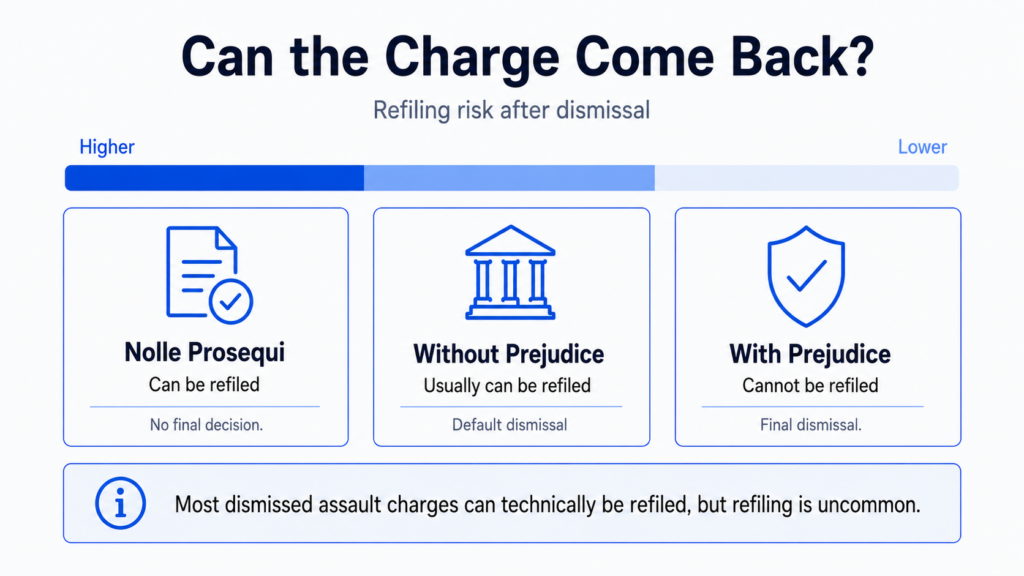
In most cases, yes. A nolle prosequi and a dismissal without prejudice both leave the door open for the Commonwealth to refile charges at a later date. There is no double jeopardy protection because the case was never adjudicated on the merits.
The exception is a dismissal with prejudice, which a judge can order under Va. Code §19.2-265.6. A dismissal with prejudice permanently bars the Commonwealth from bringing the same charges again. However, judges do not enter this type of dismissal routinely. It typically requires specific circumstances, such as prosecutorial misconduct or an unreasonable delay in prosecution.
As a practical matter, most charges that are nolle prossed are not refiled. If the prosecutor lacked sufficient evidence the first time, the same evidentiary problems usually persist. But until the statute of limitations expires, the possibility of refiling technically remains.
What a Defense Attorney Can Do
The fact that victims cannot drop charges does not mean defendants are powerless. A defense attorney can take concrete steps that lead to dismissal or reduction of assault charges:
Challenging the evidence. If the prosecution’s case relies on a single witness whose account is inconsistent, the witness has a motive to fabricate, or if physical evidence contradicts the allegations, a defense attorney can file motions to suppress evidence or argue that the Commonwealth cannot meet its burden of proof. When the evidence is genuinely weak, prosecutors are more likely to agree to a nolle prosequi rather than risk losing at trial.
Identifying constitutional violations. If the arrest was made without probable cause, or if statements were obtained in violation of the defendant’s rights, a defense attorney can move to exclude that evidence. Suppression of key evidence can effectively end the prosecution’s case.
Negotiating with the Commonwealth. Defense counsel can present mitigating circumstances, the defendant’s lack of criminal history, evidence of self-defense, or willingness to complete certain conditions. These factors can influence a prosecutor to agree to reduced charges or deferred disposition.
Presenting self-defense or other affirmative defenses. Virginia recognizes self-defense as a complete defense to an assault and battery charge. If the evidence supports it, this defense can lead to an acquittal at trial or motivate the prosecutor to dismiss before trial.
Preparing for trial. Prosecutors and their offices evaluate cases partly based on the defense attorney’s willingness and ability to try the case. When the Commonwealth knows the defense is genuinely prepared to go to trial, it changes the calculation on plea offers and dismissals.
At The Leiva Law Firm, Manuel Leiva has over 25 years of trial experience handling criminal cases across Northern Virginia, from misdemeanor assault charges to the most serious felonies in Virginia’s courts. That experience matters when negotiating with prosecutors who make different assessments based on who is representing the defendant.
Talk to a Criminal Defense Attorney About Your Assault Case
If you or someone you know is facing assault charges in Virginia, the legal process is not as straightforward as “the victim drops the charges.” Understanding the specific dismissal mechanisms available, and having an attorney who can pursue them effectively, makes a real difference in how the case resolves.
The Leiva Law Firm represents individuals charged with assault, domestic violence, and other criminal offenses throughout Northern Virginia. To discuss your case with Manuel Leiva, call (703) 352-6400. Services available in English and Spanish.

