




What to Do If You’re Charged With a Felony in Virginia (2026)
If you have been charged with a felony in Virginia, here are some important things you can do in the first hours and days, and most of them are about what not to do. Do not talk to the police without a lawyer. Do not discuss your case on a jail phone, in a text, or on social media. Do not accept any plea offer before a defense lawyer has reviewed the evidence. A felony is a different category of stakes than a misdemeanor, and the early decisions you make can shape the outcome more than almost anything that follows.
At The Leiva Law Firm, we have defended people against felony charges across Northern Virginia for more than 25 years, in cases ranging from drug and weapons charges to murder. Manuel Leiva has tried these cases himself, and clients work with him directly. This guide explains the steps to take right now, what Virginia’s felony classes actually mean for you, how a felony case moves through the courts, the consequences that outlast a sentence, and how to choose a lawyer when the decision matters this much.
What to do first if you’ve been charged with a felony in Virginia
Take these steps in roughly this order. Each one protects your case or your future, and several of them work against the instinct most people have in a crisis.
- Stop talking. You are not legally required to answer questions from the police.
- Clearly ask for a lawyer, then stay silent. Say you want an attorney and that you are exercising your right to remain silent.
- Do not discuss the case with anyone but your lawyer. That includes phone calls, video visits, texts, and social media.
- Write down everything you remember about the arrest and the events leading up to it while the details are fresh.
- Contact a defense lawyer who actually tries felony cases, ideally before your first court date.
- Do not accept any plea offer until your lawyer has reviewed the evidence and investigated the case.
The rest of this guide explains why each of these matters and what comes next.
Why you should not talk to the police without a lawyer
This is the single most important instruction in this guide. People charged with a crime often believe they can explain their way out of it, clear up a misunderstanding, or cooperate their way to leniency. In practice, talking to the police without counsel is how strong cases get built against people who could have stayed quiet.
As Manuel Leiva puts it: “A lot of people don’t realize that you are under no legal obligation to talk to the police. So, of course, anything that you do voluntarily will be used against you. So, the best thing to do is talk to a lawyer first or have a lawyer present with you when you talk to the police.”
You have two rights here, and you should use both. The Fifth Amendment gives you the right to remain silent. The Sixth Amendment gives you the right to a lawyer. Invoke them clearly and early, then say nothing else about the facts of your case until your attorney is present.
Police are allowed to lie to you
Many people assume officers have to be truthful during questioning. They do not. Under the U.S. Supreme Court’s decision in Frazier v. Cupp, law enforcement may use deception during an interrogation. An officer can claim to have your fingerprints, an eyewitness, or a confession from someone else, even when none of that exists. Virginia courts have consistently held that this kind of deception, by itself, does not make a confession inadmissible.
Manuel Leiva makes the same point to clients. Police are permitted to exaggerate the evidence they claim to have, which is exactly why staying silent and getting counsel first protects you. You cannot talk your way out of a felony, but you can talk your way into one.
Assume every jail call and video visit is recorded
If you are held in a local or regional Virginia jail, you lose almost all privacy in your communications. Jails record outgoing phone calls and video visits, and inmates agree to that recording as a condition of using the system.
Prosecutors and investigators routinely subpoena these recordings and use them at trial. A frightened person calls a spouse or parent to talk through what happened, and that conversation becomes evidence. The only protected communication is with your attorney, and only through the designated, properly flagged channels the jail uses for legal calls. Do not discuss the facts of your case on a standard jail line, even with family.
What counts as a felony in Virginia
A felony in Virginia is an offense punishable by confinement in a state correctional facility, under Va. Code § 18.2-8. State correctional facilities are run by the Virginia Department of Corrections and hold people serving longer sentences. A misdemeanor, by contrast, is punishable by no more than 12 months, and that time is served in a local or regional jail rather than state prison.
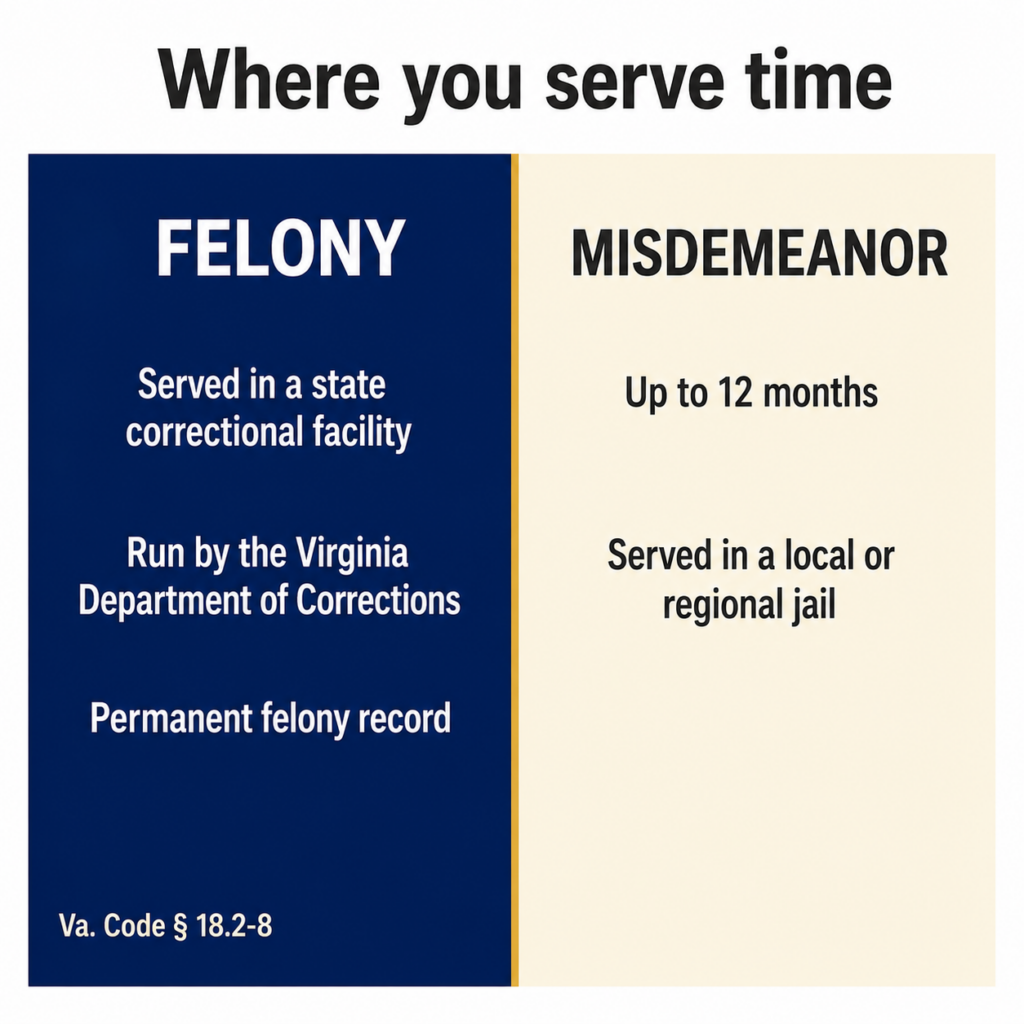
That dividing line is the practical difference a felony charge introduces. A misdemeanor caps your exposure at one year in a local jail. A felony charge puts the state prison system on the table, along with a permanent felony record and the lasting consequences that come with it.
There is one wrinkle worth understanding. For the two lowest felony levels, a judge or jury can choose to sentence you to local jail time of 12 months or less instead of prison. That sentence does not turn the conviction back into a misdemeanor. You remain a convicted felon, with all of the consequences that follow.
Virginia felony classes and penalties (Class 1 through Class 6)
Virginia sorts most felonies into six classes, from Class 1 (the most serious) to Class 6 (the least). The class sets the baseline range for prison time and fines under Va. Code § 18.2-10. Whenever you see a penalty listed, check which class it applies to, because the ranges vary enormously.
| Felony class | Possible prison term | Maximum fine |
| Class 1 | Life imprisonment | $100,000 |
| Class 2 | 20 years to life | $100,000 |
| Class 3 | 5 to 20 years | $100,000 |
| Class 4 | 2 to 10 years | $100,000 |
| Class 5 | 1 to 10 years, or up to 12 months in jail at the court’s or jury’s discretion | $2,500 |
| Class 6 | 1 to 5 years, or up to 12 months in jail at the court’s or jury’s discretion | $2,500 |
A few points behind the table matter for understanding your exposure.
Class 5 and Class 6 felonies give the judge or jury a choice. They can impose prison time, or they can hand down a lighter sentence of up to 12 months in jail. As noted above, that lighter sentence does not change the felony classification.
Not every felony fits the Class 1 through Class 6 structure. Some offenses are defined as felonies without a class, and for those “unclassified felonies,” the penalty comes from the specific statute that defines the crime rather than the general ranges above.
Two other features can extend your exposure. When a statute carries a mandatory minimum sentence, the judge cannot suspend any part of that sentence. And for felonies that result in active incarceration, Virginia law requires the court to add a suspended term of six months to three years, tied to a period of post-release supervised probation under Va. Code § 19.2-295.2. The sentence does not necessarily end when the prison time does.
The class also depends on the charge itself. Felony exposure looks very different across homicide and murder charges, drug distribution charges, weapons and firearm charges, assault and battery charges, grand larceny and theft charges, and sex crime charges. Felony DWI/DUI carries its own set of penalties as well. For the specifics of your charge, the charge-type pages on our site go into more detail than a general guide can.
How a felony case moves through Virginia courts
Knowing the path ahead helps a frightened reader understand where the case is going. A Virginia felony generally moves through these stages.
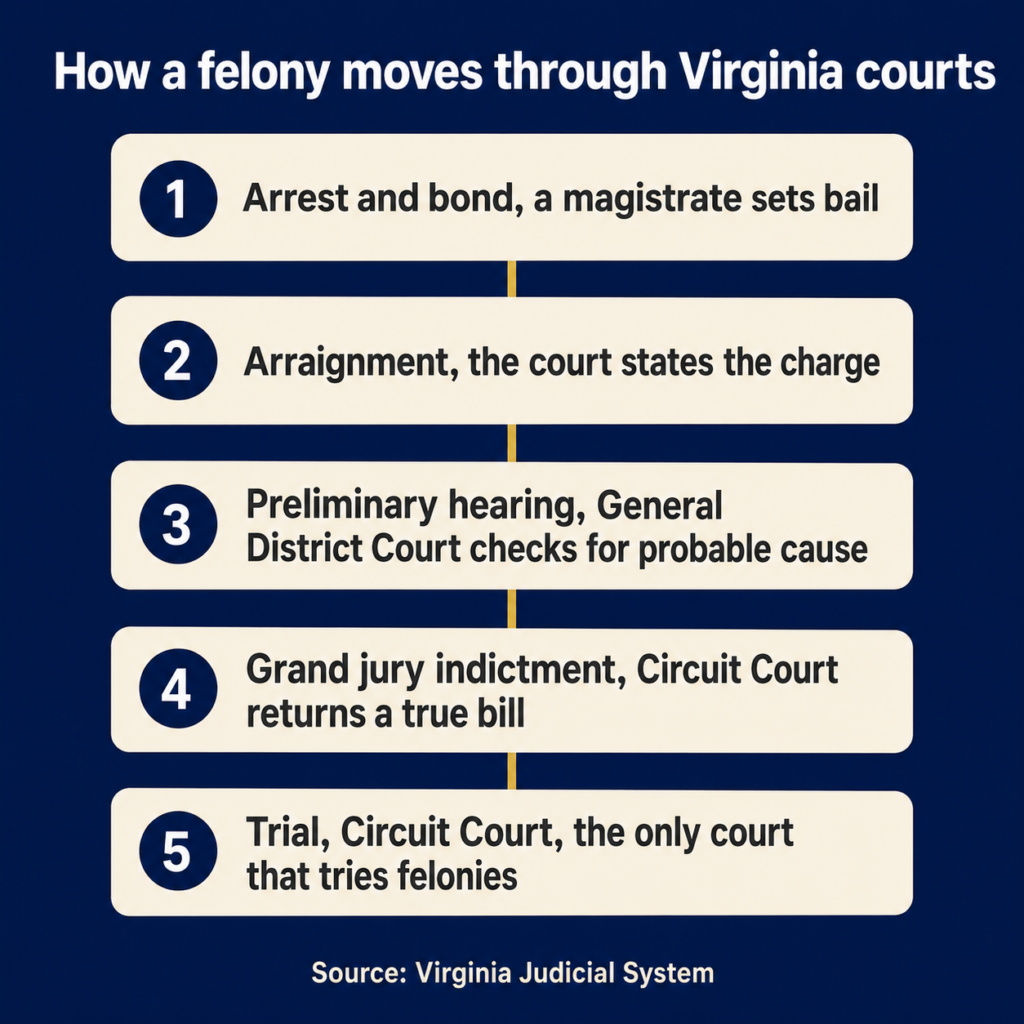
Arrest and bond. After an arrest, you are brought before a magistrate, who decides on bail or bond. The magistrate weighs whether you are likely to appear for future court dates and whether your release would be a danger to yourself or the public. Your prior record heavily influences that decision.
Arraignment. This usually happens on the next available court day if you are held. The court formally advises you of the charge.
Preliminary hearing in the District Courts. The District Courts, either the General District Court or the Juvenile & Domestic Relations District Court, cannot try an adult felony case. Their job is to act as a gatekeeper. At the preliminary hearing, a District Court judge decides whether there is probable cause to believe a felony occurred and that you committed it. That is a lower bar than proof beyond a reasonable doubt. If probable cause is found, the charge is certified to a grand jury.
Grand jury indictment. A grand jury sitting at the Circuit Court reviews the charge. If they find probable cause, they return a “true bill,” which formally indicts you. Prosecutors can also seek a direct indictment that bypasses the preliminary hearing entirely, which means a felony can land in Circuit Court without the earlier steps.
Circuit Court trial. The Circuit Court is the only court in Virginia that tries felonies and conducts jury trials.
Virginia uses a two-stage, or bifurcated, jury trial for felonies. If the jury finds you guilty in the first phase, and you elect to have the jury determine the sentence, the trial does not end once you are found guilty. It moves immediately into a separate penalty phase before the same jury. In that phase, the Commonwealth can introduce your entire prior record, including out-of-state and juvenile matters, along with victim impact testimony. The defense presents mitigating evidence, and the jury then recommends a sentence within the statutory range.
This structure is one reason trial experience matters so much in felony defense. A lawyer has to be ready to defend the guilt phase and, at the same time, prepare a mitigation strategy for a penalty phase that may never come but cannot be ignored.
Don’t take the first plea offer before the defense does its work
The first offer a prosecutor puts on the table is rarely the best one available, and accepting it before your lawyer has investigated can lock in a felony conviction you might have avoided. A real defense starts with the work: reviewing the evidence, interviewing witnesses, and filing the right pretrial motions. Only then can anyone judge whether an offer is actually good.
Manuel Leiva has seen this firsthand. In one matter we took over from another lawyer, the prosecutor’s initial offer “looked reasonable until we did the work. Once we filed the right motions and challenged key evidence, the case was dismissed. If my client had taken that initial plea offer, they’d have a conviction on their record.” In another, a client “facing a felony was ready to plead guilty because they felt there was no other option. We took the time to break the case down, interview every witness that needed to be interviewed, file the right motions, and challenge what needed to be challenged. The end result, a significantly better outcome than was first expected.”
His approach is to lay out the strengths, the weaknesses, and the realistic outcomes, and then let the client decide. He does not pressure anyone into a plea.
It also helps to understand the mechanics. When a charge goes away as part of a deal, it is usually amended to a lesser offense, not simply “dropped.” When a prosecutor agrees to dismiss a charge outright, they move for a nolle prosequi, which the court still has to approve. These distinctions matter because they tell you what is actually happening to your record.
For perspective on what thorough preparation can change, our criminal case results include a felony drug distribution charge reduced to a misdemeanor, which spared the client a mandatory minimum and a felony record, a federal murder charge dismissed before trial, and a grand larceny charge that was fully dismissed. Past results do not guarantee future outcomes, because every case turns on its own facts.
The consequences of a felony conviction that outlast the sentence
Many people walk into our office thinking the only thing they are fighting is the charge and the court date. The conviction itself can follow them for years, or for life. As Manuel Leiva tells clients: “A criminal charge just doesn’t affect your record. It can impact your job, your immigration status, your security clearance, your right to vote, your right to own a firearm. Your entire future can be affected.”
This is why fighting the charge aggressively at the front end matters so much. The collateral consequences below are often harder to undo than the sentence itself.
Firearm rights
A felony conviction in Virginia means the immediate and lifetime loss of the right to purchase, possess, or transport a firearm under Va. Code § 18.2-308.2. Possessing a firearm after a felony conviction is itself a Class 6 felony, and it carries mandatory minimum prison time in many situations, including a five-year minimum where the prior conviction was for a violent felony.
Getting those rights back is a two-step process that confuses many people who try it alone. The Governor (or the equivalent authority in the state of conviction) must first restore your political and civil rights. Only after that can you petition the Circuit Court, with fingerprints and a criminal history check, to ask a judge to reinstate your firearm rights.

Voting rights
Virginia’s rules on voting after a felony changed significantly in 2026 following a federal court ruling in King v. Youngkin. The practical effect is that many people convicted of modern statutory felonies, such as drug or fraud offenses, are no longer barred from voting and can register without waiting for individual restoration from the Governor. A narrow set of offenses rooted in older common-law felonies is treated differently, and restoration for those remains within the Governor’s discretion.
This is an evolving area of the law. If voting eligibility affects you, confirm your current status with the Virginia Department of Elections or with your attorney before you rely on a general rule.
Professional licenses and employment
A felony conviction threatens a career, but it does not automatically end one. Virginia’s Department of Professional and Occupational Regulation reviews applicants with criminal records on a case-by-case basis through an Informal Fact-Finding Conference. The board weighs how closely the crime relates to the profession, how much time has passed, and evidence of rehabilitation. Outright denial based on a record alone is uncommon. The point for anyone in a licensed field is that the license is worth fighting for, and that fighting the underlying charge gives you the strongest position.
Immigration status
For anyone who is not a U.S. citizen, including lawful permanent residents, a Virginia felony conviction can carry severe federal immigration consequences. Federal law treats certain offenses as “aggravated felonies,” which can mean mandatory detention, deportation, and a permanent bar to returning.
The trap is that state and federal definitions do not line up. A plea that looks like a win in a Virginia courtroom, such as a suspended one-year sentence on a property charge, can still meet the federal threshold for an aggravated felony and trigger removal. If you are not a citizen, your defense and any plea decision should account for immigration consequences from the start, and you should involve an immigration attorney where appropriate.
Can a felony charge or conviction be expunged or sealed in Virginia?
The short answer is that relief is narrow, slow, and not available for most convictions. That is precisely why avoiding a conviction in the first place is the better strategy.
Expungement, which actually destroys the record, is reserved for people the law treats as innocent. Under Va. Code § 19.2-392.2, it applies to charges that end in acquittal, dismissal, or an absolute pardon. If you plead guilty or are found guilty, expungement is not available for that offense.
Virginia’s new petition-based sealing law takes effect July 1, 2026, under Va. Code § 19.2-392.12. Sealing hides a record from most public background checks but does not destroy it, and law enforcement and courts keep access. Eligibility is tight. It is limited to Class 5 felonies, Class 6 felonies, and felony larceny, and it requires a clean 10-year period after the conviction or release. An individual can have only two sealing petitions granted in a lifetime. The statute also lists offenses that can never be sealed, including violent felonies, any offense involving a firearm, sex offenses requiring registration, and domestic violence convictions.
There is also a faster path for non-convictions. Effective July 1, 2026, Va. Code § 19.2-392.8 allows automatic sealing when a felony charge ends in acquittal or is dismissed with prejudice. With the prosecutor’s agreement, the defense can ask the judge in the courtroom to seal the arrest and court records right away, without filing a separate petition.
Is there a statute of limitations on felonies in Virginia?
No. Virginia has no general statute of limitations for felonies, which means a person can be charged years or even decades after the alleged offense. The Commonwealth is limited mainly by its practical ability to prove the case. Misdemeanors generally must be prosecuted within one year, and a few narrow felony categories, such as certain tax offenses, carry their own short limitation periods. For the vast majority of violent crimes, drug offenses, and property felonies, there is no clock that runs out.
How to choose a felony defense lawyer in Virginia
Of every decision you make after a felony charge, who you hire affects the outcome the most. Yet most people weigh the wrong thing when they choose.
Manuel Leiva’s advice is direct: “You shouldn’t judge on who you’re going to hire as a lawyer by the number of years they’ve been a lawyer. It’s the experience they have in that particular field, but more importantly, the trial experience they have.” His suggestion is that the question “how many years have you practiced” should always be followed by three more. How many jury trials have you had? What kinds of cases? How often do you actually go to trial?
Years of practice and trial experience are not the same thing. A lawyer can practice for decades while resolving nearly every case through a plea, never trying a case before a jury. Many criminal defense attorneys in Northern Virginia have little or no jury trial experience, and that affects how the other side treats their cases. Prosecutors negotiate differently against a lawyer they know will take a case to trial if the offer is not good enough. Trial readiness drives better plea offers, and in some cases it is what makes a dismissal or acquittal possible.
There is a related point worth keeping in mind. An attorney who has tried the most serious felonies can handle a lesser charge with ease, while a lawyer whose work has been limited to minor matters may be out of their depth if a felony escalates. The skills built in high-stakes trials carry down to simpler cases. The reverse does not hold.
One more thing to watch for. Be wary of any lawyer who guarantees a result before studying your case. As Manuel Leiva points out, no honest attorney can promise an outcome at the outset, because your attorney does not yet have the complete picture. A candid assessment of the strengths, weaknesses, and realistic outcomes is worth far more than a confident promise.
This is the standard we hold ourselves to. Manuel Leiva’s background started in the Fairfax County Public Defender’s Office handling serious felonies, and across more than 25 years he has tried cases up to and including murder. He prepares multiple jury trials in a single year, which is not typical in this market. Our documented felony results include a federal RICO murder indictment dismissed before trial and a murder acquittal that was featured on NBC Dateline and Investigation Discovery (HBO Max). In one matter he took over a murder case after a prior firm’s trial ended in a hung jury leaning toward a first-degree murder conviction. He used a biomechanical engineer to reconstruct the shooting and obtained three not-guilty verdicts, along with a manslaughter result rather than first-degree murder for the remaining defendant. Past results do not guarantee future outcomes, because every case depends on its own facts.
Two practical notes on choosing counsel. Do not price yourself out of good representation, and do not let a high-pressure sales pitch rush your decision. Take the time to find a lawyer you trust with something this important.
Talk to a Northern Virginia felony defense lawyer
A felony charge is serious, but the early decisions are yours to make well. Stay silent, get counsel before you talk to anyone, and do not accept any offer before the defense has done its work.
At The Leiva Law Firm, we defend people charged with felonies throughout Fairfax, Arlington, Alexandria, Loudoun, Prince William, and Stafford, and we represent individuals charged with federal offenses in the Eastern District of Virginia. Manuel Leiva handles cases personally, and we work with clients in both English and Spanish. If you or a family member is facing a felony charge, contact our office to schedule a consultation and talk through your situation with an attorney who tries cases.
This article is general information about Virginia law, not legal advice about your specific situation. For advice on your case, speak with a licensed attorney.

