




Do You Have to Pay a Lawyer Upfront for a Personal Injury Case?
No, you do not have to pay a lawyer upfront for a personal injury case when the lawyer takes it on a contingency fee. On a contingency fee, the lawyer’s fee comes out of the money you recover through a settlement or a verdict, and if you recover nothing, you owe no legal fee. At The Leiva Law Firm, we handle personal injury cases on a contingency fee, so our clients pay nothing upfront and owe no legal fees unless we recover compensation for them.
The legal fee is not the only money involved in a case. A personal injury case also has costs, such as court filing fees and expert witness fees. Not every firm handles case costs the same way. We will advise you of our cost payment policy for costs covering filing fees, expert witness fees, and other litigation costs. .
How Do Personal Injury Lawyers Get Paid in Virginia?
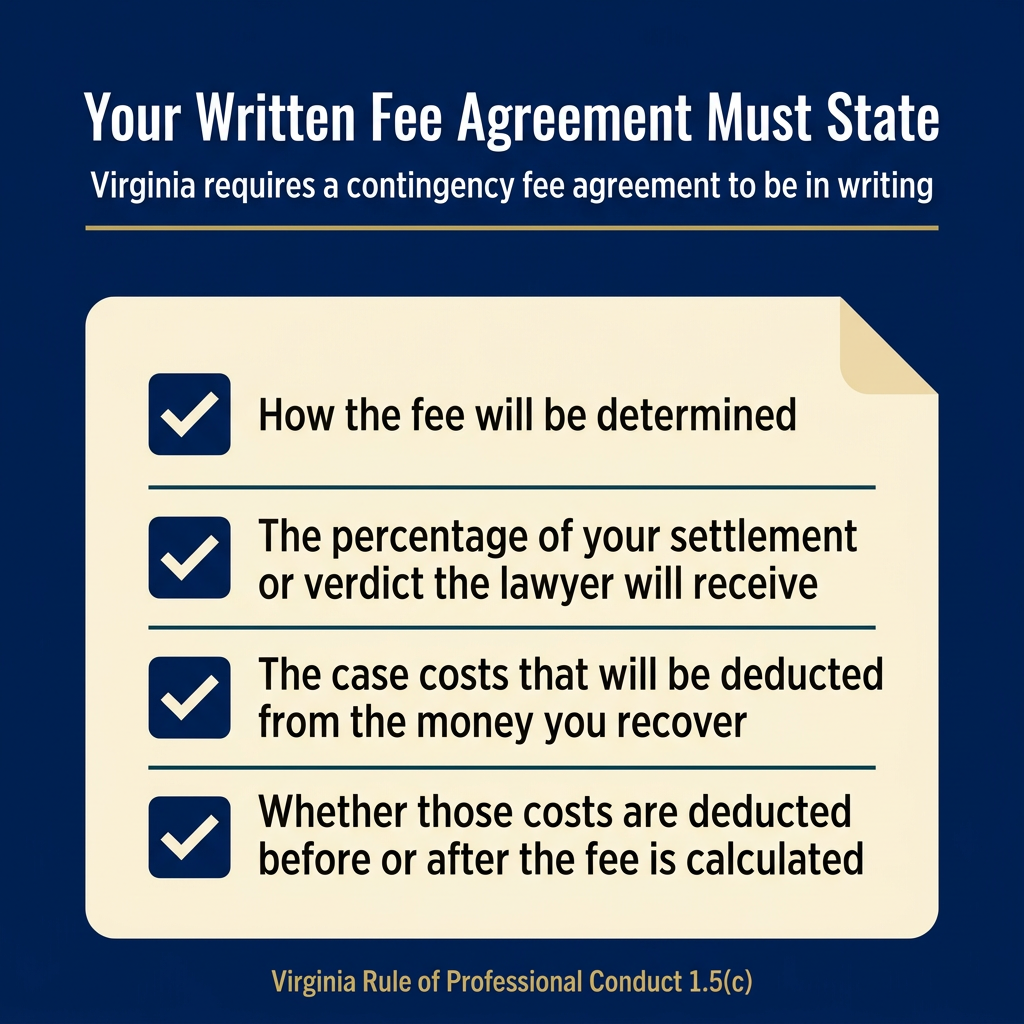
On a contingency fee, a personal injury lawyer is paid a percentage of whatever you recover, whether the money comes from a settlement or a verdict. The fee depends on the type of case, which is why it is called a contingency fee. Virginia’s rules on legal fees require a contingency fee agreement to be in writing, so you can see how the fee works before you sign. The written agreement must state:
- How the fee will be determined
- The percentage of your settlement or verdict the lawyer will receive
- The case costs that will be deducted from the money you recover
- Whether those costs are deducted before or after the fee is calculated
Virginia also requires every lawyer’s fee to be reasonable. Virginia’s rule lists eight factors for judging whether a fee is reasonable, including the time and skill your case requires, the fee lawyers in the area usually charge for similar work, the result the lawyer obtains, the lawyer’s experience, and whether the fee is fixed or contingent.
What Does the Contingency Fee Cover?
The contingency fee pays for the lawyer’s work on your case from start to finish. At our firm, once you sign the fee agreement, we handle the investigation, discovery and the communication with the insurance carrier. We also prepare the demand, which is the formal request for payment sent to the insurance carrier. Then we negotiate the settlement. If the case needs it, we file a lawsuit, also called an action, and take it to trial. You work directly with Manuel Leiva at every stage. We take car accident cases and premises liability cases, such as falls and dog bites, on this same contingency fee.
How much the insurance carrier offers affects how much money you receive. When the insurance carrier decides what to offer, it considers whether your lawyer is willing and able to take the case to trial. That is why we prepare every case as though it will go to trial. Manuel Leiva has more than 25 years of trial experience, so the insurance carrier makes its offer knowing the case can go to trial if the offer is not fair.
What’s the Difference Between Attorney Fees and Case Costs?
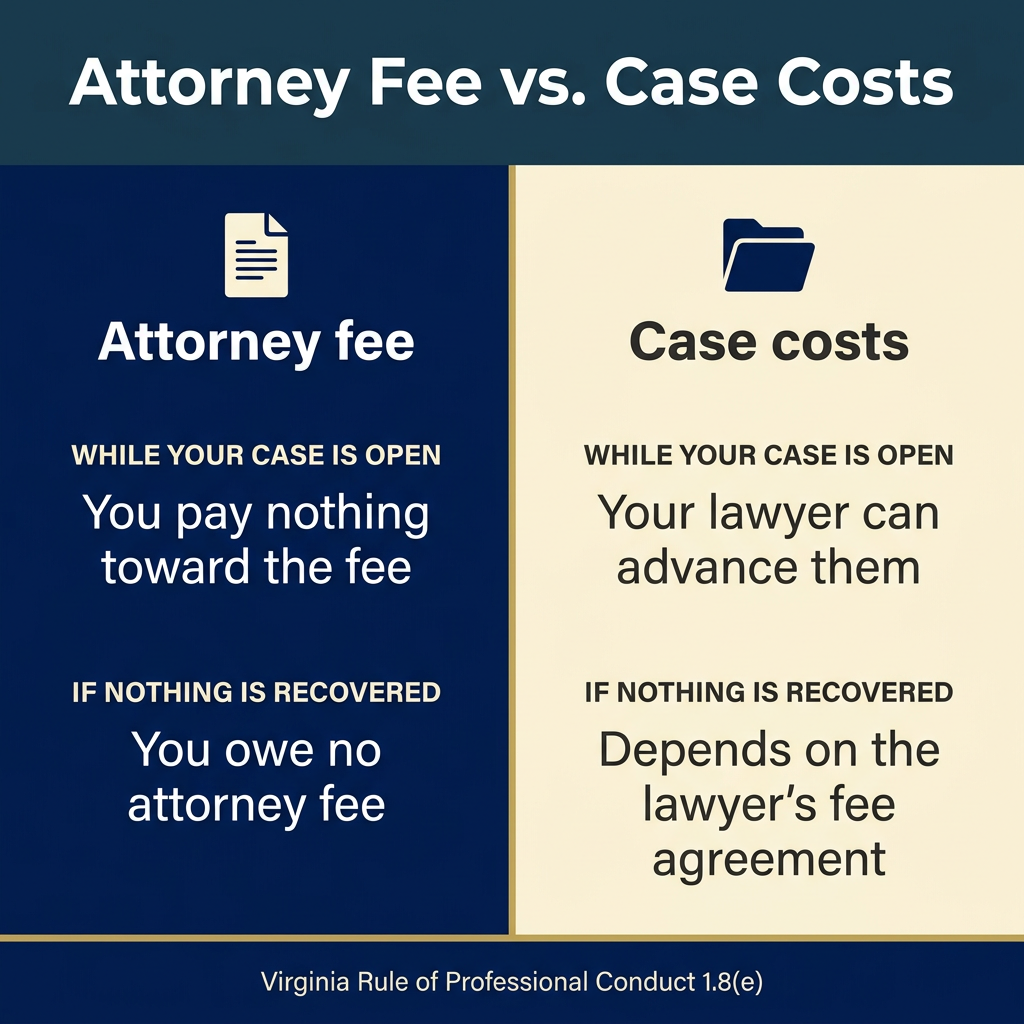
The attorney fee pays your lawyer for the work on your case. Case costs pay for the expenses of building and pursuing the case, such as court filing fees and expert witness fees. The two are handled differently while the case is open, at the end of the case, and if the case is lost.
| Attorney fee (contingency) | Case costs | |
|---|---|---|
| What it is | Payment to your lawyer for working on your case | Expenses of building and pursuing the case, paid to others such as the court or an expert witness |
| Who pays it while the case is open | You pay nothing toward the attorney fee while the case is open | Your lawyer can advance them, which means your lawyer pays them now and you pay your lawyer back. Virginia’s ethics rules allow a lawyer to do this. |
| When it is paid | At the end of the case, out of the money recovered. Your fee agreement sets the percentage. | If your lawyer advanced them, they are repaid out of the money recovered at the end of the case from your amount. |
| What happens if nothing is recovered | You owe no attorney fee | Depends on the lawyer’s fee agreement |
Common costs in a lawsuit include:
- Court filing fees
- Fees paid to a process server to deliver court papers
- Fees paid to expert witnesses
- Photocopying charges
- Copy costs
- Costs associated with discovery
Will I Owe Anything If I Lose My Personal Injury Case?
If you lose a personal injury case that your lawyer took on a contingency fee, you will not owe a legal fee to compensate your lawyers time and work, because a contingency fee is owed only when you recover money.
Case costs work differently, and what you would owe depends on the lawyer’s fee agreement. Under Virginia’s Rule 1.8(e), a lawyer can advance court costs and litigation expenses. The rule also allows a lawyer to agree that you repay those costs only if you recover compensation, but it does not require the lawyer to make that agreement. One fee agreement might say you owe nothing for costs if you lose, while another might require you to repay the costs anyway. The cost clause in the agreement says which arrangement applies to you.
At our firm, you pay nothing unless we recover compensation for you. You pay no case costs while your case is open, and if we do not recover compensation, you owe us neither a fee nor case costs.
Medical bills are separate from the fee agreement. The fee agreement covers only what you owe your lawyer. Your medical bills are what you owe your doctors and the hospital for your treatment, and you owe them whether or not the case succeeds. If you do recover compensation, your medical bills and any medical liens will be paid out of the settlement.
What Comes Out of a Personal Injury Settlement?
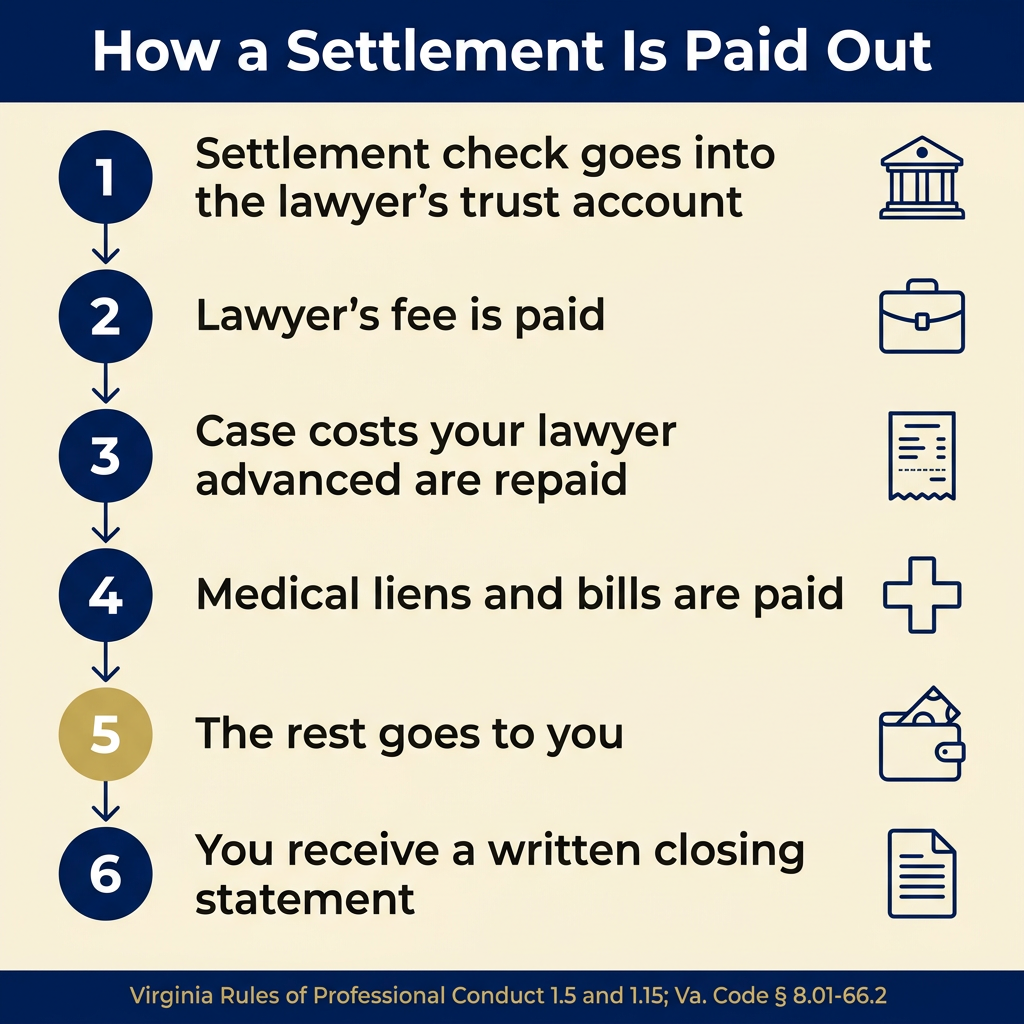
The lawyer’s fee, the case costs, and any medical liens and bills come out of a personal injury payment, and the rest goes to you. The settlement is paid out in these steps:
- The settlement check goes into the lawyer’s trust account. Virginia requires a lawyer to keep client money in a trust account, separate from the lawyer’s own money.
- The lawyer’s fee is paid. The fee is the percentage your fee agreement sets.
- The case costs your lawyer advanced are repaid.
- Medical liens and bills are paid. Under Virginia law, the medical providers who treated you for the injury, such as the hospital, your doctors, or the ambulance service, can have a lien on your claim. A lien gives a provider the right to be paid out of your settlement, so your lawyer pays it before the rest of the money goes to you.
- The rest goes to you. Virginia’s trust account rules also require the lawyer to pay you promptly.
- You receive a written closing statement. Virginia’s rules require the lawyer to give you a written statement at the end of the case. The statement records how the case ended, how much was paid to you, and how that amount was calculated.
Whether case costs are deducted before or after the fee is calculated changes how much money you receive, even when the settlement and the percentage are the same. If the costs are deducted first, the lawyer’s percentage is calculated on a smaller amount, so the fee is smaller and more money is left for you. If the fee is calculated first, the percentage applies to the full settlement, and the costs then come out of what is left. When case costs are high, the order of these deductions makes a bigger difference to what you receive.
What Should I Ask Before Signing a Personal Injury Fee Agreement?
The fee agreement decides what you will owe when the case ends, so ask the lawyer to go through it with you before you sign. These questions cover the parts of the agreement that change what you owe:
- What percentage of the settlement or verdict will you receive?
- What case costs do you expect in my case, and will I have to pay any of them while the case is open?
- Are case costs deducted before or after your fee is calculated?
- If we recover nothing, will I owe you anything for case costs?
Frequently Asked Questions
Is the first consultation with a personal injury lawyer free?
At The Leiva Law Firm, the first personal injury consultation is free. Manuel Leiva uses the consultation to evaluate the facts of your case, assess your chances of recovering compensation, and explain the legal process. If you are meeting with another firm, ask whether it charges for the consultation before you go.
Does the contingency fee change if my case goes to trial?
The contingency fee can change if your case goes to trial. A fee agreement can set one percentage if the case settles and a different percentage if it goes to trial or to appeal. Virginia’s rules require the agreement to state each of those percentages in writing, so you can see before you sign whether the percentage changes at trial.
Talk With The Leiva Law Firm About Your Injury
If you were hurt in an accident and are worried about what a lawyer will cost, call us at (703) 352-6400 or contact us online for a free consultation. There is no cost and no obligation. Most personal injury lawsuits in Virginia must be filed within two years of the injury under Va. Code § 8.01-243(A), so talking with a lawyer well before that deadline leaves time to investigate your case and file it.
We represent injured people throughout Northern Virginia, including Arlington, Alexandria, Fairfax, Loudoun, and Prince William. We also represent injured people in Fairfax County communities such as Reston. Manuel Leiva speaks English and Spanish, and you can read about our personal injury services in Spanish.

