




How Bail Works in Virginia: A Step-by-Step Guide for 2026
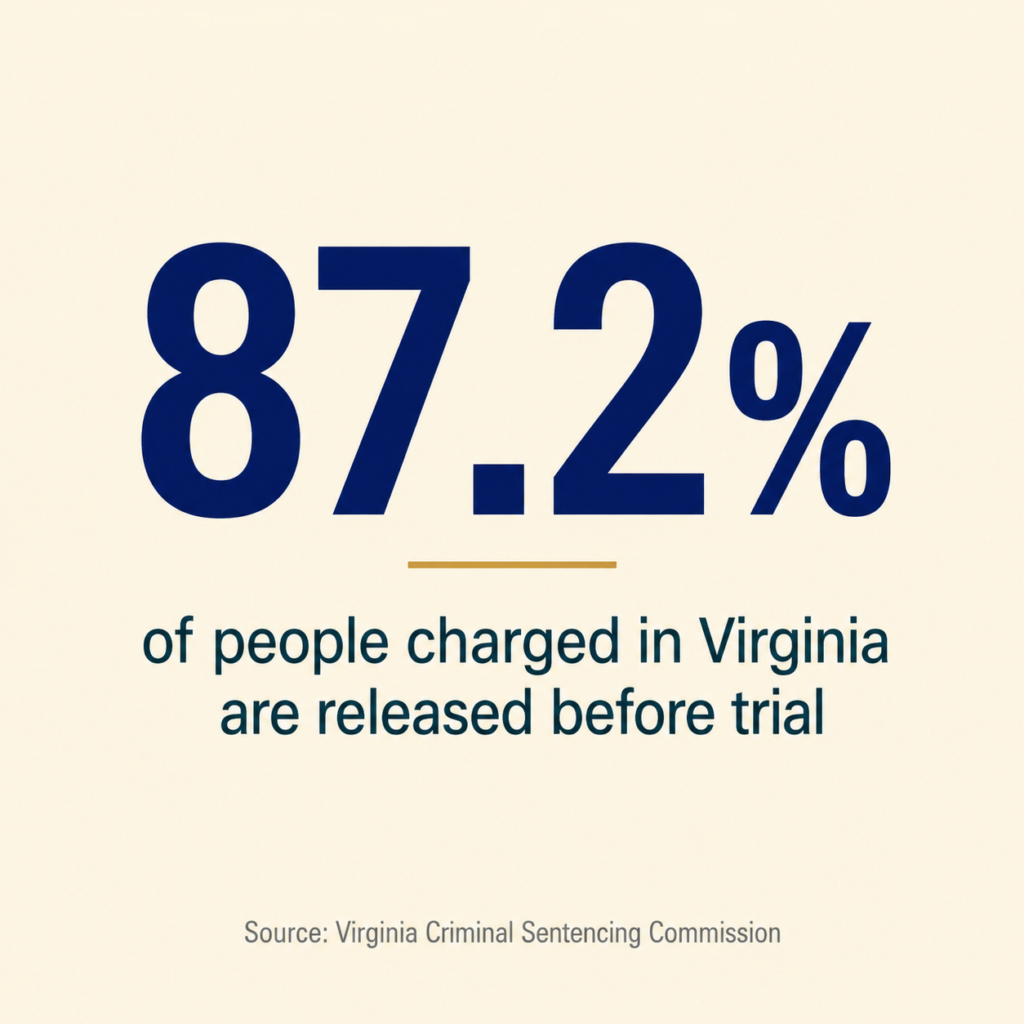
When someone is arrested in Virginia, the first decision about their freedom happens fast. A magistrate reviews the case within hours and decides whether to release the person, set a bond, or hold them in custody. Virginia law starts from a presumption that an accused person should be released on bail. The Commonwealth has to establish probable cause to keep someone in jail, not the other way around, and most people charged in Virginia are released before trial. The statewide pretrial release rate for the most recent year measured by the Virginia Criminal Sentencing Commission was 87.2 percent.
At The Leiva Law Firm, we handle criminal defense cases and appear at bond hearings throughout Northern Virginia, in Arlington, Alexandria, Fairfax, Loudoun, and Prince William, as well as in federal matters in the Eastern District of Virginia. This guide walks through the Virginia bail process from arrest to release, explains what each decision-maker does, and shows where the outcome can turn on having a lawyer in the room. The information here reflects current Virginia law as of 2026, including changes that many older pages have not caught up to.
What happens right after an arrest in Virginia
After an arrest, the accused is brought before a magistrate. The magistrate is the first judicial officer to look at the case, and the magistrate office operates around the clock. The magistrate works from the arresting officer’s sworn statements, a quick criminal history check, and a short interview with the accused. This is a fast, preliminary review, not a full hearing with witnesses and evidence.
The magistrate can release the person on a written promise to appear, set a bond, or deny bail entirely. If the magistrate denies bail or sets an amount the family cannot pay, the person stays in jail until they can be brought before a judge.
How soon does someone see a judge after the magistrate?
A person held in custody must be brought before a judge of a court not of record on the first day that court sits after the arrest. That judge has broader authority than the magistrate and can review the bail decision, set a bond, or change the conditions of release. This first court date is the first real opportunity for a defense attorney to argue for release.
When Virginia must grant bail
The starting point in Virginia is release. Under Virginia Code § 19.2-120, a judicial officer must admit an accused person to bail unless the Commonwealth shows probable cause that the person is a flight risk or an unreasonable danger to themselves, their family, or the public. The burden is on the Commonwealth to justify holding someone, not on the accused to earn their way out.
To decide whether the Commonwealth has met that burden, the magistrate or judge weighs a set of factors, including the nature and circumstances of the offense, whether a firearm was allegedly involved, the weight of the evidence, the person’s criminal history, and their ties to the community. Because the law tells the court to weigh the strength of the evidence, a bond hearing is one of the earliest points where a defense attorney can challenge the foundation of the case.
What do “flight risk” and “danger to the community” actually mean?
Flight risk is about whether someone will come back to court. Courts look at local ties, steady employment, family in the area, and any past failures to appear, not simply whether a person could afford to leave the state. Danger to the community is the court’s assessment of whether releasing the person creates an unreasonable safety risk, which is why the offense charged and any alleged use of a weapon carry weight. A person’s prior criminal record, especially for violent crimes is strongly considered in determining a danger to the community.
The 2021 change many websites still get wrong
This is the most common error on older bail pages, so it is worth stating plainly. Before July 1, 2021, Virginia law contained “rebuttable presumptions” against bail for a long list of charges, which put the burden on the defendant to prove they deserved release. Virginia repealed those presumptions in 2021, returning the burden to the Commonwealth. Attempts to bring the presumptions back have failed, including a 2026 bill that would have reinstated them for certain serious offenses. As of 2026, the presumptions remain repealed.
A separate 2026 change, effective July 1, 2026, removes an old requirement that anyone arrested for a felony who had a prior felony conviction could only be released on a secured bond. Under the new law, a court has full discretion to grant personal recognizance or an unsecured bond to a person with a prior record, based on their present circumstances. If a page you come across still warns about an automatic presumption against bail or a mandatory secured bond for prior felons, it is out of date.
Types of bonds and pretrial release in Virginia
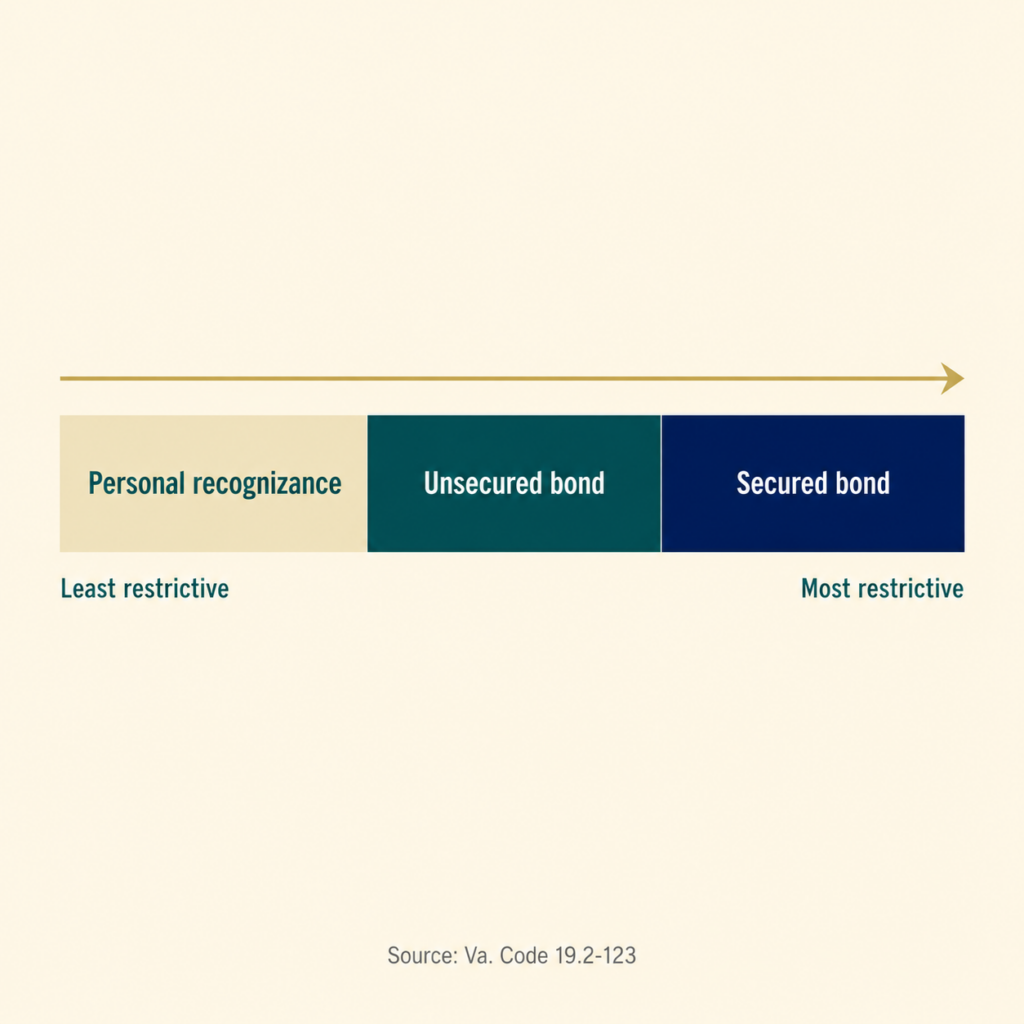
Virginia uses a graduated system of release, scaling from a simple promise to appear up to a bond that requires money or property upfront. The goal at a bond hearing is to secure the least restrictive option the court will accept. The main types are defined in Virginia Code § 19.2-123.
| Type of release | What it requires | When money is paid |
|---|---|---|
| Personal recognizance (PR) | A signed written promise to return to court | No money; nothing is posted |
| Unsecured bond | A promise to appear backed by a set dollar amount | Nothing upfront; the amount is owed only if the person fails to appear |
| Secured bond (cash) | The full bond amount deposited with the court | Paid upfront; refundable at the end of the case if all court dates are met |
| Secured bond (property) | Real estate with equity equal to or above the bond | Pledged upfront; requires title search and appraisal |
| Secured bond (surety) | A licensed bail bondsman posts the bond for a fee | A non-refundable premium paid to the bondsman |
Personal recognizance and an unsecured bond are the most favorable outcomes because no money changes hands at release. A secured bond is the most restrictive because collateral has to be posted before the person can leave jail.
How to post bond with cash or a bail bondsman
When a court sets a secured bond, a family usually has to choose between posting the full amount in cash or paying a bail bondsman. The difference comes down to whether the money comes back.
Posting a cash bond
A cash bond is fully refundable at the end of the case, as long as the accused attends every required court date. A 2022 change to Virginia Code § 19.2-121 added an important protection: the court cannot apply a cash bond to fines and court costs unless the person who posted it agrees. For families with the savings on hand, that protection makes posting cash directly a realistic option.
Using a bail bondsman
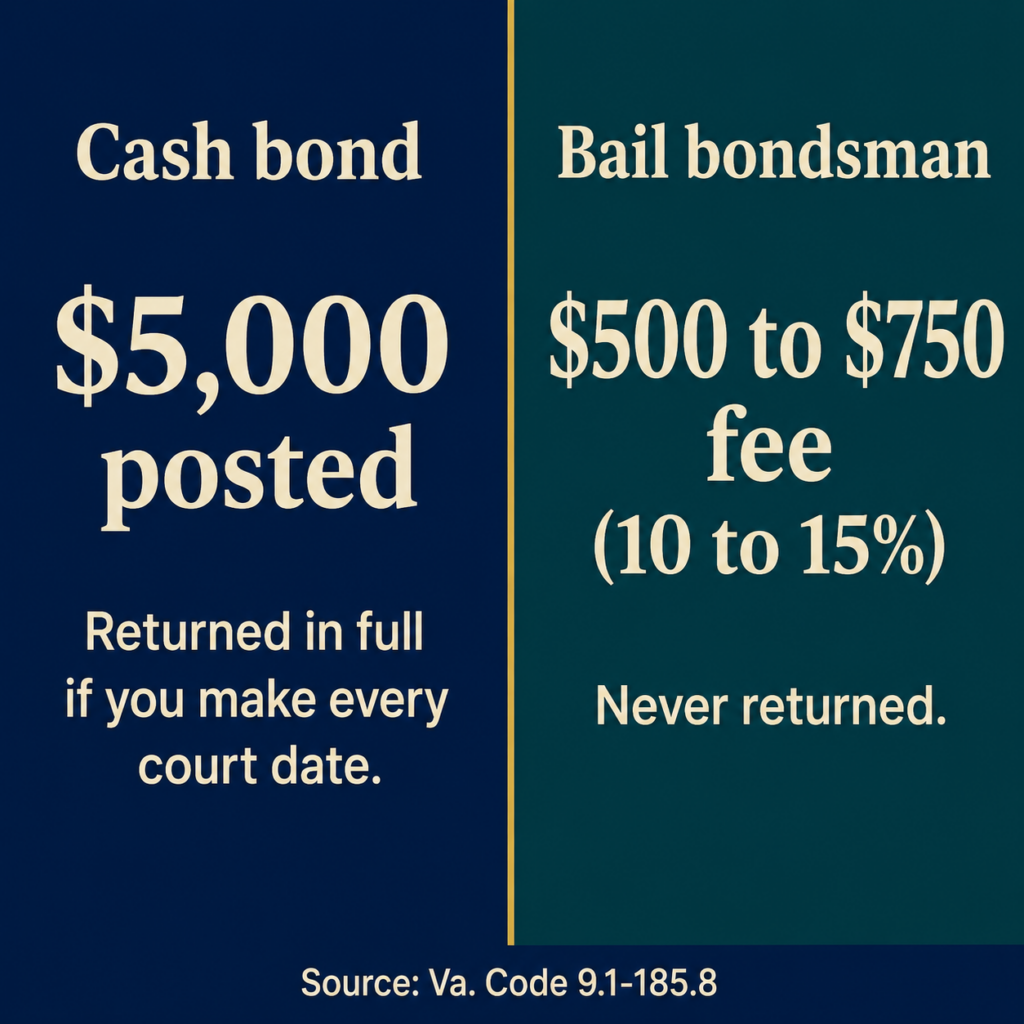
A bail bondsman charges a premium for posting the bond on the family’s behalf. Under Virginia Code § 9.1-185.8, a licensed bondsman must charge between 10 and 15 percent of the total bond, and the law forbids adding interest or finance fees to a payment plan. That premium is the bondsman’s fee for taking on the risk, and it is never returned, even if the charges are later dismissed.
Here is the practical difference on a $5,000 bond. Posting $5,000 in cash ties up the money during the case but returns it in full afterward. Hiring a bondsman costs between $500 and $750 that the family does not get back, but it frees up the rest of the cash.
Conditions of pretrial release
Release almost always comes with conditions, and a violation can send a person back to jail. Common conditions of release in Virginia include:
- No contact with alleged victims or co-defendants
- Maintaining employment
- Travel restrictions, often limiting the person to Virginia or a set of nearby states
- Surrender of firearms or a passport
- Supervision by a local Pretrial Services Agency, with regular check-ins
- Random drug and alcohol testing in some cases
Drug and alcohol testing is one of the conditions people worry about most, so one detail is worth knowing. Under Virginia Code § 19.2-123, a failed pretrial test can trigger a bond violation and a return to custody, but the result cannot be used as evidence of guilt on the underlying charge.
What happens if bond is denied in Virginia
A denial early on does not end the matter. Virginia gives a defendant two main paths to fight a denied or unaffordable bond, and both are points where having a lawyer makes a practical difference.
Appeal to a higher court
The first path is appeal. If a magistrate denies bail, the defendant has a right to ask the district court to set it. If a district court judge denies bail, the defense can take the issue up to the Circuit Court under Virginia Code § 19.2-124. A Circuit Court bond appeal is heard de novo, which means the judge starts fresh rather than reviewing the earlier ruling for error. That fresh hearing lets the defense present new evidence, character witnesses, and a structured supervision plan that the lower court never saw.
Motion to reconsider the bond
The second path is a motion for reconsideration. If circumstances change after a denial, for example a treatment bed becomes available or a key witness’s account shifts, defense counsel can file a motion under Virginia Code § 19.2-132 asking the court to modify the bond.
Can the Commonwealth appeal a bond grant?
There is one honest caution here. The appeal process runs both ways. The Commonwealth’s Attorney can appeal a decision that grants bail. If a prosecutor appeals a favorable ruling from the General District Court, the accused can remain in custody for several more days until the Circuit Court hears the matter. A favorable bond ruling is not always an immediate release.
Failure to appear and bond forfeiture
Missing a court date carries two separate consequences in Virginia, and both are serious. The first is criminal. Under Virginia Code § 19.2-128, a willful failure to appear is its own crime. If the original charge was a felony, the failure to appear is a Class 6 felony. If the original charge was a misdemeanor, it is a Class 1 misdemeanor. A person can beat the original charge at trial and still face a conviction for missing court.
The second consequence is financial. A failure to appear triggers bond forfeiture under Virginia Code § 19.2-143. Once the court records the default, the person who posted the bond, whether a bondsman or a family member who pledged property, has 150 days to locate the defendant and return them to court. Resolve it inside that window and the court dismisses the default. Miss the deadline and the court can move to seize the pledged property or funds. This is why co-signing a bond is a real financial commitment, not a formality.
How federal bail differs in the Eastern District of Virginia
If the arrest involves federal charges, the bail process is not the Virginia magistrate system at all. Federal pretrial release runs under the Bail Reform Act, 18 U.S.C. § 3142, and the differences matter from day one.
Commercial bail bondsmen play almost no role in federal court. Instead of buying release, a federal defendant is often released to a “third-party custodian,” a vetted adult who signs a sworn agreement to supervise them and report any violation. Federal law also keeps the rebuttable presumptions against release that Virginia repealed, so for serious drug, terrorism, and certain firearm offenses, the court starts from the position that detention may be warranted. Overcoming that at a federal detention hearing takes a different strategy than a state bond hearing. We represent individuals charged with federal offenses in the Eastern District of Virginia, and the approach there is built around the federal rules, not the state ones.
How a lawyer helps with bail in Virginia
The bail process has several points where the result can shift based on the argument made. At the bail determination, a defense attorney argues for the least restrictive release the court will allow and challenges the Commonwealth’s claim that the person is a flight risk or a danger. If bond is denied, the attorney can appeal to a higher court for a fresh hearing or file a motion for reconsideration when circumstances change. These are steps a lawyer takes on a client’s behalf, and they are hard to do well without local experience.
That local experience is important. In Fairfax County, for example, a bond motion in the General District Court has to be filed in person with the clerk by 2:00 PM the day before the hearing, with copies routed to the Commonwealth’s Attorney and Court Services, to make the next morning’s bond docket. The filing rules for bond motions are specific to each court, and missing a deadline can cost a day or more in custody. Manuel Leiva has appeared in these courts for more than 25 years. We handle bond hearings across our Fairfax criminal defense practice and the surrounding Northern Virginia courts, and we know how each jurisdiction runs its docket.
There is also data behind the value of counsel. The Virginia Criminal Sentencing Commission’s pretrial data project found that defendants who retained private counsel secured pretrial release at higher rates than those without it, a gap that was most pronounced in felony and violent cases. Speed matters too. Because criminal cases move quickly and a person sitting in jail is losing time, we return criminal defense inquiries within 24 hours, and often within hours.
Frequently asked questions about bail in Virginia
How long does it take to get out of jail after posting bond?
Release usually happens within a few hours of the bond being posted and processed, though it varies by jail and time of day. If a magistrate sets a bond at the initial appearance, a person can sometimes be released the same night. If bond requires a court hearing, release follows the judge’s decision.
Can you get bail for a felony charge in Virginia?
Yes. There is no automatic bar to bail for a felony in Virginia. The court applies the same standard, asking whether the Commonwealth has shown the person is a flight risk or an unreasonable danger. About 79 percent of felony defendants in the most recent statewide data secured pretrial release, though release is harder to secure for serious felony charges.
Is bail money returned in Virginia?
A cash bond posted with the court is returned at the end of the case if the accused makes every court appearance. A premium paid to a bail bondsman is not returned, because it is the bondsman’s fee. As of 2022, a cash bond cannot be applied to fines and costs without the consent of the person who posted it.
What is the difference between bail and bond?
Bail is the court’s decision to release a person before trial and the conditions attached to it. A bond is the financial guarantee that backs that release. People often use the words interchangeably, but bail is the release decision and the bond is the money or property securing it.
Do you need a lawyer for a bond hearing?
A lawyer is not legally required, but a bond hearing is an adversarial proceeding where the prosecutor may argue for a higher bond or for holding the person without bail. An attorney can present community ties, challenge the weight of the evidence, and propose supervision terms, which is difficult for a family member to do effectively.
Talk to a Northern Virginia criminal defense attorney
If a loved one has been arrested, the hours after the arrest are when the first decisions about release are made, and they move quickly. We appear at bond hearings throughout Northern Virginia, including Arlington, Alexandria, Fairfax, Loudoun, and Prince William, and in the Eastern District of Virginia, and we offer services in English and Spanish. Contact us to schedule a consultation and discuss the situation with Manuel Leiva directly.

