




Malicious Wounding vs. Assault & Battery in Virginia: How the Charges Differ (2026)
In Virginia, malicious wounding and assault and battery sit at opposite ends of the same family of offenses against the person. Assault and battery is a Class 1 misdemeanor under Virginia Code § 18.2-57, punishable by up to 12 months in jail. Malicious wounding is a Class 3 felony under § 18.2-51, punishable by 5 to 20 years in prison. Three elements decide where a case lands: whether the victim suffered a wound or bodily injury, whether the accused acted with the specific intent to maim, disfigure, disable, or kill, and whether the act was done with malice or in the heat of passion.
The same incident can be charged at very different levels depending on how the prosecutor reads those elements, which is why the gap between a misdemeanor and a serious felony is often narrower than it looks. At The Leiva Law Firm, we have defended violent-crime cases, including malicious wounding, across Northern Virginia for more than 25 years, and the cases that turn on these elements are often the ones where a charge can be challenged or amended. This article walks the full offense ladder, shows which element separates one charge from the next, and explains how an overcharged case can come down.
What is malicious wounding in Virginia?
Malicious wounding is a Class 3 felony under Virginia Code § 18.2-51. It applies when a person maliciously shoots, stabs, cuts, or wounds another, or by any means causes bodily injury, with the intent to maim, disfigure, disable, or kill. The penalty is 5 to 20 years in prison and a fine of up to $100,000.
Two things make this charge serious. First, it requires a specific intent to cause lasting harm, not just an intent to make contact. Second, it requires malice, which sets it apart from the lesser felony of unlawful wounding. Both elements are explained in detail below.
What is assault and battery in Virginia?
Assault and battery is a Class 1 misdemeanor under Virginia Code § 18.2-57, punishable by up to 12 months in jail and/or a fine of up to $2,500. The statute does not define the offense, so Virginia courts apply the common law definitions built up over centuries.
Under that common law, a battery is a willful or angry touching of another person. No injury is required. The slightest offensive contact, done in an angry, rude, or vengeful way, can satisfy the offense. An assault is an overt act intended to cause bodily harm, or an act that puts the victim in reasonable fear of imminent harm. Because no wound and no injury are needed, assault and battery charges cover conduct that would never reach the felony wounding statutes.
Certain circumstances raise the exposure. Assault and battery against a family or household member is charged separately, and offenses against protected victims such as law enforcement officers, or offenses motivated by a victim’s race, religion, or other protected status, can carry enhanced penalties.
The Virginia offense ladder: from misdemeanor to felony
Virginia’s offenses against the person climb from a misdemeanor floor to a felony that can carry a life sentence. The table below lays out each rung, the controlling statute, and the penalty exposure.
| Offense | Statute | Classification | What sets it apart | Penalty exposure |
| Assault and battery | § 18.2-57 | Class 1 misdemeanor | Offensive or angry touching; no injury required | Up to 12 months in jail; fine up to $2,500 |
| Domestic assault and battery (1st or 2nd) | § 18.2-57.2 | Class 1 misdemeanor | Same act against a family or household member | Up to 12 months in jail; fine up to $2,500 |
| Domestic assault and battery (3rd within 20 years) | § 18.2-57.2 | Class 6 felony | Third qualifying domestic offense within 20 years | 1 to 5 years in prison (a jury or judge may impose up to 12 months in jail instead) |
| Unlawful wounding | § 18.2-51 | Class 6 felony | Wound or bodily injury with intent to maim, but without malice | 1 to 5 years in prison (a jury or judge may impose up to 12 months in jail instead) |
| Malicious wounding | § 18.2-51 | Class 3 felony | The same act done with malice | 5 to 20 years in prison; fine up to $100,000 |
| Aggravated malicious wounding | § 18.2-51.2 | Class 2 felony | Malicious wounding causing permanent, significant impairment | 20 years to life in prison; fine up to $100,000 |
Virginia also treats some related acts as their own felonies, including strangulation under § 18.2-51.6. The rest of this article focuses on the core ladder above, because that is where most of these cases live.
The first dividing line: a touch, a bodily injury, or a wound
The first thing that separates a misdemeanor from a felony is the physical act itself. Assault and battery needs only a touch. To reach the felony wounding statute, the Commonwealth has to prove either a wound or a bodily injury.
Does a “wound” require broken skin in Virginia?
Yes. Under Virginia law, a “wound” requires a break in the skin. In Harris v. Commonwealth, 150 Va. 580 (1928), the Virginia Supreme Court defined a wound as a breach of the skin, or of the skin and flesh, produced by external violence. The court reaffirmed this in Johnson v. Commonwealth, 184 Va. 409 (1945), clarifying that a tear of internal skin, such as a laceration inside the mouth, can count, but blunt force that leaves the skin intact does not.
That narrow definition would seem to leave a gap. A severe beating that causes internal bleeding and broken bones, but no broken skin, would not be a “wound.” Virginia closed that gap by writing the statute to also cover causing “bodily injury” by any means. Courts read bodily injury very broadly. In Bryant v. Commonwealth, 189 Va. 310 (1949), the Supreme Court of Virginia described it as any bodily hurt whatsoever, and in Ricks v. Commonwealth, 290 Va. 470 (2015), the court confirmed that no visible cut or broken skin is required for a bodily injury to occur. Because prosecutors can charge under the bodily injury part of the statute, the felony can stand even when the skin was never broken.
The second dividing line: did the person intend serious harm?
The second element that separates the charges is intent. Assault and battery is a general-intent crime. The Commonwealth only has to prove the person meant to make the contact in an angry or offensive way. It does not have to prove they intended any particular result.
Malicious and unlawful wounding are specific-intent crimes. The Commonwealth must prove the person acted with the intent to maim, disfigure, disable, or kill. That is a much higher bar, because it asks what was in the accused person’s mind.
Juries are allowed to infer that intent from the facts: the severity of the attack, how long it lasted, what the person said before or after, and whether a weapon was used. In Commonwealth v. Perkins, 295 Va. 323 (2018), the Supreme Court of Virginia held that when a violent attack actually injures the victim, a jury may reasonably infer the intent to maliciously wound from the nature of the attack itself. Where that intent is genuinely in dispute, for example a single thrown punch in a chaotic scuffle, the case may belong on the misdemeanor rung rather than the felony one.
What separates malicious wounding from unlawful wounding?
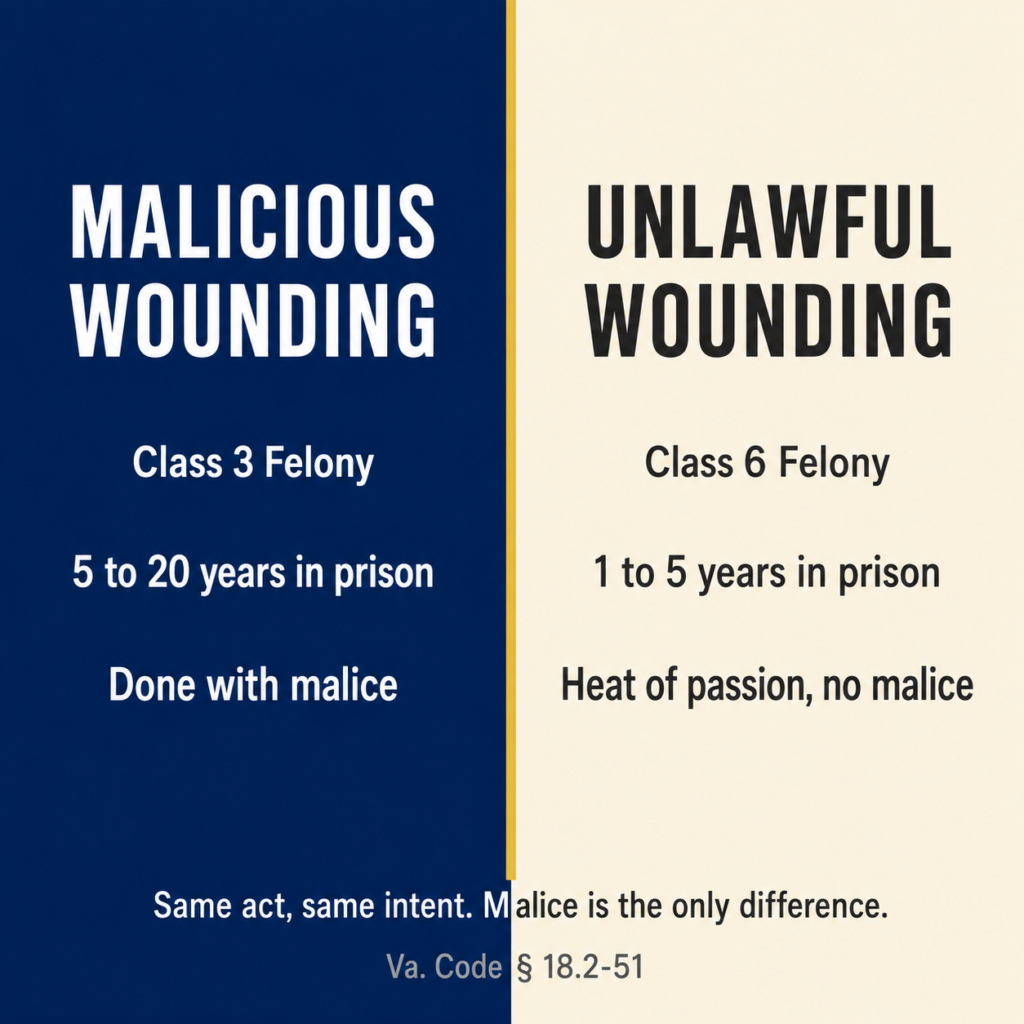
Malice is the only difference between malicious wounding and unlawful wounding. Both charges live in the same statute, require the same physical act, and require the same specific intent. If the act was done with malice, it is malicious wounding, a Class 3 felony carrying 5 to 20 years. If it was done without malice, in the heat of passion, it is an unlawful wounding charge, a Class 6 felony carrying 1 to 5 years.
This is the single most important line in the whole ladder, and it turns on two terms of art.
What counts as malice in a Virginia wounding case?
Malice is more than dislike or general anger. In Williams v. Commonwealth, 64 Va. App. 240 (2015), the Court of Appeals described malice as a wrongful act done intentionally, without just cause or excuse, flowing from a wicked or corrupt motive by a mind that is in control of reason but bent on harm. Virginia law also recognizes implied malice: the deliberate use of a deadly weapon in a way calculated to cause death or serious harm can let a jury infer malice on its own.
What is heat of passion in Virginia law?
Heat of passion arises when a person is provoked so strongly that rage, terror, or fear overcomes their reason and they act on impulse. It is the legal counterweight to malice. In Dandridge v. Commonwealth, 72 Va. App. 669 (2021), the Court of Appeals stated that malice and heat of passion are mutually exclusive, because malice excludes passion and passion presupposes the absence of malice. Two limits matter. The provocation has to be reasonable, meaning it would stir the same passion in an ordinary person, and the act has to follow closely in time. If the person had a cooling-off period to reflect, the law attributes the act to malice rather than passion.
Virginia’s Model Jury Instructions reflect this directly. A jury that finds the required intent but also finds the person acted in the heat of passion is instructed to convict of the lesser offense of unlawful wounding, not malicious wounding.
What is aggravated malicious wounding?
Aggravated malicious wounding is the most serious charge on the ladder. It is a Class 2 felony under Virginia Code § 18.2-51.2, punishable by 20 years to life in prison and a fine of up to $100,000.
This charge requires everything malicious wounding requires, plus a specific result: the victim must be severely injured and left with permanent and significant physical impairment. In Lamm v. Commonwealth, 55 Va. App. 637 (2010), the Court of Appeals defined that impairment broadly, as any physical condition, anatomic loss, or cosmetic disfigurement, and held that a jury can use its common sense to decide whether an injury is permanent. In Lamm, surgically implanted metal plates and lasting numbness were enough, even though the victim’s overall prognosis was described as good. The statute also provides that if the attack causes the involuntary termination of a woman’s pregnancy, that result is automatically treated as a severe and permanent impairment.
Is assault and battery a felony in Virginia?
Assault and battery is a misdemeanor in Virginia, not a felony. A standard assault and battery is a Class 1 misdemeanor under § 18.2-57, and a first or second domestic assault and battery against a family or household member is also a Class 1 misdemeanor.
It becomes a felony in narrower situations. A third domestic assault and battery within a 20-year period is a Class 6 felony under § 18.2-57.2, where the prior qualifying offenses can include earlier domestic assaults, malicious or unlawful wounding, aggravated malicious wounding, or strangulation. When a warrant issues for domestic assault and battery, a magistrate is also required to issue an emergency protective order in most cases. Anyone facing domestic assault charges should understand how those prior convictions and protective orders factor in.
How the same incident can be charged at different levels
One fight can support several different charges, and the charge depends on how the Commonwealth reads the intent and malice elements. Assault and battery is a lesser-included offense of malicious wounding. That means a jury hearing a malicious wounding case can convict on misdemeanor assault and battery instead if it decides the physical contact happened but the specific intent to maim was not proven.
The Class 6 felonies add another wrinkle. Both unlawful wounding and a third domestic assault and battery are “wobbler” offenses, where a jury or judge can impose a misdemeanor-length jail sentence even though the conviction itself stays a felony. A person can end up serving a short jail term while still carrying a permanent felony record, which is why the decision to accept a plea or take a case to trial deserves careful analysis. If you have been charged with a violent crime, the specific charge on the warrant is only the starting point.
Can a malicious wounding charge be reduced or dismissed?
A malicious wounding charge can be challenged, and in some cases amended to a lesser charge, though no outcome is ever guaranteed. Whether that happens depends on the evidence behind the disputed elements: the injury, the intent, and the malice.
It helps to understand how charges actually move in Virginia, because a few common assumptions are wrong:
- A victim cannot “drop” the charge. A crime in Virginia is an offense against the Commonwealth of Virginia, not against the individual. The Commonwealth’s Attorney controls the prosecution. A complaining witness can choose whether to go forward and cooperate, but the decision to continue or end the case belongs to the prosecutor, not the victim.
- Charges are amended, not “dropped.” When a prosecutor cannot prove malice or specific intent beyond a reasonable doubt, the charge is often amended downward, for example from malicious wounding to unlawful wounding, or to misdemeanor assault and battery, as part of a plea agreement.
- A full dismissal runs through the court. To dismiss a charge entirely, the prosecutor moves for a nolle prosequi under Virginia Code § 19.2-265.3, and the judge must approve it for good cause shown.
This is where trial readiness matters. When the defense is genuinely prepared to test the intent and malice elements in front of a jury, the Commonwealth has to weigh those weaknesses when deciding what charge it can sustain. Manuel Leiva has more than 25 years of jury trial experience in serious violent-crime cases, including malicious wounding, and that preparation is what gives an overcharged case room to be challenged or amended rather than simply pleaded out.
Collateral consequences of a felony wounding conviction
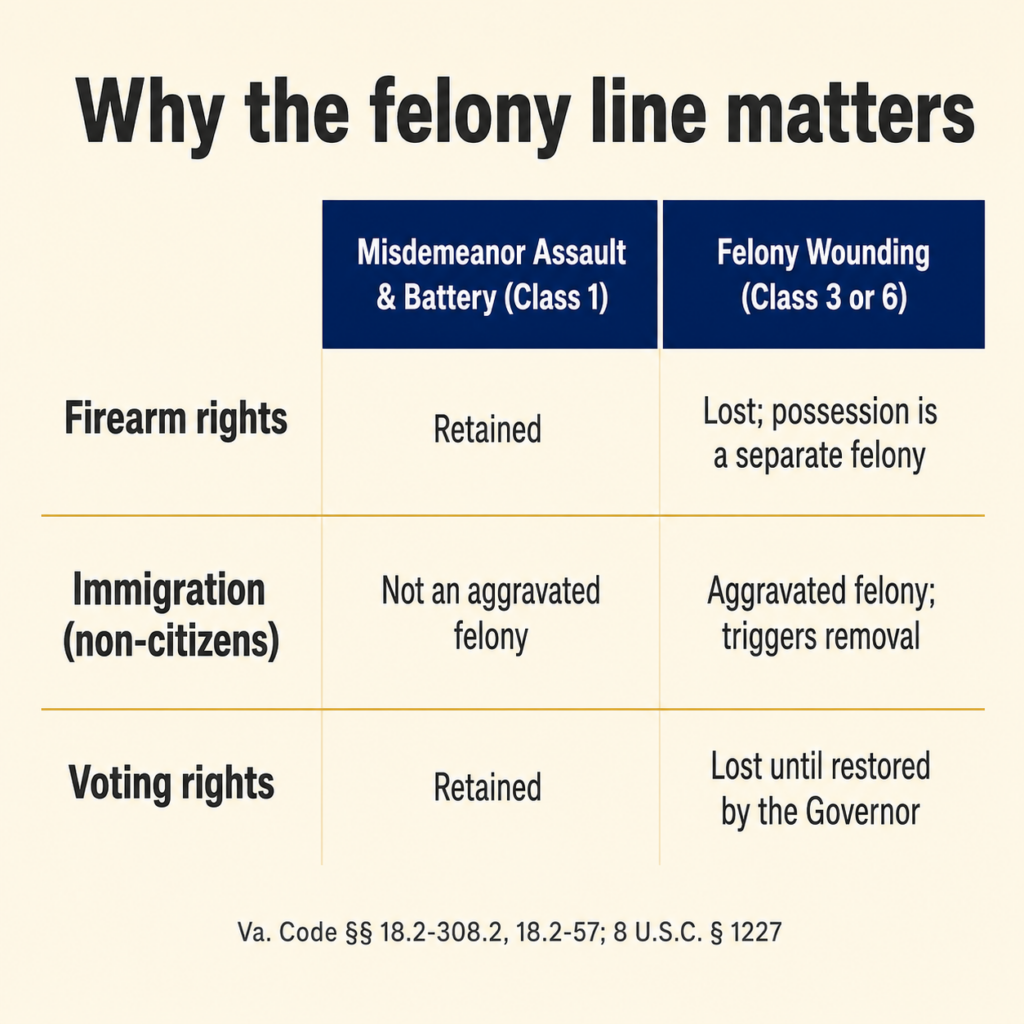
The penalty range is only part of the picture. A felony conviction under § 18.2-51 or § 18.2-51.2 carries consequences that outlast any jail or prison term, and this is one of the biggest practical reasons the misdemeanor-versus-felony line matters so much.
Firearm rights
Under Virginia Code § 18.2-308.2, a convicted felon cannot possess, transport, or carry a firearm, and a violation is a separate felony. Restoring that right is a two-step process. The Governor can restore civil rights such as voting, but the Governor cannot restore firearm rights. After the civil rights are restored, the person has to file a separate petition in Circuit Court, which decides whether to grant it.
Immigration consequences for non-citizens
For non-citizens, including green card holders and visa holders, a wounding conviction is especially serious. Federal courts have held that both malicious wounding and unlawful wounding in Virginia qualify as a crime of violence and an aggravated felony under federal immigration law. The Fourth Circuit reached that conclusion for malicious wounding in United States v. Alas (2023) and for unlawful wounding in Moreno-Osorio v. Garland (2021). A conviction can trigger deportation proceedings and bar most forms of immigration relief. A misdemeanor assault and battery and a felony wounding conviction carry very different immigration consequences, and for many non-citizens in Northern Virginia, that gap can be the difference between keeping a green card and facing removal. We represent clients in both English and Spanish across Fairfax, Arlington, Alexandria, Loudoun, and Prince William.
How Virginia sentences violent felonies
The statutory ranges are the ceiling. Two features of Virginia law shape what a sentence actually looks like. Virginia abolished parole in 1995, so a person convicted of a felony must serve at least 85% of any active sentence. And the Virginia Criminal Sentencing Commission applies steep enhancements for violent crimes: under Virginia Code § 17.1-805, the midpoint of the recommended range for malicious wounding or aggravated malicious wounding is increased by 100% for a defendant with no prior violent felony, and by 300% for a defendant who has one. Even a first offense carries guideline recommendations weighted toward years of active time.

Talk to a Northern Virginia violent crime defense lawyer
If you or a family member is facing assault and battery, unlawful wounding, malicious wounding, or aggravated malicious wounding in Northern Virginia, the charge on the warrant is not the final word. These cases turn on a handful of specific elements, and where those elements are in dispute, the charge can be challenged or amended. We have defended these cases for more than 25 years in courts across Fairfax, Arlington, Alexandria, Loudoun, and Prince William, in both English and Spanish. Contact The Leiva Law Firm to discuss your case and your options.

