




Sex Crime Charges in Virginia: Penalties, Classifications, and the Registry
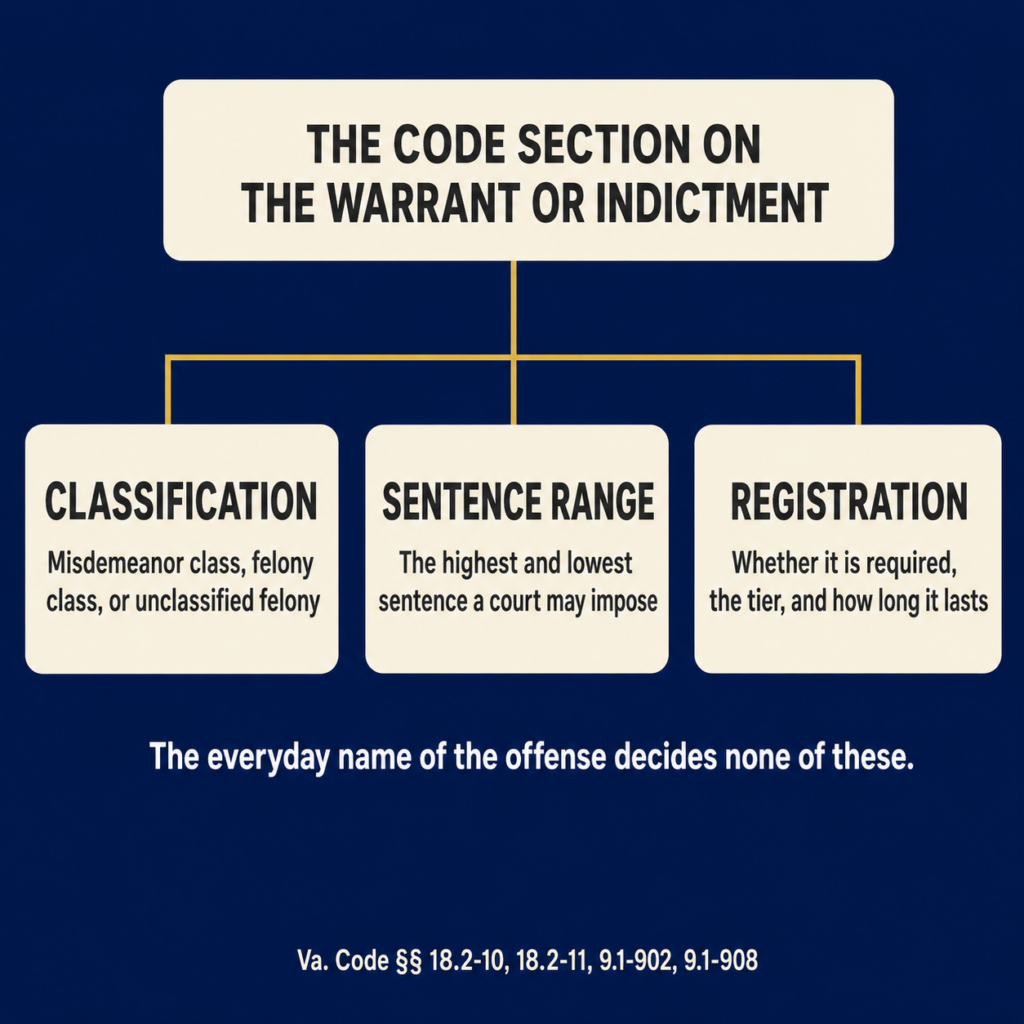
In Virginia, “sex crime charges” covers a wide range of offenses. At one end is sexual battery, a Class 1 misdemeanor punishable by up to 12 months in jail and/or a fine of up to $2,500. At the other end are rape, forcible sodomy, and object sexual penetration, each punishable by five years to life in prison. Where your charge falls on that range is set by the code section written on your warrant or indictment rather than by the everyday name for the offense.
At The Leiva Law Firm, we defend people charged with sex offenses in Northern Virginia, in Arlington, Alexandria, Fairfax, Loudoun, and Prince William , and we represent individuals charged with federal offenses in the Eastern District of Virginia. Manuel Leiva has been licensed in Virginia since 1998 and has tried cases before Northern Virginia juries, including murder cases.
The main sex offense charges in Virginia, and what each one carries
| Charge | Code section | Classification | Penalty | Registration required |
|---|---|---|---|---|
| Rape | § 18.2-61 | Unclassified felony | Five years to life | Yes, Tier III, for life |
| Forcible sodomy | § 18.2-67.1 | Unclassified felony | Five years to life | Yes, Tier III, for life |
| Object sexual penetration | § 18.2-67.2 | Unclassified felony | Five years to life | Yes, Tier III, for life |
| Aggravated sexual battery | § 18.2-67.3 | Unclassified felony | One to 20 years and a fine of up to $100,000 | Yes, Tier III, for life |
| Sexual battery | § 18.2-67.4 | Class 1 misdemeanor | Up to 12 months in jail and/or a fine of up to $2,500 | Not on a first conviction, unless the accused was 18 or older and the victim was under six, which is a Tier III offense. A third or subsequent conviction is a Tier I offense |
| Carnal knowledge of a child 13 or 14 | § 18.2-63 | Class 4 felony. Subsection B sets lower classifications where the child consented and the accused is a minor | Two to 10 years and a fine of up to $100,000 | Yes. Tier III, for life, where the conviction is under subsection A and the accused is more than five years older than the child. Tier I otherwise |
| Taking indecent liberties with children | § 18.2-370 | Class 5 felony. Class 4 for a second or subsequent violation | One to 10 years, or up to 12 months in jail and/or a fine of up to $2,500 | Yes, Tier III, for life |
| Taking indecent liberties with a child by a person in a custodial or supervisory relationship | § 18.2-370.1 | Class 6 felony. Class 5 for a second or subsequent violation | One to five years, or up to 12 months in jail and/or a fine of up to $2,500 | Yes, Tier III, for life |
| Possession of child pornography | § 18.2-374.1:1(A) | Class 6 felony. Class 5 for a second or subsequent violation | One to five years, or up to 12 months in jail and/or a fine of up to $2,500 | Yes, Tier I |
| Reproduction, sale, distribution, transmission, or display of child pornography | § 18.2-374.1:1(C) | Unclassified felony | Five to 20 years. A second or subsequent violation carries a five-year mandatory minimum sentence | Yes, Tier II |
| Use of communications systems to facilitate certain offenses involving children | § 18.2-374.3 | Class 6 felony under subsection B. Class 5 felony under subsections C, D, and E. Class 1 misdemeanor under subsection D1 | See the note below | Yes. Tier I under subsection B, Tier II under subsections C, D, and E. Section 9.1-902 does not list subsection D1 |
| Unlawful creation of image of another | § 18.2-386.1 | Class 1 misdemeanor. Class 6 felony where the person in the image is younger than 18 | Up to 12 months in jail and/or a fine of up to $2,500. The felony carries one to five years, or the same jail and fine | Not on a first conviction. A third or subsequent conviction is a Tier I offense |
| Unlawful dissemination or sale of images of another | § 18.2-386.2 | Class 1 misdemeanor | Up to 12 months in jail and/or a fine of up to $2,500 | Not on a first conviction. A third or subsequent conviction committed on or after July 1, 2020 is a Tier I offense |
Source: Code of Virginia, Title 18.2 and § 9.1-902
Five of the offenses above carry no class. Rape, forcible sodomy, object sexual penetration, aggravated sexual battery, and distribution of child pornography are unclassified felonies, so the range is written into the offense statute itself. Where a charge does carry a class, its range comes from § 18.2-10 for felonies and § 18.2-11 for misdemeanors.
Several of these offenses carry a mandatory minimum sentence, and when a statute sets one, the judge cannot suspend any part of that sentence (§ 18.2-12.1). Under §§ 18.2-61, 18.2-67.1, and 18.2-67.2, the mandatory minimum sentence is life where the child was under 13 and the indictment alleges the accused was 18 or older.
The penalties under § 18.2-374.3 depend on the subsection. Subsection B carries one to five years in prison, and subsections C, D, and E carry one to 10 years, each with the alternative of up to 12 months in jail and/or a fine of up to $2,500. Under subsection C, where the accused is at least seven years older than a child he knows or has reason to believe is under 15, the range is five to 30 years with a five-year mandatory minimum sentence. Subsection D1 carries up to 12 months in jail and/or a fine of up to $2,500.
Will a conviction put you on the sex offender registry?
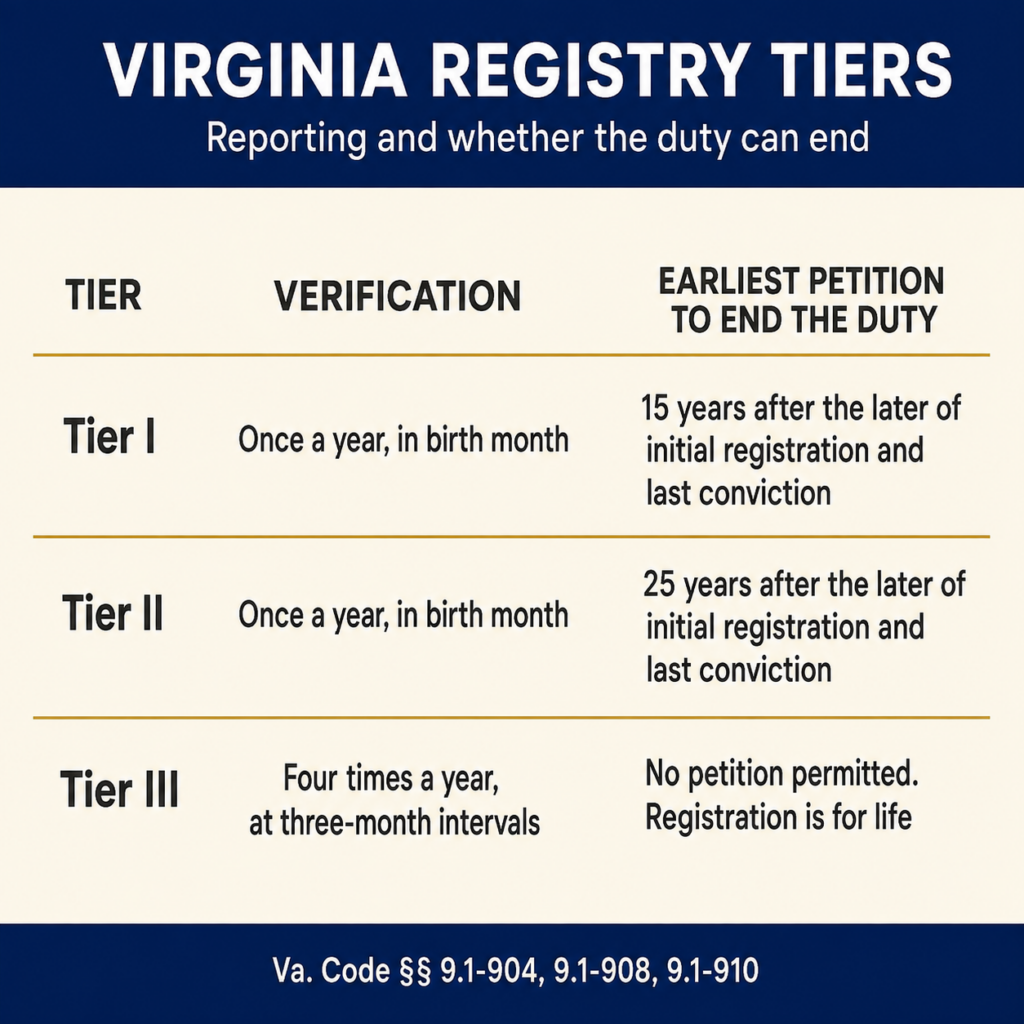
For most of these charges, yes. Va. Code § 9.1-902 lists the convictions that require registration and sorts them into Tier I, Tier II, Tier III, and Murder, so the tier is decided by the section you are convicted under, not by a judge’s assessment of you.
Being charged does not put you on the registry. Under § 9.1-901, the duty attaches on a conviction, a juvenile finding of delinquency, or a finding of not guilty by reason of insanity, in each case of an offense set forth in § 9.1-902. A pending case creates no registration duty.
The registration column in the table above gives the tier for each charge. How long you have to remain on the registry depends on the conviction.
A Tier III conviction or a murder conviction carries a duty to reregister for life (§ 9.1-908). Tier I and Tier II carry no end date either, and those registrants keep reregistering until a circuit court terminates the duty.
A person convicted of a single Tier I offense may petition a circuit court to end the duty 15 years after the later of the date of initial registration and the date of the last conviction, and a single Tier II offense carries a 25-year requirement (§ 9.1-910). The court grants the petition only if it finds that the person no longer poses a risk to public safety.
Four groups cannot petition at all: a person convicted of a Tier III offense, of murder, of two or more offenses requiring registration, or under former § 18.2-67.2:1. For them, registration is permanent.
What happens after you’re arrested for a sex crime in Virginia
The bail decision and the conditions that come with release
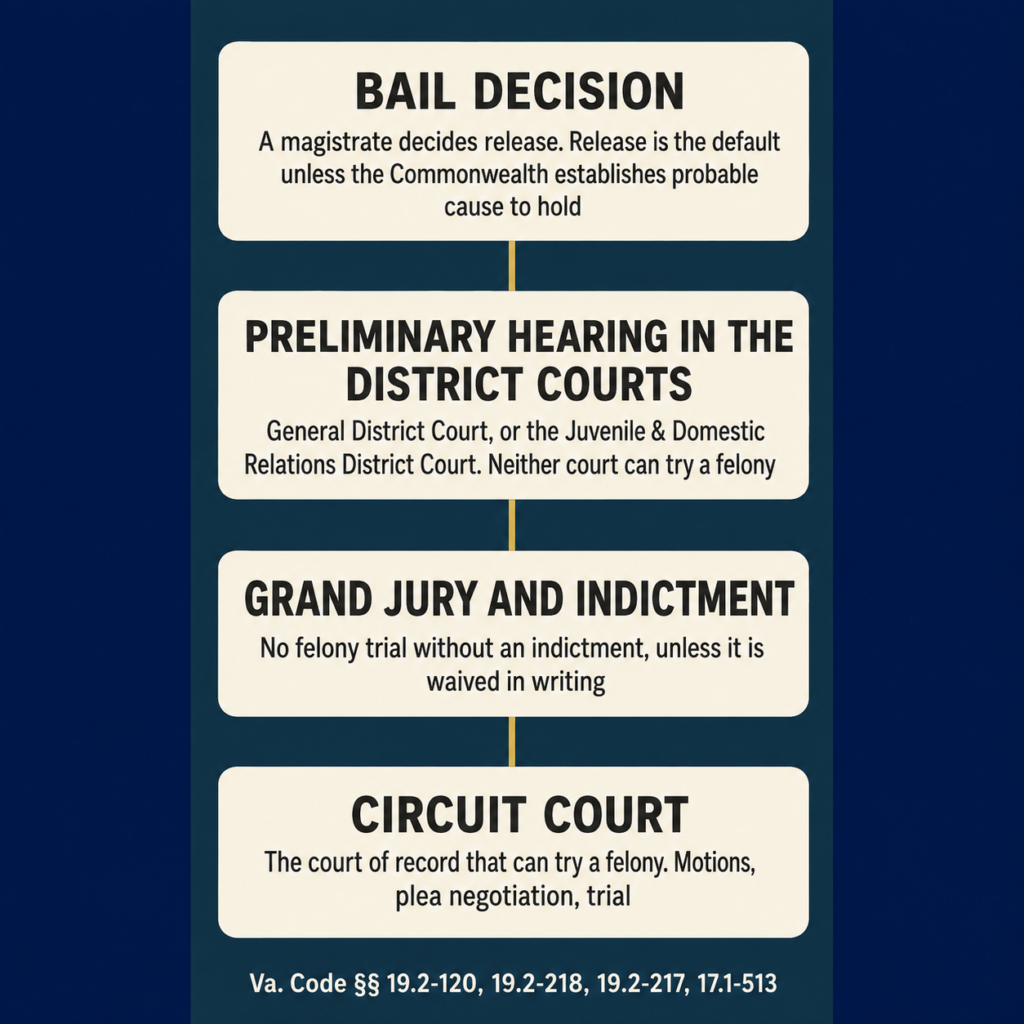
The first decision is about release, and a judicial officer, usually a magistrate, makes it soon after the arrest. Virginia’s bail statute, § 19.2-120, begins with release as the default. A person held in custody pending trial shall be admitted to bail unless there is probable cause to believe that he will not appear for trial, or that his liberty will constitute an unreasonable danger to himself, to family or household members, or to the public. The Commonwealth has to establish probable cause on one of those two grounds to keep someone in custody.
Subsection C directs the judicial officer to consider all relevant information, including the nature and circumstances of the offense and the accused person’s record of convictions. In practice, a person’s prior criminal record, especially for violent crimes, is strongly considered in determining a danger to the community.
A judicial officer who admits a person to bail may also attach conditions under § 19.2-123. These govern daily life while the case is pending:
- Restrictions on travel, association, or place of abode, and restricted contact with household members for a specified period of time.
- Avoiding all contact with an alleged victim and with any potential witness who may testify concerning the offense.
- A specified curfew.
- No firearm or other dangerous weapon.
- No excessive use of alcohol, and no illegal drug or controlled substance not prescribed by a health care provider.
- Testing for drugs and alcohol until the final disposition of the case.
From the District Courts to Circuit Court
The code section on the warrant, rather than the name of the offense, sets the sentence range and controls whether a conviction requires registration. A felony charge starts in one of Virginia’s District Courts, and neither of those courts can try a felony (§ 17.1-513) or convict you of a felony. A felony in which one family or household member is charged with an offense against another starts in the Juvenile & Domestic Relations District Court, as does any charge against a juvenile (§ 16.1-241). Every other felony charge starts in the General District Court.
Under § 19.2-218, a person arrested on a felony charge cannot be denied a preliminary hearing unless he waives it in writing. Under § 19.2-217, no person may be put on trial for a felony unless a grand jury has first returned an indictment, or the person waives indictment in writing.
The circuit court is the court of record that can try a felony, and it is where the plea negotiation and the trial happen. If you hire an attorney with little or no trial experience, the prosecutor will expect that your attorney is not going to try the case, and the plea offer will reflect that.
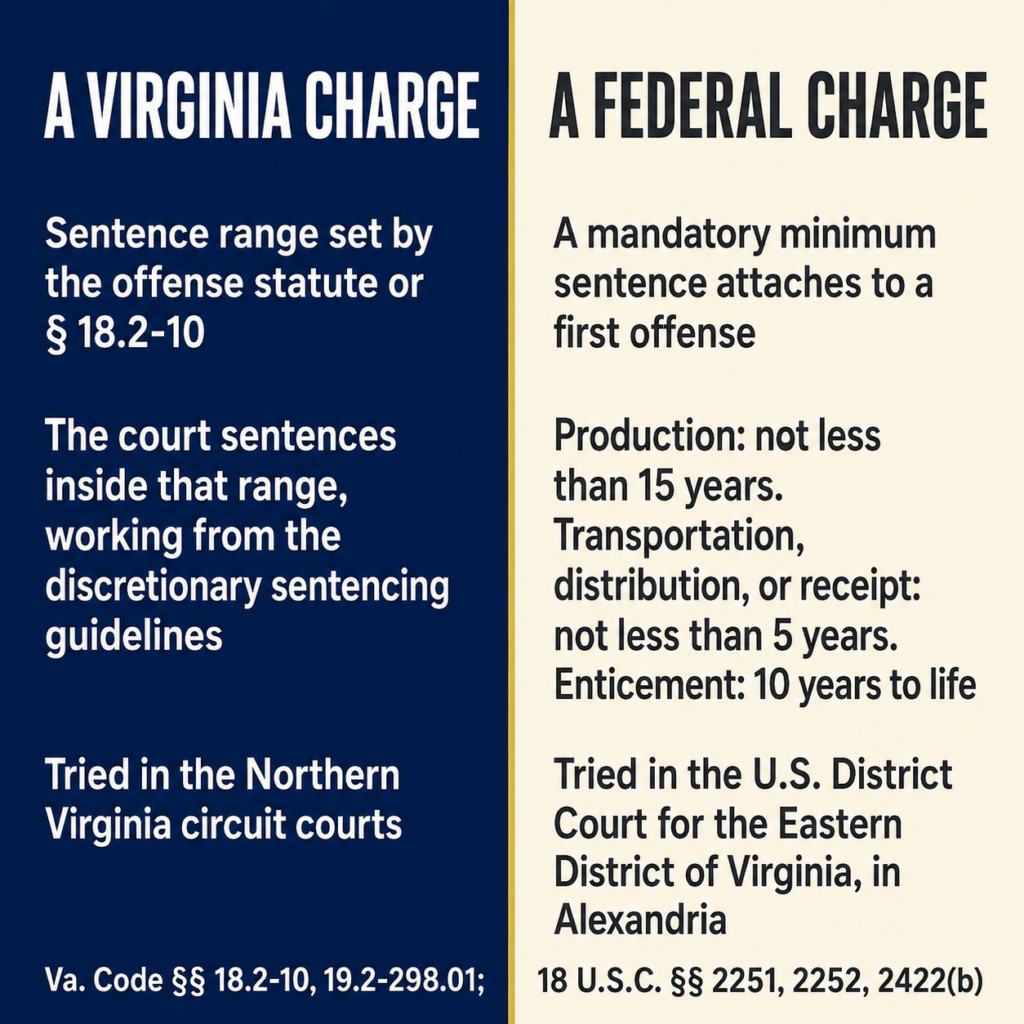
Inside the statutory range, the judge works from Virginia’s discretionary sentencing guidelines, and a court that imposes a sentence greater or less than the one they indicate must file a written explanation of the departure (§ 19.2-298.01).
What is at stake beyond the sentence
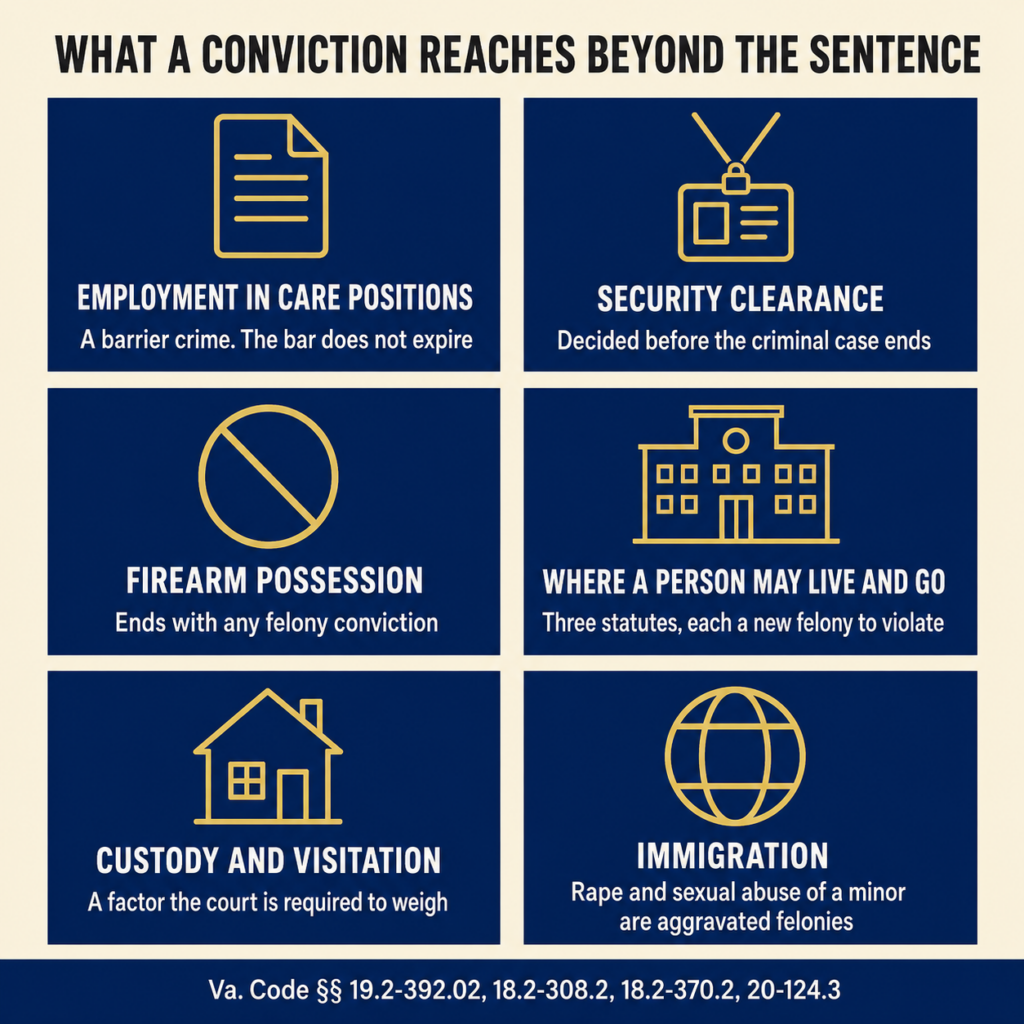
A conviction reaches parts of your life that the sentence itself does not touch.
- Work with children, the elderly, or people with disabilities. A conviction that requires registration is a barrier crime under § 19.2-392.02, so when an organization that provides care to those groups runs a background check, it is notified that you are not qualified for a position involving unsupervised access. Other felonies stop counting as barrier crimes five years after the conviction. These offenses never stop counting.
- A security clearance. Clearance eligibility is decided under the National Security Adjudicative Guidelines, and Guideline J reaches evidence of criminal conduct “regardless of whether the individual was formally charged, prosecuted, or convicted.”
- Firearm rights. Under § 18.2-308.2, it is unlawful for a person convicted of a felony to knowingly and intentionally possess or transport a firearm or ammunition, and a violation is itself a Class 6 felony.
- Where you can live and where you can go. A separate set of statutes restricts where certain offenders may reside and where they may go, and violating one of them is a new Class 6 felony (§ 18.2-370.3, § 18.2-370.2).
- School property. Under § 18.2-370.5, an adult convicted of a Tier III offense may not be on school property during school hours or during school-sponsored activities unless the circuit court grants permission on his petition.
- Custody and visitation. Va. Code § 20-124.3 lists the factors a court must consider in deciding a child’s best interests, and one of them is any history of sexual abuse. The statute does not say a conviction ends custody or visitation, and it makes that history a factor the court is required to weigh.
- Immigration status. Federal law defines “aggravated felony” to include murder, rape, and sexual abuse of a minor (8 U.S.C. § 1101(a)(43)(A)), and an aggravated felony conviction makes a person deportable and closes off most forms of relief from removal. Anyone who is not a citizen, including a lawful permanent resident, needs immigration counsel from the beginning.
When a sex offense case becomes a federal case
Some of this conduct violates federal law as well as Virginia law, and internet cases are the ones most likely to be charged federally. Federal jurisdiction attaches when the conduct crosses state lines or uses a facility of interstate commerce, which for online conduct includes the Internet and the mail. Prison time is different in federal court. The main federal child exploitation statutes attach a mandatory minimum sentence to a first offense: 15 years for production under 18 U.S.C. § 2251, and five years for transportation, distribution, or receipt under 18 U.S.C. § 2252.
If you have been accused and no one has charged you yet
An investigation can run for a long time before anyone is charged. A detective calls and asks you to come in and clear something up. Someone asks for consent to search you, your phone, your electronic devices, your car, or your home. None of that requires a charge, and none of it requires a warning first.
Miranda warnings are required only for questioning after a person has been taken into custody or otherwise deprived of his freedom of action in any significant way (Miranda v. Arizona, 1966). In Oregon v. Mathiason (1977), the Supreme Court held that a man who came to a police station on his own, was told there that he was not under arrest, and was free to leave was not in custody, so no warnings were required. In a consensual encounter, an officer is not required to provide you with Miranda warnings, and what you say can still be used against you.
Manuel Leiva puts the point plainly: “You are under no legal obligation to talk to the police.” He adds, “The best thing to do is talk to a lawyer first or have a lawyer present with you when you talk to the police.” Once we notify the law enforcement agency and the prosecutor that you are represented, the questions come to us instead of to you.
Frequently asked questions
Can a sex crime charge in Virginia be dismissed before trial?
Yes, and a felony charge is reviewed twice before it can be tried. Under § 19.2-186, the District Court judge discharges the accused at the preliminary hearing if he/she considers that there is not sufficient cause for charging him, and under § 19.2-191 if a grand jury fails to return an indictment where it finds no sufficient probable cause. Which challenges are available depends on the charge and the evidence, and that is the first thing we go through with a client in a sex offense case.
Does the accuser decide whether a sex crime case goes forward?
No. The prosecutor decides what to charge and whether to continue with the case. The accuser, called the complaining witness in court, can cooperate and go forward as a witness, but does not control the charge, so a case can continue even after the complaining witness asks for it to stop.
Is a first sex offense charge treated differently in Virginia?
There is no first time offender exception in Virginia for sex offenses. A conviction of an offense listed in § 9.1-902 requires registration. Three charges in the table are the exception. A first conviction of § 18.2-386.1 or § 18.2-386.2 does not require registration, and neither does a first conviction of sexual battery, unless the accused was 18 or older and the victim was under six, which § 9.1-902 makes a Tier III offense.
Talk to us about your case
If you have been charged with a sex offense in Northern Virginia, or a detective has contacted you about one, we would rather hear from you before an interview happens or the police conduct a sting call against you. We handle these cases in Fairfax and Reston and in the Arlington, Alexandria, Loudoun, and Prince William courts, and we represent individuals charged with federal offenses in the Eastern District of Virginia, in English and in Spanish.
When you call, Manuel Leiva’s assistant takes down the basic information, and Manuel Leiva calls you back himself, usually within hours and within 24 hours at most. For a serious felony charge, we then schedule an in-depth consultation, which carries a fee of $300 to $400 and runs a full hour, and in that hour he gives you his honest assessment of the case and the defense options.
Call our Fairfax office at (703) 352-6400 or contact us to schedule a consultation.

