



What You Need to Prove in a Virginia Slip and Fall Case
To have a slip and fall case in Virginia, you have to prove that the property owner owed you a duty of care, that the owner knew or should have known about the dangerous condition that made you fall, and that the owner failed to fix it or warn you about it. You also have to prove that the fall caused your injuries. Virginia adds a rule that most states do not have, called contributory negligence. If the owner proves that your own carelessness contributed to the fall, you cannot recover anything, even if the owner was more at fault.
At The Leiva Law Firm, we represent people hurt in falls caused by uneven surfaces, broken flooring, poor lighting, and other unsafe conditions on someone else’s property. Every one of those claims depends on proving the same elements.
What Do You Need to Prove in a Slip and Fall Case?
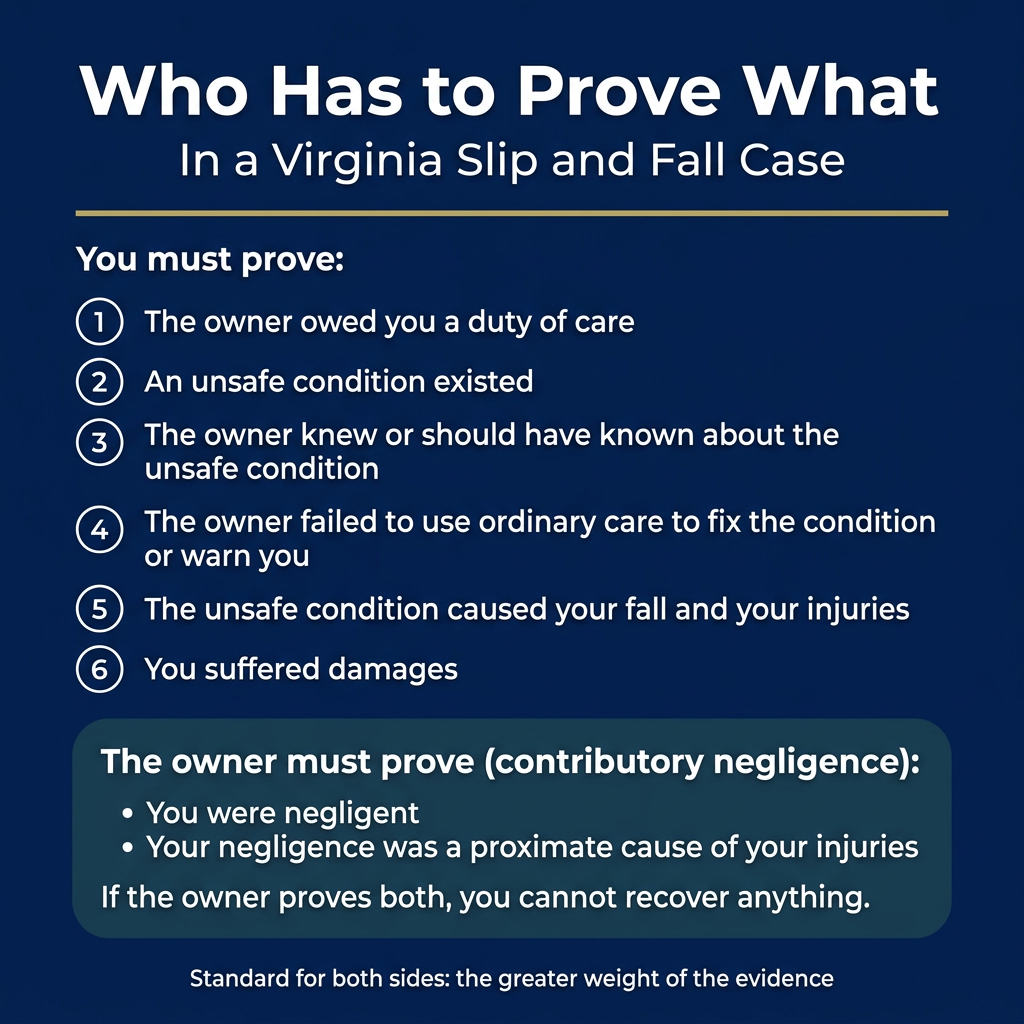
You need to prove that the property owner was negligent and that the owner’s negligence caused your injuries. In Virginia, that means proving each of these elements:
- The owner owed you a duty of care, meaning the law required the owner to take certain steps for your safety. The steps depend on whether you were a business customer or a social guest.
- There was an unsafe condition on the property, such as a spill or a loose step.
- The owner knew about the unsafe condition or should have known about it.
- The owner failed to use ordinary care to fix the condition or warn you about it.
- The unsafe condition caused your fall and your injuries.
- You suffered damages because of those injuries.
You carry the burden of proof on each element. The standard is the greater weight of the evidence. It means the jury has to find your evidence on each element more persuasive than the evidence against it.
Did the Property Owner Owe You a Duty?
The duty the owner owed you depends on why you were on the property. Virginia premises liability law decides when a property owner is responsible for an injury on the property. Under that law, a business customer is owed more care than a social guest. The Supreme Court of Virginia set out both duties in Tate v. Rice (1984).
| Visitor status | Who fits | Duty the owner owes |
|---|---|---|
| Invitee | A business customer, such as a shopper in a store, a diner in a restaurant, or a customer crossing a business’s parking lot | Use ordinary care to keep the premises reasonably safe, and warn of unsafe conditions the owner knew about or should have known about, unless those conditions are open and obvious, meaning a reasonable person would have seen them |
| Licensee or social guest | A social guest, such as a friend invited to someone’s home, or another person on the property with permission who is not there as a business customer | No duty to keep the property safe for the guest. The owner is liable only for failing to warn of a hidden danger the owner knew or had reason to know about, for carelessness in the owner’s own activities (called active or affirmative negligence), or for willful or wanton conduct, which is more serious than ordinary carelessness |
The owner does not owe you compensation just because you fell on the property, even if you were an invitee. An owner does not have to guarantee a customer’s safety (Roll ‘R’ Way Rinks, Inc. v. Smith, 1977). The owner is responsible only for failing to use ordinary care. That is why a customer’s case depends on what the owner knew about the hazard and what the owner did about it.
What If You Fell at a Friend’s or Neighbor’s Home?
If you fell at a friend’s or neighbor’s home, you were a social guest. The host, meaning the owner or occupant of the home, owed you a narrower duty than a business owes its customers. A host has no duty to keep the home safe for a guest, under Busch v. Gaglio (1966). When a condition of the property caused your fall, such as a loose step, the host is liable in only two situations: the host failed to warn you about a danger you were not expected to discover, or the host’s conduct was willful or wanton. Willful or wanton conduct is more serious than ordinary carelessness.
To prove a failure to warn, you would have to show that:
- The host knew about the dangerous condition, or had reason to know about it.
- The host should have realized the condition was unreasonably risky and should have expected that you would not discover the danger.
- The host did not use reasonable care to make the condition safe or to warn you.
- You did not know about the condition or the risk, and had no reason to know.
A different rule applies when something the host was doing caused your injury, rather than the condition of the property. A host’s own activities are judged by reasonable care under the circumstances, as the Supreme Court of Virginia held in Bradshaw v. Minter (1965). Courts call a failure of that care active or affirmative negligence.
The business-customer rules on notice and open and obvious hazards do not govern a guest’s claim about the condition of the property. A guest’s claim depends instead on the failure-to-warn rule: what the host knew or had reason to know, and whether you knew about the danger yourself. The causation requirement and the two-year filing deadline apply to a social guest’s claim the same way they apply to a customer’s. Virginia’s contributory negligence rule also applies to a guest’s claim that the host was negligent. Under Virginia’s model jury instructions, a host whose conduct was willful or wanton cannot use contributory negligence as a defense unless your own conduct was also willful or wanton.
Did the Owner Know About the Hazard, or Should the Owner Have Known?
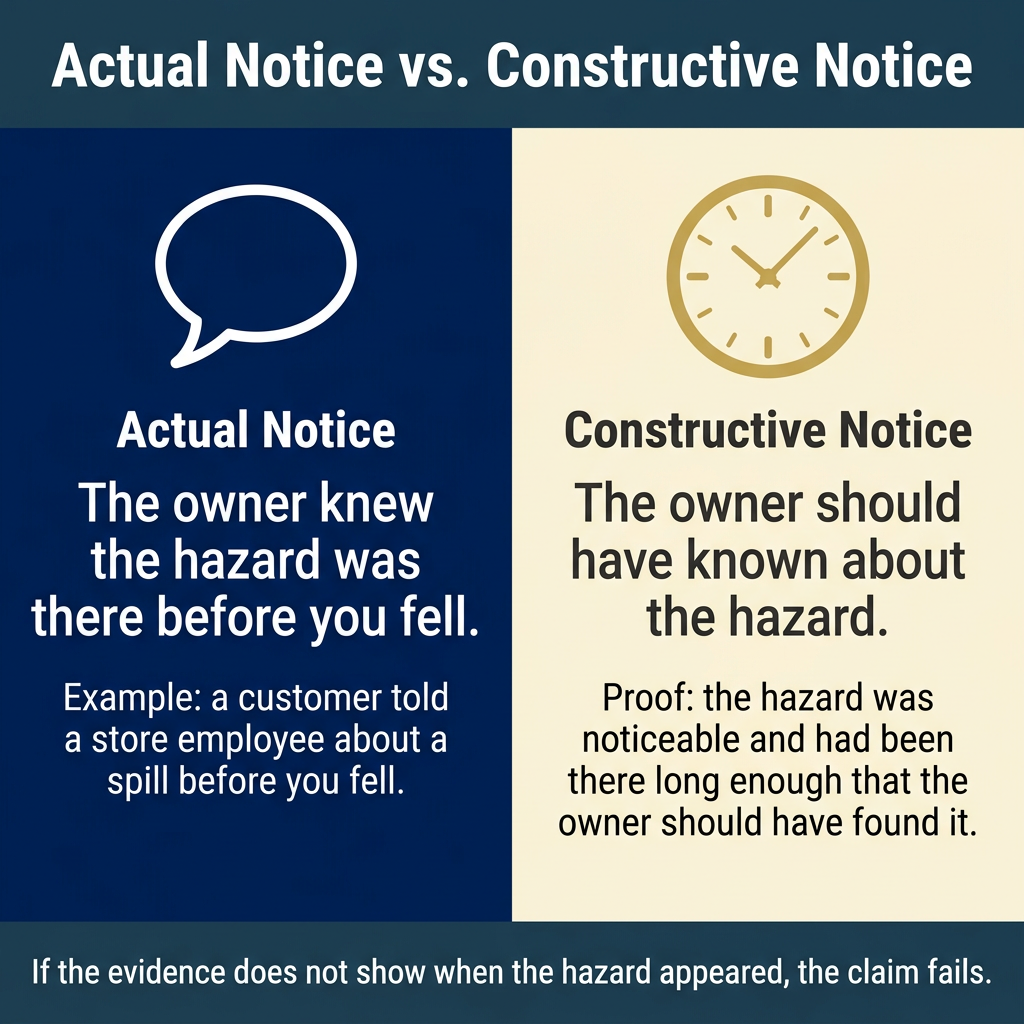
If you were a business customer, you have to prove that the owner knew about the unsafe condition, or should have known about it, before you fell. The Supreme Court of Virginia stated this requirement in Colonial Stores, Inc. v. Pulley (1962). Courts call it notice, and it can be actual or constructive.
What Is Actual Notice?
Actual notice means the owner knew the hazard was there before you fell. For example, if a customer told a store employee about a spill and the spill was still on the floor when you fell, that report is evidence the store knew about it.
What Is Constructive Notice?
Constructive notice means the owner should have known about the hazard, even if nobody told the owner it was there. You prove constructive notice with evidence that the hazard was noticeable and had been there long enough that the owner should have found it (Grim v. Rahe, Inc., 1993). If the evidence does not show when the hazard appeared, the claim fails. The Supreme Court of Virginia explained that, without that evidence, the owner would be paying for customers’ injuries whether or not the owner had been careless.
What If the Owner Created the Hazard?
When the hazard comes from the way the owner runs the business, you still have to prove notice. The proof can be that the owner’s own setup made the hazard foreseeable, meaning the owner could expect it to happen. In Memco Stores, Inc. v. Yeatman (1986), a store displayed a plant that shed onto the floor beside a walkway, and a customer was hurt in a fall there. Because the store set up the display, it could expect pieces of the plant to end up in the walkway. The Supreme Court of Virginia held that the store’s own display was enough to show constructive notice. The customer did not have to prove how long the fallen pieces of the plant had been on the floor.
The foreseeability rule does not apply when customers or other people create the hazard. In Ashby v. Faison & Associates, Inc. (1994), water tracked in by others collected on a lobby floor, and there was no evidence the owner did anything to cause it. For that reason, the Supreme Court of Virginia held that the foreseeability rule did not apply. A hazard that customers or other people create is judged under the constructive notice rule, which asks whether the hazard had been there long enough that the owner should have found it.
What If the Hazard Was Open and Obvious?
If you were a business customer and the hazard was open and obvious, the owner did not have to warn you about it. That means you cannot base your claim on the owner’s failure to warn you about that hazard. A hazard is open and obvious when a reasonable person using ordinary care for his or her own safety would have seen it. The Supreme Court of Virginia stated this rule in Fobbs v. Webb Bldg. Ltd. Partnership (1986).
A judge decides whether a hazard was open and obvious only when the evidence allows just one answer. When the evidence is disputed, for example because the lighting was poor or the hazard blended in with its surroundings, the jury decides. That rule comes from Bassett Furniture Industries, Inc. v. McReynolds (1976). Photos and other evidence showing poor lighting or a hazard that was hard to see can therefore stop a judge from deciding the question against you.
Is Virginia a Contributory Negligence State?
Yes, Virginia is a contributory negligence state. Any negligence on your part that was a proximate cause of the accident, meaning one of the causes that led directly to it, bars you from recovering anything. That is true even if the owner was more at fault than you were. The rule is stated in Virginia’s model jury instructions, the instructions Virginia judges use to explain the law to a jury in a civil case.
Virginia’s model jury instructions also place the burden of proving contributory negligence on the owner. The owner has to prove, by the greater weight of the evidence, that you were negligent and that your negligence was a proximate cause of your injuries. To meet that burden, the property owner and the property owner’s insurance carrier point to conduct such as:
- Looking at your phone while walking
- Wearing shoes that were unsafe for the walking surface
- Walking past a warning sign, such as a wet floor sign
- Missing a hazard that was in plain view
Sometimes a judge decides contributory negligence without a jury. A person who knows about a condition, forgets about it without a reasonable excuse, and then falls on it is contributorily negligent as a matter of law (Scott v. City of Lynchburg, 1991). “As a matter of law” means the judge decides the question. Because Virginia bars recovery for contributory negligence, the claim ends there.
Most states use comparative fault instead, which reduces what the injured person can recover rather than barring the claim. Only four states still bar all recovery when the injured person’s own negligence helped cause the injury: Alabama, Maryland, North Carolina, and Virginia. The District of Columbia follows the same rule, except for pedestrians and cyclists hurt in motor vehicle accidents. In D.C., a pedestrian or cyclist hurt in a motor vehicle accident can still recover if he or she was 50% or less at fault.
How Do You Prove the Fall Caused Your Injuries?
You have to show that the fall was a proximate cause of your injuries. Under Virginia’s model jury instructions, that means the fall was one of the causes that led directly to your injuries. Medical records are how you make that connection. They document the injury and link it to the fall.
What Damages Can You Recover?
If you prove every element, you can recover damages, meaning money for the losses the fall caused. The categories a Virginia jury considers are listed in the model jury instruction on personal injury damages:
- Bodily injuries and their effect on your health
- Physical pain and mental anguish, past and future
- Disfigurement or deformity
- Inconvenience, past and future
- Medical expenses, past and future
- Lost earnings
- Loss of future earning capacity
What Evidence Is Needed in a Slip and Fall Case?
A slip and fall case needs evidence for each element you have to prove, and for answering the owner’s arguments that the hazard was open and obvious or that you were careless.
| Issue in the case | Evidence that addresses it |
|---|---|
| An unsafe condition existed | Photos of the hazard and the area around it; the incident report |
| The owner knew or should have known about the unsafe condition | Surveillance video; names and contact details of witnesses who saw the hazard before the fall |
| The owner’s argument that the hazard was open and obvious | Photos showing the lighting and how visible the hazard was |
| The owner’s argument that you were careless (contributory negligence) | The shoes you were wearing; surveillance video of the fall; names and contact details of witnesses |
| The fall caused your injuries and your damages | Medical records |
How Long Do You Have to File a Slip and Fall Lawsuit in Virginia?
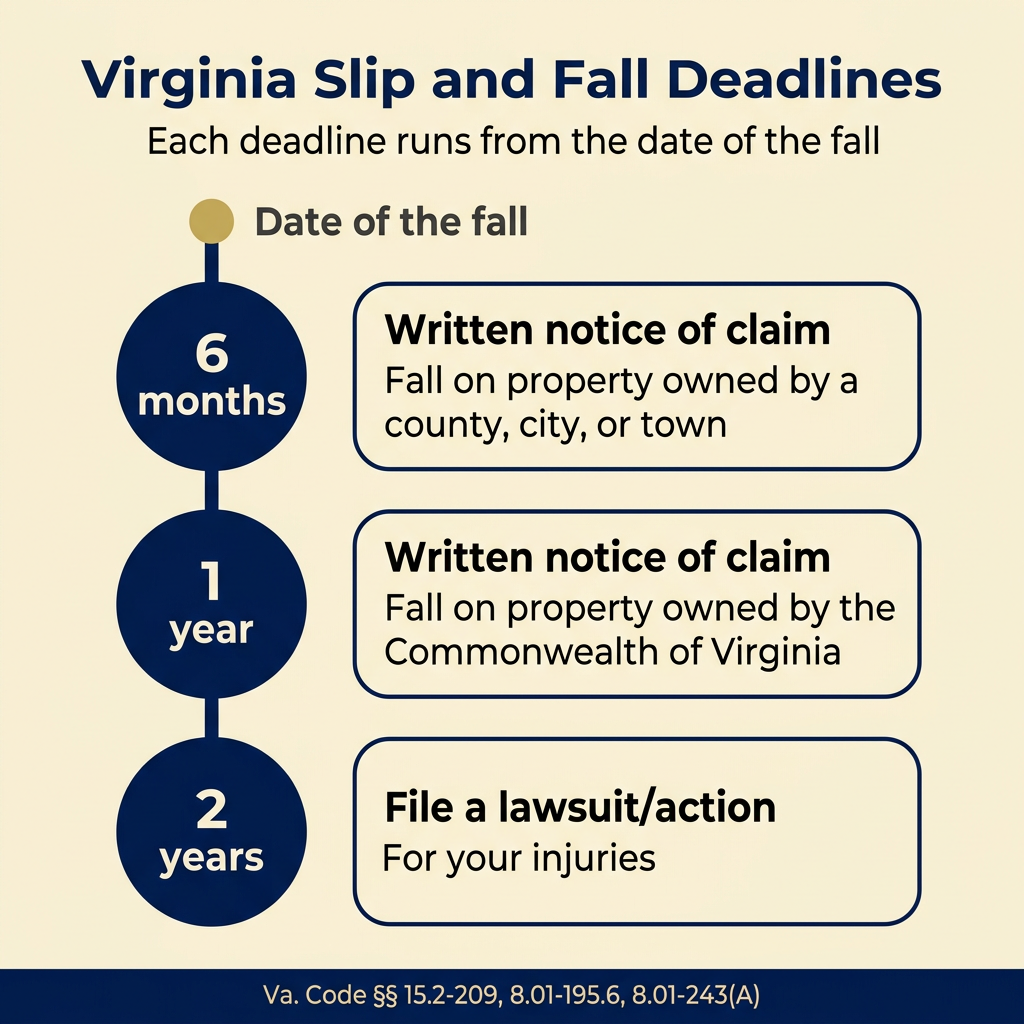
You have two years from the date of the fall to file a lawsuit/action for your injuries under Va. Code § 8.01-243(A). A fall on government property adds a shorter deadline for a written notice of claim.
If you fell on property owned by a county, city, or town, Va. Code § 15.2-209 requires a written notice of claim within six months of the fall, filed with the county, city, or town attorney, or with the chief executive or mayor.
If you fell on property owned by the Commonwealth of Virginia, Va. Code § 8.01-195.6, part of the Virginia Tort Claims Act, requires a written notice of claim within one year of the fall, filed with the Director of the Division of Risk Management or the Attorney General.
How Manuel Leiva Evaluates a Slip and Fall Claim
Manuel E. Leiva evaluates a slip and fall claim by asking the questions the property owner’s side will ask. Before founding the firm, he defended physicians in malpractice suits, answering claims brought by injured patients. In a fall case, the property owner’s lawyers and the property owner’s insurance carrier are the ones answering the injured person’s claim. His time on the defense side showed him how they will challenge each part of your claim. When he reviews a fall, he looks at:
- Whether you were a customer or a social guest, because that decides the duty the owner owed you
- What evidence shows what the owner knew about the hazard
- Whether the defense can argue the hazard was open and obvious
- What the defense could point to as carelessness on your part
- Whether your medical records connect your injuries to the fall
Manuel Leiva has been licensed in Virginia since 1998 and has more than 25 years of trial experience. He prepares every fall case as though he will have to prove each element at trial. When the property owner’s insurance carrier knows he will take the case to trial if it does not settle, the insurance carrier has to weigh that risk in deciding how much to offer.
We represent people in slip and fall cases throughout Northern Virginia, including Arlington, Alexandria, Fairfax, Loudoun, and Prince William. Clients work directly with Manuel Leiva. The firm serves clients in English and Spanish. If you were hurt in a fall on someone else’s property, we can review what happened and what evidence exists. Call us at (703) 352-6400 or contact us online for a free personal injury consultation. The consultation does not commit you to hiring us. You owe no fee unless we recover compensation for you.

