




What Happens If You Get a Third DUI/DWI in Virginia
A third DUI/DWI in Virginia is a Class 6 felony when all three offenses were committed within 10 years, under Va. Code § 18.2-270(C). A conviction carries a mandatory minimum sentence of 90 days in jail, or 6 months if all three offenses were committed within 5 or 10 years, respectively. It also carries a mandatory minimum fine of $1,000, and your driver’s license is revoked with no end date under Va. Code § 46.2-391(B). If the third offense was committed more than 10 years after the last conviction,, the new charge is a misdemeanor, not a felony.
The dates of your earlier offenses decide which of those penalties you face. To convict you of a third offense, the Commonwealth, meaning the prosecution, has to prove the new DUI/DWI and both earlier convictions. If the defense successfully challenges the proof of the new offense or of either earlier conviction, the charge can be handled as a misdemeanor, and in some cases it can be dismissed.
At The Leiva Law Firm, we defend people charged with DUI/DWI, including third offenses, in Arlington, Alexandria, Fairfax, Loudoun, Prince William, and Stafford. Manuel Leiva has been licensed in Virginia since 1998 and has tried cases ranging from traffic offenses to murder.
Is a Third DUI/DWI a Felony in Virginia?
Yes, when all three offenses were committed within the same 10-year period. Virginia’s DUI/DWI penalty statute makes a third offense in that window a Class 6 felony.
A Class 6 felony can be punished with a prison term of at least 1 year and no more than 5 years, under Va. Code § 18.2-10. The jury, or the judge if there is no jury, can choose a jail sentence of no more than 12 months and/or a fine of up to $2,500 instead of the prison term. Whichever sentence the jury or judge chooses, it cannot be shorter than the mandatory minimum sentence of 90 days or 6 months.
How Much Jail Time Is Mandatory for a Third DUI/DWI?
The mandatory minimum sentence for a third DUI/DWI is 90 days in jail when all three offenses were committed within 10 years. When all three were committed within 5 years, the mandatory minimum sentence is 6 months, under Va. Code § 18.2-270(C). A mandatory minimum sentence is the least amount of time the judge must impose.
The judge cannot suspend any part of that sentence, which means the judge cannot excuse you from serving any of it. That rule comes from Va. Code § 18.2-12.1, which covers every mandatory minimum sentence in Virginia.
Having a passenger 17 or younger in the vehicle adds to the sentence. In that situation, § 18.2-270(D) requires a mandatory minimum sentence of 5 more days in jail and an extra fine of $500 to $1,000, both on top of the third-offense penalties.
Whether the three offenses fall within 5 years or within 10 years changes the mandatory minimum jail sentence, but not the fine or the license outcome.
| When the three offenses were committed | Classification | Mandatory minimum jail sentence | Mandatory minimum fine | License outcome |
|---|---|---|---|---|
| All three within 5 years | Class 6 felony | 6 months | $1,000 | Revoked with no end date; restored only by petition to a Circuit Court |
| All three within 10 years, but not within 5 | Class 6 felony | 90 days | $1,000 | Revoked with no end date; restored only by petition to a Circuit Court |
| Not all three within 10 years | Class 1 misdemeanor, handled as a first or second offense | The third-offense mandatory minimum sentence does not apply | The third-offense mandatory minimum fine does not apply | The third-offense license revocation with no end date does not apply |
What Fines and Court Programs Come With a Third DUI/DWI?
The fine for a third offense is at least $1,000, and it can go as high as $2,500, which is the most a Class 6 felony allows. The general Class 6 felony range lets the jury or judge impose jail and/or a fine, so a sentence can include a jail sentence and/or fine. . For a third offense, the court does not have that choice. Both the jail sentence and the fine are mandatory, so a conviction brings both.
The court also orders you to complete the Virginia Alcohol Safety Action Program, known as VASAP. Virginia law requires anyone convicted of DUI/DWI to enter the program and successfully complete it.
Will I Lose My License Permanently After a Third DUI/DWI?
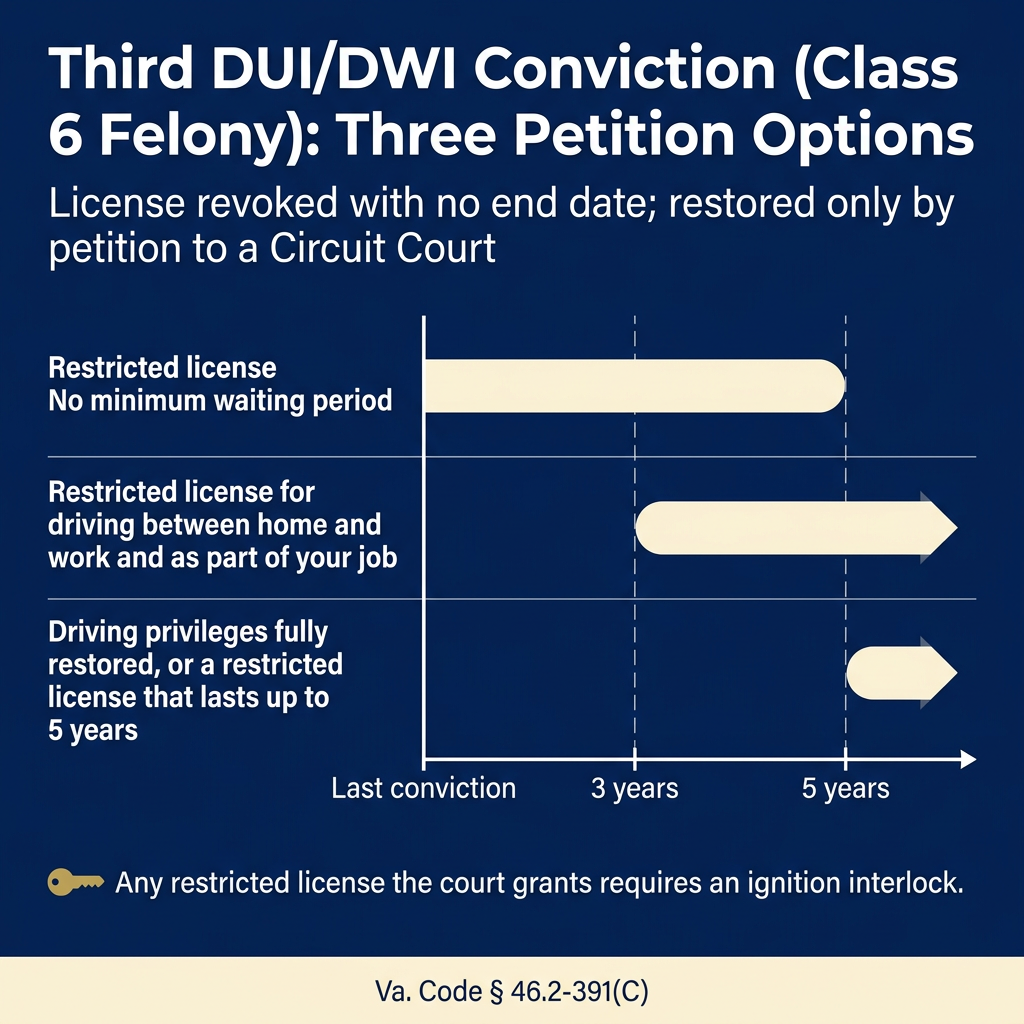
A third conviction within 10 years revokes your license with no end date. You can still petition a Circuit Court for a restricted license, and Virginia law sets no waiting period before you can file that petition.
Losing your license starts at the arrest. For a third offense, your license is suspended from the arrest until the day and time of your trial. That means you cannot legally drive on your license at any point between the arrest and the trial. This administrative suspension is separate from any penalty the court imposes after a conviction.
A conviction then brings a revocation. After a third conviction, Virginia law requires your license to be revoked and not reissued, and it sets no end date for the revocation. The only way to drive again is to petition the Circuit Court where you live, or any Circuit Court if you live outside Virginia.
The law gives you three petition options under Va. Code § 46.2-391(C), and each one becomes available at a different point after your last conviction. Any restricted license the court grants requires an ignition interlock, which is a device attached to your car’s steering column that tests your breath and keeps the vehicle from starting if it detects alcohol.
- From your last conviction until 5 years have passed: you can petition for a restricted license. The statute sets no minimum waiting period for this option, so you can file it at any time after the conviction. This is the earliest way to ask the court for permission to drive again.
- Once 3 years have passed since your last conviction: you can petition for a restricted license that covers driving between home and work and driving as part of your job.
- Once 5 years have passed since your last conviction: you can petition to have your driving privileges fully restored, or for a restricted license that lasts up to 5 years.
Every petition has to meet the same requirements, whichever option you use. The court orders VASAP to evaluate you. To grant the petition, the court must find that you were addicted to or psychologically dependent on alcohol or other drugs at the time of your earlier convictions. The court must also find that you are no longer addicted or dependent at the time of the hearing, and that you are not a threat to your own safety or the safety of others.
Do I Have to Get an Ignition Interlock Device After a Third DUI/DWI?
Yes.all DWI convictions require ignition interlock. After DUI/DWI conviction, Va. Code § 18.2-270.1(B) requires the court to order an ignition interlock on each motor vehicle you own or that is registered to you. The interlock has to stay in place for at least 12 consecutive months without an alcohol-related violation. Those 12 months are counted from the date the court issues you a restricted license.The device keeps the vehicle from starting if it detects a blood alcohol concentration above 0.02%, and it asks for more breath samples at random while you drive. You pay a $20 administrative fee, plus the costs of leasing, monitoring, and maintaining the device.
Can My Car Be Seized After a Third DUI/DWI?
It can, if you were the sole owner of the car and were driving it. Under Va. Code § 19.2-386.34, a vehicle solely owned and operated by the accused during a felony DUI/DWI is subject to seizure and forfeiture. Forfeiture means you lose ownership of the vehicle. A third offense within 10 years is a felony, so the statute applies to it. The statute does not apply to a car that belongs to someone else, or to a car you own jointly with another person.
The forfeiture is handled as its own case in Circuit Court. If the car is the family’s only vehicle and losing it would cause a substantial hardship, an immediate family member can petition the court to release it.
What Does a Felony DUI/DWI Record Mean for Gun Rights and Voting?
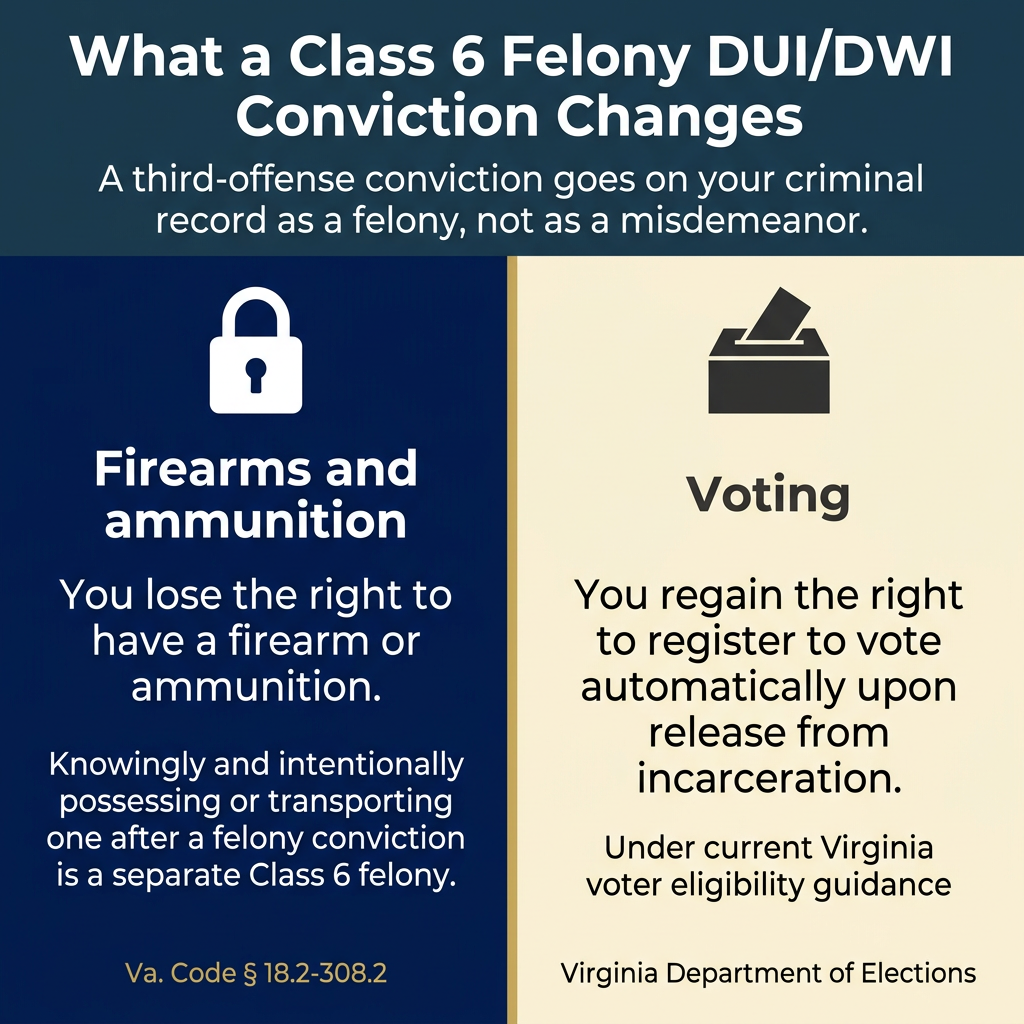
A third-offense conviction goes on your criminal record as a felony, not as a misdemeanor. Because of that felony conviction, you lose the right to have a firearm or ammunition. Knowingly and intentionally possessing or transporting a firearm or ammunition after a felony conviction is a separate Class 6 felony. The rule treats a felony DUI/DWI conviction the same as any other felony.
The right to vote is handled differently from gun rights: under current Virginia voter eligibility guidance, a person with a felony DUI/DWI conviction regains the right to register to vote automatically upon release from incarceration.
What Happens After an Arrest for a Third DUI/DWI?
When a third offense is charged as a felony, the case goes to a preliminary hearing in the District Courts, then to a grand jury, and then to trial in the Circuit Court.
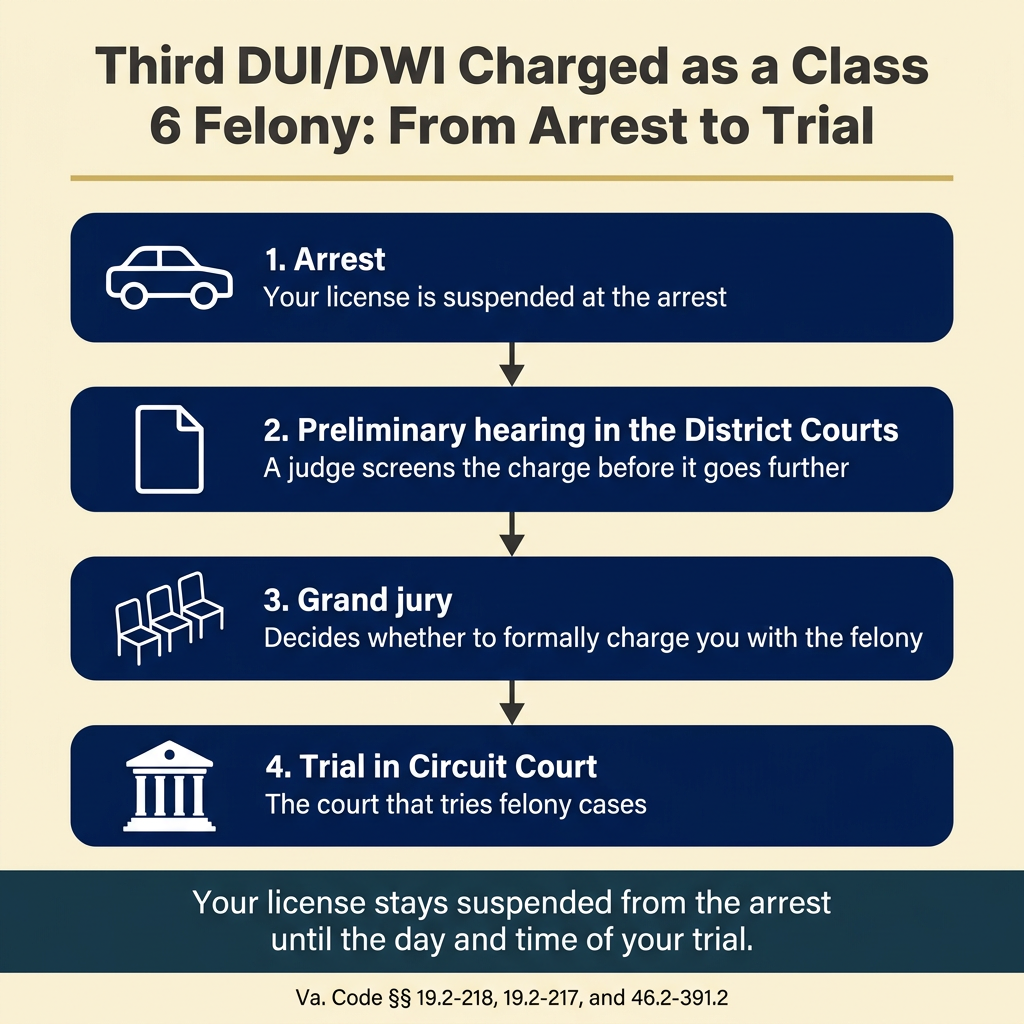
The arrest. Your license is suspended at the arrest and stays suspended until your trial. The suspension starts before any court has found you guilty.
The preliminary hearing in the District Courts. Your case starts in the District Courts, where a judge holds a preliminary hearing. At this hearing, the judge decides whether there is reasonable ground to believe you committed the offense. The District Courts cannot decide whether you are guilty of a felony, so the preliminary hearing screens the charge before it goes further. If the judge finds sufficient cause, the judge sends your case to the Circuit Court. If the judge does not, the judge must discharge you. You have a right to a preliminary hearing, and you can give it up only in writing, which is a decision to make with your attorney.
The grand jury. Next, a group of citizens called a grand jury decides whether to formally charge you with the felony. If the grand jury decides to charge you, it issues an indictment or True Bill, which is the charge you are tried on. You cannot be tried for a felony without an indictment unless you waive it in writing.
The trial in Circuit Court. Your trial takes place in the Circuit Court, the court that tries felony cases. The suspension of your license from the arrest ends at the trial. If you are convicted, the mandatory minimum sentence, the mandatory minimum fine, and the revocation of your license all follow.
Do Out-of-State or Older DUI/DWI Convictions Count Toward a Third Offense?
Out-of-state convictions count, and older convictions count only when they fall inside the 10-year window. A DUI/DWI conviction from another state, or under federal law, counts as a prior offense when the law behind it is substantially similar to Virginia’s.
Can a Third DUI/DWI Charge Be Fought?
Yes. To convict you of a third offense, the Commonwealth has to prove the new DUI/DWI and both earlier convictions. When you are able to prove that the prior DWIs do not meet the statutory framework or timeline, the prosecutor can amend your felony DWI to a misdemeanor. In our DUI/DWI defense work, we examine whether the traffic stop was legally justified, how the breath test and field sobriety tests were given, and whether the records of the earlier convictions are accurate and properly certified.
Was the Traffic Stop Legal?
An officer needs reasonable articulable suspicion to stop your car (Terry stop). Reasonable articulable suspicion means specific facts that point to a violation, not just a hunch. The Supreme Court of Virginia applied that standard to a DUI/DWI stop in Harris v. Commonwealth, decided in 2008. The officer had an anonymous tip about a possibly intoxicated driver, but saw only lawful, normal driving before making the stop. The court held that the tip and the driving did not establish reasonable articulable suspicion, and it reversed the conviction.
When a stop was not lawful, the defense can challenge the evidence gathered after the stop and ask the court to suppress it. Suppressed evidence cannot be used against you at trial. If the evidence that remains does not prove the new DUI/DWI, the charge can be dismissed. One of our case results is a third-offense DUI/DWI charge that was dismissed after the evidence from an illegal stop was suppressed. Past results do not guarantee future outcomes, because every case depends on its own facts and circumstances.
Were the Breath Test and Field Sobriety Tests Done Correctly?
The breath test has to be given the way Virginia’s regulations require. Before a breath sample is collected, the person being tested must be observed for at least 20 minutes. This is called the observation period. During those 20 minutes, the person must not drink anything, eat, smoke, vomit, or bring anything up from the stomach. If any of those things happen, a new 20-minute observation period has to be performed, under 6VAC40-20-110.
The test also has to be given by a licensed operator on approved equipment, and the operator issues a certificate with the result, under Va. Code § 18.2-268.9. If the observation period was cut short or not restarted, or if the operator or the equipment did not meet those requirements, the breath test result can be challenged.
Field sobriety tests are the roadside tests an officer asks a driver to perform. We review how the officer gave and scored those tests by comparing the officer’s report with the bodycam footage and dashcam footage. When the report does not match what the footage shows, the results of the tests can be challenged.
Can the Commonwealth Prove the Earlier Convictions?
The earlier convictions are part of what the Commonwealth has to prove, so the defense can challenge the proof of each one. The Commonwealth proves a prior offense with records, such as a certified copy of your DMV record. That record is prima facie evidence, which means it proves the prior offense unless the defense shows a problem with it. We check whether the records are properly certified and whether the offense dates put all three offenses inside the 10-year window. When an earlier conviction comes from another state, we also check whether that state’s law is substantially similar to Virginia’s.
If the Commonwealth cannot prove one of the earlier convictions, it cannot get a third-offense felony conviction. The new charge would then be handled as a misdemeanor: as a second offense if one earlier conviction within 10 years is proven, or as a first offense if none is.
Can the Charge Be Reduced Through a Plea Offer?
Before trial, the prosecutor may make a plea offer, such as an offer to amend the charge to a less serious offense if you plead guilty. How good that offer is depends partly on what the prosecutor expects to happen if you turn it down. If your attorney has little or no trial experience, the prosecutor can expect the case to end in a plea anyway, so the prosecutor has less reason to make a better offer. Manuel Leiva has 25+ years of trial experience. If the offer is not adequate, we try the case. A prosecutor who expects the case to go to trial has a reason to make a better offer.
Frequently Asked Questions About a Third DUI/DWI in Virginia
What happens if I drive on a license revoked after a third DUI/DWI?
Driving on a license revoked after a third DUI/DWI is a separate crime. A first violation that does not put other people or their property in danger is a Class 1 misdemeanor with a mandatory minimum sentence of 10 days in jail. If the driving puts other people or their property in danger, or if it is a second or later violation, the charge is a felony with a mandatory minimum sentence of 12 months that cannot be suspended.
What happens with a fourth DUI/DWI within 10 years?
A fourth DUI/DWI offense within 10 years is a Class 6 felony with a mandatory minimum prison term of 1 year and a mandatory minimum fine of $1,000.
Talk With Us About Your Third DUI/DWI Charge
What a third DUI/DWI costs you depends on the dates of your earlier offenses, the records the Commonwealth uses to prove them, and the evidence from the new stop. We can go through each of those with you. Clients in our criminal defense practice work with Manuel Leiva directly. We handle cases in Arlington, Alexandria, Fairfax, Loudoun, Prince William, and Stafford. Call us at (703) 352-6400 to schedule a consultation to discuss your case.

