




What to Do If There’s a Warrant Out for Your Arrest in Virginia
If there’s a warrant out for your arrest in Virginia, a judicial officer has already signed an order telling law enforcement to arrest you. Before signing it, a magistrate or another judicial officer looked at a sworn complaint and decided there was probable cause to believe you committed a crime. The single most important thing to do right now is this: do not talk to the police about the case, and contact a criminal defense attorney before you do anything else. What you say and do in the first hours can affect what you are charged with, how the arrest happens, and whether you are released on bond. Getting advice before you act protects you.
At The Leiva Law Firm, we have represented people across Northern Virginia who are facing an arrest warrant or an active investigation. A warrant is serious, but there is a lawful path through it, and the earliest moves usually matter the most. Here is what a warrant actually is, how to find out whether one exists, and what to do next without making your situation worse.
What an arrest warrant is in Virginia
An arrest warrant is a written order that commands law enforcement to arrest you and bring you before a court. In Virginia, a magistrate or another judicial officer issues one, but only after questioning the person making the complaint and any witnesses under oath and finding probable cause to believe you committed an offense. That means a neutral judicial officer, not the police alone, decided there was enough to justify the warrant.
The warrant has to name or describe you, describe the offense, and be signed by the officer who issues it.
Arrest warrant vs. bench warrant vs. capias vs. summons
These terms get mixed up, and the differences matter. Here is how each one works and when it is used.
| Instrument | What it is | When it is issued |
|---|---|---|
| Arrest warrant | An order for law enforcement to arrest you, signed by a magistrate or judicial officer | At the start of a case, after a finding of probable cause |
| Bench warrant (capias) | A court’s own order to take you into custody | Later in a case, commonly after you miss a required court date or violate a court order |
| Summons | A written notice to appear in court, not an order to arrest you | By an officer for many misdemeanors, so you are released on the spot instead of taken to jail |
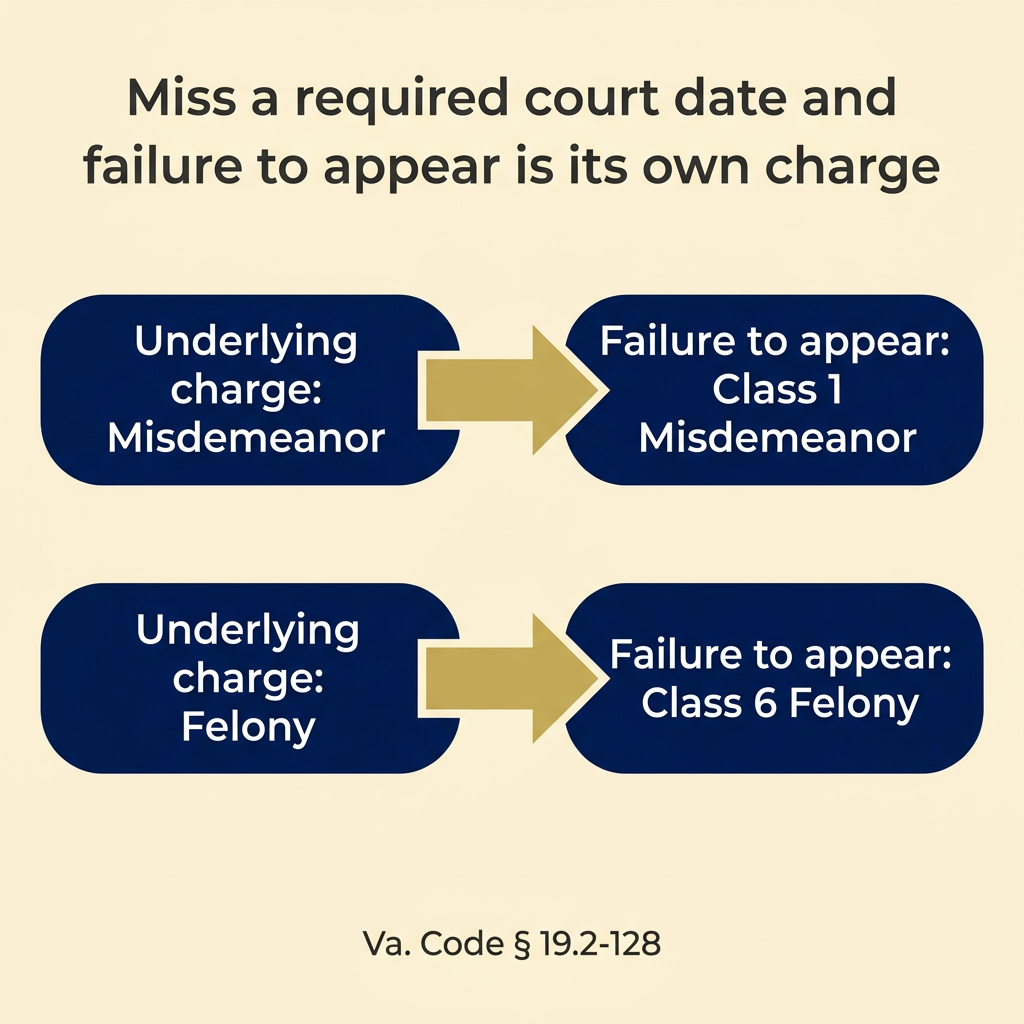
A “capias” and a “bench warrant” mean the same thing in Virginia practice: an order the court issues to have you brought in. Missing a required court date is its own problem, because failing to appear is a separate crime. If the underlying charge is a misdemeanor, failure to appear is a Class 1 misdemeanor. If the underlying charge is a felony, failure to appear is a Class 6 felony. That is one reason ignoring a warrant tends to make things worse rather than better.
How to find out if there is a warrant for you in Virginia
The safest way to check is not to ask the police directly. You can start with Virginia’s Online Case Information System, the court system’s public case search. It has a real limit, though: it shows cases that are already in the court system, so an arrest warrant that has not been served yet may not appear online at all. Calling the clerk’s office for the court where the case would likely be, or having an attorney check for you, is more reliable for a warrant that has not been served. Across Northern Virginia, that could mean the courts in Arlington, Alexandria, Fairfax, Loudoun, or Prince William.
We would caution you against calling or walking into a police station to ask whether there is a warrant. The law treats a phone call, a knock at your door, or a request to “come in and talk” as a non-custodial contact. In that kind of contact, the officer does not have to read you your Miranda rights first. Anything you say can still be used against you, even though you were never warned.
What to do right now, and what not to do
The goal in the first hours is simple: do not give up your rights, and get an attorney involved before you talk to anyone. A few specific steps protect you.
- Do not discuss the case with the police. You are under no legal obligation to answer their questions, and staying quiet is not an admission of anything.
- Do not consent to a search of you, your home, car, or phone without advice. Officers can ask to search, and a voluntary “yes” lets them search without a warrant, but you can decline. They are not required to tell you that you can say no.
- Contact a criminal defense attorney right away. An attorney can become the point of contact with the law enforcement agency, deal with officers so you do not have to, and assert your rights in writing.
If officers actually show up to make the arrest, the most important thing is to stay calm. Do not resist, argue, or run, even if you believe the arrest is a mistake and even if you are frightened. Fighting it will not help the case and can add new charges. Say out loud that you want your attorney and that you do not want to answer questions, and then stop talking about the case. You can be polite and cooperate with being taken into custody while still saying nothing about what happened.
As Manuel Leiva puts it: “You are under no legal obligation to talk to the police. The best thing to do is talk to a lawyer first or have the lawyer present with you when you talk to the police.” That advice rests on two constitutional rights: the right to remain silent and the right to counsel. Getting a lawyer in early is how you use both.
Should you turn yourself in, and what surrender looks like
Whether to turn yourself in is a real decision, and it is one to make with an attorney rather than on your own. We are not going to tell you here that you should or should not surrender, because the right answer depends on the facts of your case, the charge, and your situation. What we can do is explain what surrender involves so it is not a mystery.
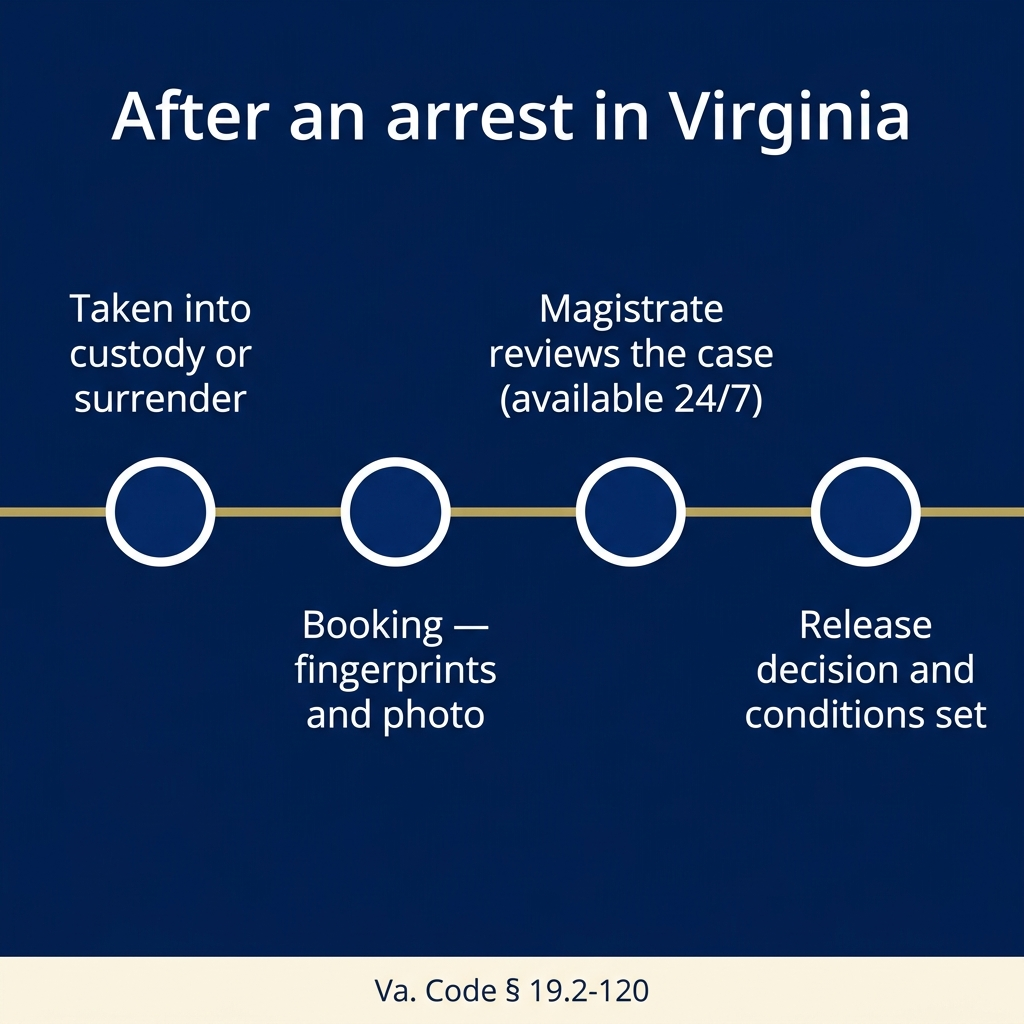
If you are taken into custody, you are brought before a magistrate, the first judicial officer to see the case. The magistrate reviews the matter and decides the conditions of your release. Magistrate services operate around the clock, so this can happen at any hour. Booking usually involves fingerprints and a photograph. When surrender is the right move, arranging it through an attorney can make it orderly: your lawyer can coordinate the timing and be ready to argue for your release from the start, instead of you showing up alone and unprepared.
Bond and release in Virginia
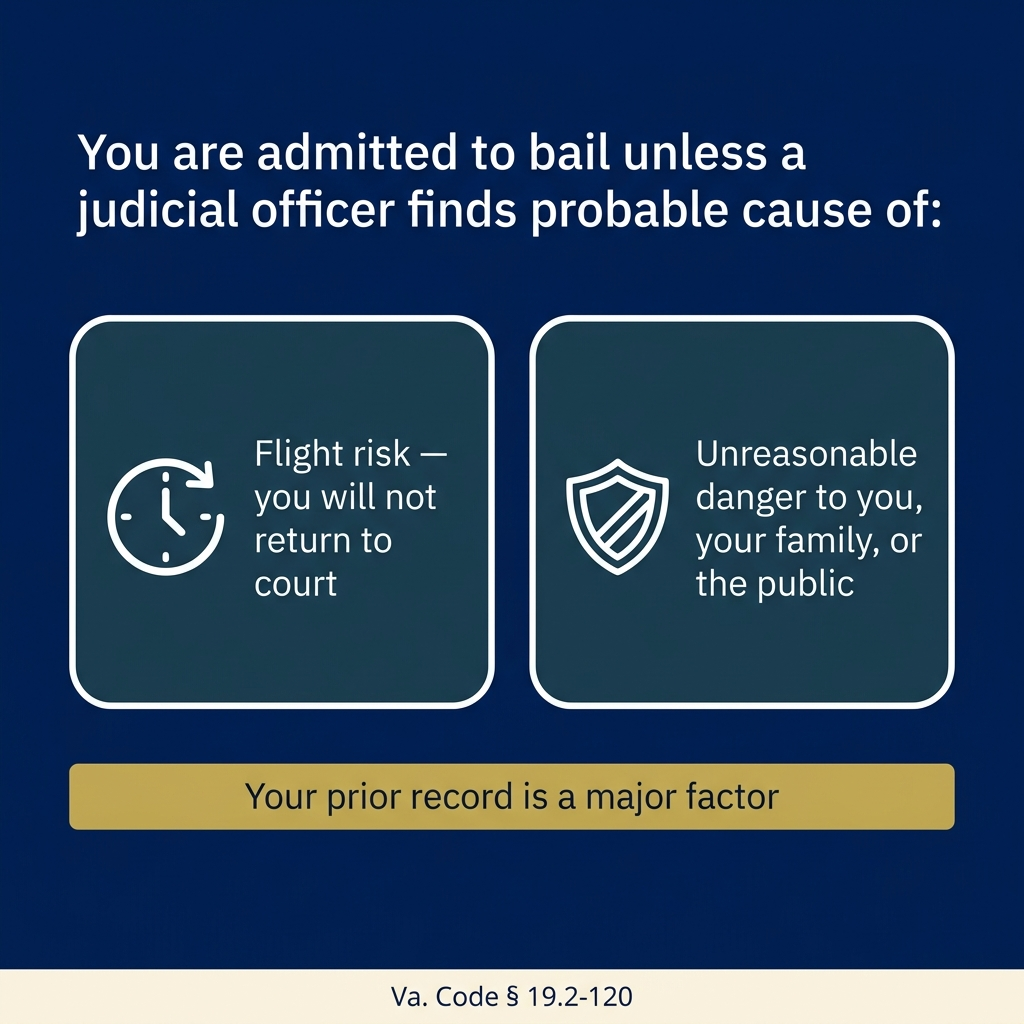
After an arrest, a judicial officer decides whether to release you and under what conditions. In Virginia, you are supposed to be admitted to bail unless there is probable cause to believe one of two things: that you will not come back to court (flight risk), or that releasing you would be an unreasonable danger to yourself, your family, or the public.
One of the first questions families ask is how quickly someone can get out. A magistrate is available around the clock and makes the first decision about release right after an arrest. That decision can come within hours of the arrest or surrender, sometimes the same day. Release is not automatic, though, and the conditions the magistrate sets depend on the factors below.
When a judicial officer weighs whether releasing you would put someone in danger, your prior criminal record is a major factor, especially any prior violent offenses. A history of missed court dates counts on the flight-risk side. For certain offenses, Virginia law used to start from a presumption against release, meaning you could be held without bond. That presumption no longer applies, so a judicial officer decides each case on the factors above. Release is still not guaranteed, and the officer can set conditions or deny bail.
Do warrants expire in Virginia?
No. A Virginia arrest warrant does not expire on its own. There is no expiration date set in the Code, so an outstanding warrant stays active until an officer serves it or a court withdraws or quashes it. Waiting does not make it go away.
How a criminal defense attorney helps
An attorney can step in before you are arrested, and sometimes before charges are even filed. Early representation is where a lawyer can do the most. We can assert your rights in writing, become the point of contact with the investigating law enforcement agency so officers deal with us instead of you, look into the facts while memories are still fresh, and take legal or factual problems to the prosecutor before a charging decision is made. If surrender is the right move, we arrange it. At the bond hearing, we argue for your release. And we prepare the defense of the underlying charge from the start.
Prosecutors handle a case differently depending on whether they expect it to go to trial. When the defense attorney is prepared to take a case to trial, a prosecutor has more reason to offer a better plea deal. Many criminal defense attorneys in the Northern Virginia area have little or no jury trial experience, so prosecutors do not expect those cases to reach a jury. Manuel Leiva has 25+ years of trial experience, including murder cases, and takes cases to trial when a plea offer is not good enough. The Leiva Law Firm is a boutique firm, so clients work with Manuel Leiva directly. If you want to read more about how we handle these cases, see our Fairfax criminal defense page.
Talk to us before you talk to the police
If you think there may be a warrant for your arrest, or for someone in your family, contact us before you talk to the police or decide about surrendering. The first step is a criminal defense consultation. That is a conversation where we go over your situation and your options so you understand what you are facing. We return criminal defense inquiries within 24 hours, and often within hours, and we work with clients in both English and Spanish. You can reach The Leiva Law Firm through our contact page.

