



What to Do Immediately After a Dog Bite in Virginia
After suffering a dog bite in Virginia, the first steps are to wash the wound with soap and water, get medical care, find out who owns the dog and whether the dog’s rabies vaccination is current, report the bite to the local health department or animal control, and keep records and photographs of the injury. Many dog bites need more than first aid at home. Nearly 1 in 5 people bitten by a dog need medical attention. At The Leiva Law Firm, we represent people in Northern Virginia who were injured by someone else’s dog. The medical steps taken to treat your injury are evidence. The doctor’s notes, the owner’s contact information, and the bite report are the records you would use if you later make an injury claim.
What should I do right after a dog bite?
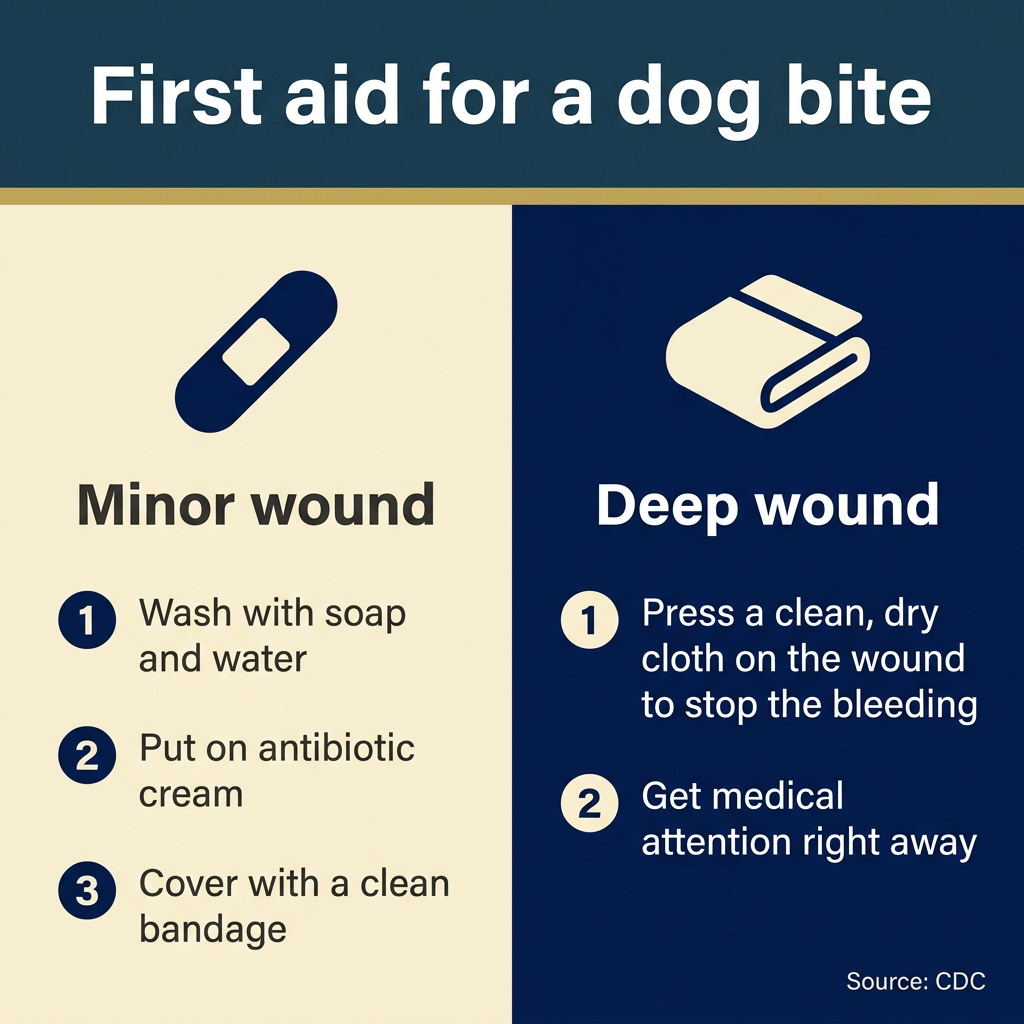
The first thing to do is get away from the dog, so it cannot bite you or your child again. Then clean the wound. Washing a bite wound immediately with soap and water for 15 minutes helps flush out the rabies virus if the dog carried it. For a minor wound, put on antibiotic cream after washing it and cover it with a clean bandage. For a deep wound, press a clean, dry cloth on it to stop the bleeding, and get medical attention right away.
Do I need to see a doctor for a dog bite?
A dog bite needs medical attention when the wound is serious or deep, when it becomes infected, when you don’t know whether the dog is vaccinated against rabies, or when your last tetanus shot was more than 5 years ago. An infected bite can be red, swollen, or painful, and it can also cause a fever.
The doctor visit also starts the medical record of the injury. The doctor’s notes show what the wound looked like, how it was treated, and the date/s you received medical treatment. If you later make an injury claim, those records document the injury from day one, so keep copies of the records from every visit.
Do I need rabies shots after a dog bite?
Your doctor and the local health department decide whether you need rabies shots. They make that decision quickly for anyone who may have been exposed to rabies. The treatment is called rabies post-exposure prophylaxis, or PEP. It includes washing the wound, a dose of human rabies immune globulin, and a series of rabies vaccine shots. PEP works very well when it is given as soon as possible after exposure.
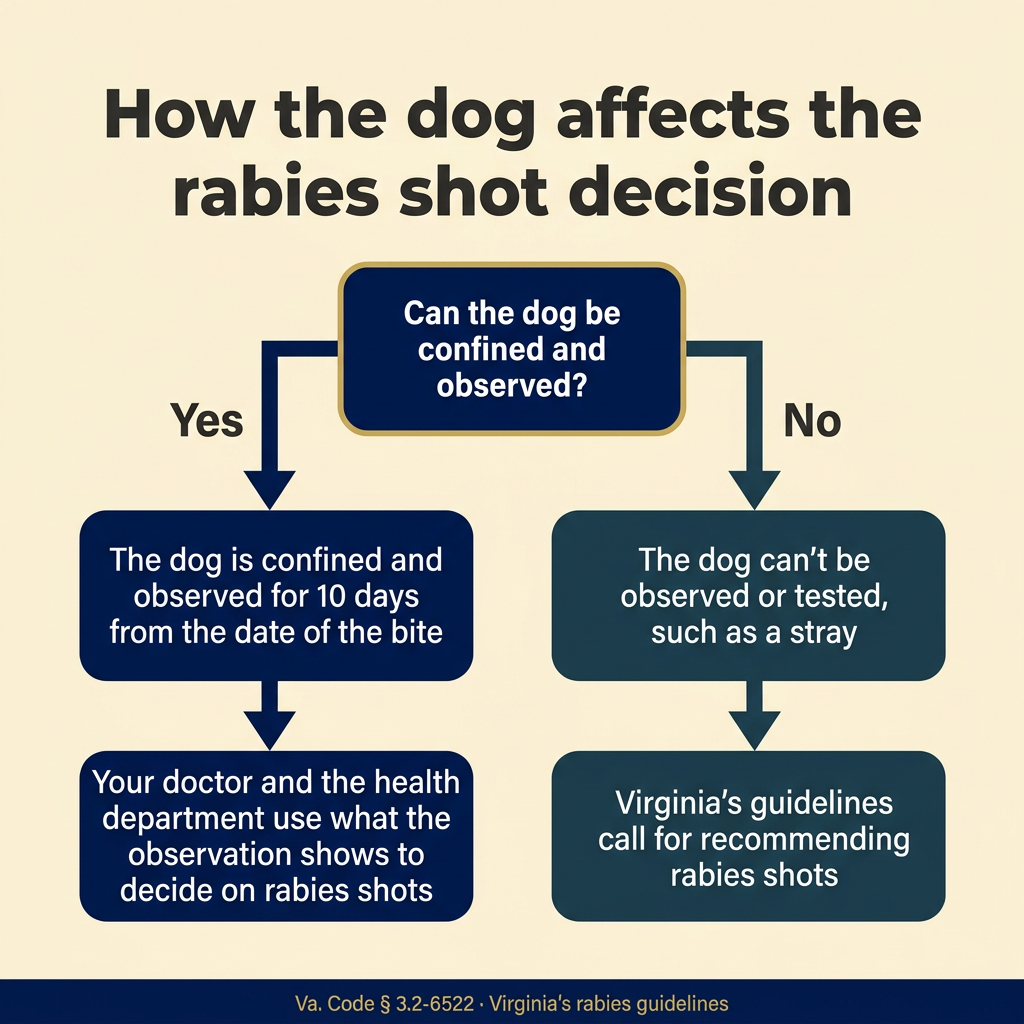
The decision depends partly on the dog. The doctor and the health department look at whether the dog is vaccinated against rabies and whether the dog can be confined and observed. Identifying the dog and reporting the bite are how they get that information.
Find out whose dog it is and whether it is vaccinated
Get the owner’s name, phone number, and address, and ask whether the dog’s rabies vaccination is current. Your doctor and the health department need the vaccination status to decide whether you need rabies shots. You also need to know who owns the dog to make an injury claim. If the owner is willing, ask for the name of the dog owner’s homeowners or renters insurance. That insurance is usually what pays for a dog bite injury.
If the owner won’t show you proof of the rabies vaccination, animal control, the police, or the health department can confirm it. Under Va. Code § 3.2-6521, the owner must show the dog’s vaccination certificate when an animal control officer, a law enforcement officer, or a health department official asks for it. The same statute requires every dog 4 months of age or older to have a current rabies vaccination.
If the dog was a stray, or the owner cannot be found, tell your doctor and the health department. Virginia’s rabies guidelines say that when the dog can’t be observed or tested, a person who was exposed should get rabies shots.
Are you required to report a dog bite in Virginia?
Virginia law requires a report when the dog that bit you is suspected of having rabies. Under Va. Code § 3.2-6522, anyone who knows that an animal suspected of rabies may have exposed a person must report it immediately, including the person who was bitten, the dog’s owner, and the doctor. That legal duty depends on a suspicion of rabies. If the dog seems healthy, reporting the bite still matters for your health. The report is how the health department learns about the bite and orders the dog confined and observed for rabies.
The report goes to the health department or animal control office for the city or county where the bite happened, such as Arlington, Alexandria, Fairfax, Loudoun, or Prince William. In Fairfax County, the Health Department and the Department of Animal Services take animal bite reports.
A report also creates an official record of when and where the bite happened and which dog was involved. That record is useful if the owner or the owner’s insurance carrier later disputes what happened.
What happens when a dog bite is reported in Virginia?
After a bite is reported, the dog is confined and observed for 10 days from the date of the bite. Under Va. Code § 3.2-6522 and Virginia’s rabies guidelines, this applies to any healthy dog that bites a person, whether or not the dog is vaccinated. The local health director orders the confinement, and the owner pays for it. If the dog belongs to a neighbor or friend, you may be hesitant to report the bite. The confinement is the same rabies check that every healthy dog goes through after biting a person, so it is not a punishment for the dog.
The observation is also part of your own rabies treatment decision. During the confinement, the dog is watched for signs of active rabies. Your doctor and the health department use what the observation shows when they decide whether you need PEP. When the biting animal is not available to be observed or tested, the guidelines call for PEP for the person who was exposed.
Document the bite and the scene
The records you keep now are the evidence that will be used for an injury claim. Some of them, such as photos of the wound on the day of the bite, cannot be made later. Keep these records:
- Photos of the wound, taken on the day of the bite and again as it heals. A series of photos shows how serious the injury was and how long healing took.
- The location. Write down the address and photograph the spot, including any gate, fence, or leash involved. The photos can show whether the dog was loose. Under Butler v. Frieden, a 1967 Supreme Court of Virginia decision, an owner who broke a local leash law can be responsible for the bite even without knowing the dog was dangerous.
- Torn or bloodstained clothing. Keep it unwashed in a bag, because it is physical evidence of the bite.
- Witnesses. Get the names and phone numbers of anyone who saw the bite.
- Medical records and bills from every visit, along with receipts for prescriptions.
- Missed work. Write down the dates you missed and the pay you lost.
- Earlier incidents involving the dog, such as a prior bite or complaints from neighbors. An earlier incident can help show that the owner knew or had reason to believe the dog would hurt someone. In Virginia, a dog owner can be responsible for a bite based on what the owner knew about the dog.
Who pays for a dog bite in Virginia?
The dog owner’s homeowners or renters insurance usually pays for a dog bite injury. Those policies typically cover dog bite liability, which means the policy pays when the owner is legally responsible for a bite. Making a claim against a dog owner’s insurance is common. Nationwide, in 2025 there were 28,450 dog bite liability claims under homeowners policies.
The owner’s insurance carrier may contact you about the bite. The insurance carrier works for its policyholder, the dog owner, not for you. The insurance carrier also decides how much to offer you on the claim. Keep a copy of every letter, email, and form you send and/or receive from the insurance carrier. For phone calls, write down the date and the name of the person you spoke with.
How long do you have to file a dog bite claim in Virginia?
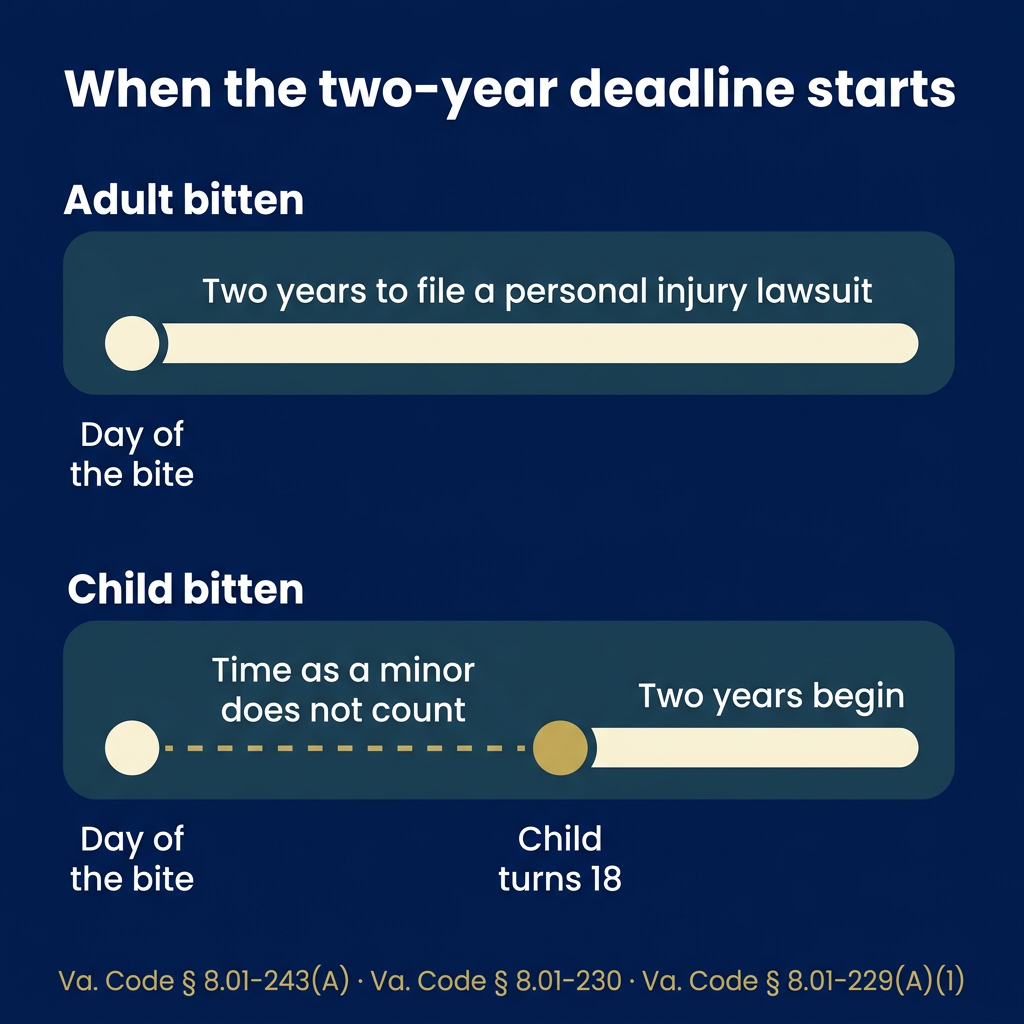
You have two years to file a personal injury lawsuit/action for a dog bite in Virginia, under Va. Code § 8.01-243(A). The two years start on the date of the injury, which for a dog bite is the day of the bite, under Va. Code § 8.01-230. Under Va. Code § 8.01-229(A)(1), the time a child spends as a minor does not count toward the two years. When the person bitten is a child, the two years begin when the child turns 18.
Does Virginia have a one-bite rule?
Yes. Under Virginia law, a dog owner can be responsible for a bite when the owner knew or had reason to believe the dog would hurt someone, for example because of an earlier bite. An owner who broke a local leash law can also be responsible, even without that knowledge. In Butler v. Frieden, decided in 1967, the Supreme Court of Virginia held that breaking a city or county law requiring dogs to be leashed or controlled is negligence per se when the person bitten is someone that law is meant to protect. Negligence per se means the broken law itself shows the owner was careless. Because an owner can be responsible under either rule, it helps to write down whether the dog was loose or off its leash when it bit, along with anything you learn about earlier bites. Our Fairfax dog bite lawyer page covers Virginia dog bite claims in more detail.
Frequently asked questions about dog bites in Virginia
Should I wait for animal control before getting treatment?
No. Wound care and medical treatment do not need to wait for animal control. A bite wound should be washed with soap and water immediately, and rabies treatment works best when it starts as soon as possible after exposure. The bite can be reported while you are getting care.
What if the dog belongs to a friend or relative?
Reporting the bite and making a claim are standard steps, even when the owner is someone close to you. The report is a health step, because your doctor and the health department need information about the dog to decide whether you need rabies shots. A claim is typically paid by the owner’s homeowners or renters insurance carrier, rather than by your friend or relative directly.
Can a dog be declared dangerous after a bite in Virginia?
Yes. Under Va. Code § 3.2-6540, a court can declare a dog “dangerous” if it seriously injured a person, and the owner must then follow the court’s registration and restraint orders. That court process is separate from the rabies confinement that follows a reported bite.
When should you talk to a lawyer?
A conversation with an injury lawyer is useful after you have received medical care, especially if the bite needed treatment or the person bitten is a child. For a child, the two-year deadline does not start until the child turns 18. Even so, evidence such as photos of the wound and the names of witnesses is easiest to gather while the bite is recent. Talking with a lawyer also helps when the owner’s insurance carrier contacts you or the owner disputes what happened. A lawyer can review the records you have gathered, work out whether the claim is based on what the owner knew or on a leash law violation, and keep track of the two-year deadline.
At The Leiva Law Firm, we represent people injured by dog bites throughout Northern Virginia. Dog bite cases are part of our premises liability practice, which covers injuries that happen on someone else’s property. Manuel Leiva has been licensed in Virginia since 1998 and has 25+ years of trial experience. That trial experience matters when the owner’s insurance carrier decides what to offer. Insurance carriers make better settlement offers when they know the lawyer is prepared to file a lawsuit and try the case. Clients work with Manuel Leiva directly, in English or Spanish. If you or your child was bitten by someone else’s dog, call us at (703) 352-6400 or contact us for a free consultation with no obligation.

