




How to Choose the Best Drug Crime Lawyer in Fairfax (2026)
Choosing the best drug crime lawyer in Fairfax comes down to four things: jury trial experience in Virginia courts, a focused criminal defense practice, familiarity with Fairfax judges and prosecutors, and credentials that hold up to peer review. At The Leiva Law Firm, we have defended drug cases in Northern Virginia for over 25 years, including large federal narcotics matters in the Eastern District of Virginia and cases involving extradited defendants from Mexico, Colombia, and Honduras. The right attorney for your case is the one with demonstrated trial experience, a clear assessment of your specific charge, and a willingness to take the case to trial if the plea offer is inadequate.
This guide explains how to evaluate Fairfax drug crime attorneys before you hire one, what to ask in the first meeting, and the credentials that actually matter when your freedom is on the line.
Understand What’s Actually at Stake
Drug penalties in Virginia vary widely based on the substance, the amount, and whether the charge is possession, distribution, manufacturing, transportation, or conspiracy. A small possession case in Fairfax General District Court is a different problem than a federal indictment in federal court in Alexandria. Knowing which category you fall into helps you screen for the right attorney.
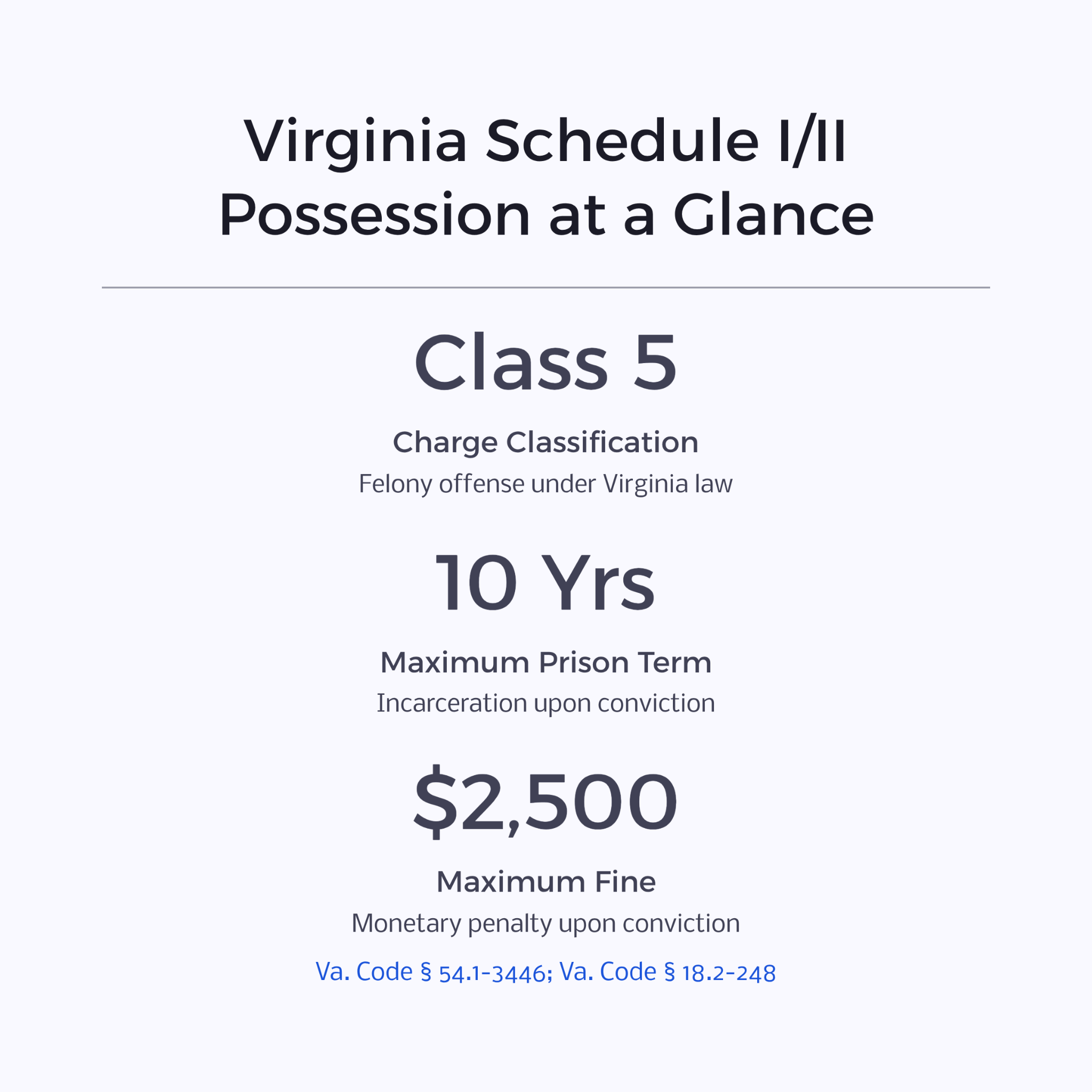
Virginia classifies controlled substances into six schedules under Va. Code § 54.1-3446. The most serious charges involve Schedule I and II substances, which include heroin, cocaine, methamphetamine, and fentanyl. Possession of a Schedule I or II substance is a Class 5 felony carrying up to 10 years in prison and a fine of up to $2,500. Distribution charges carry significantly more time, and weight thresholds can trigger mandatory minimum sentences under Va. Code § 18.2-248 and affect sentencing guideline calculations.
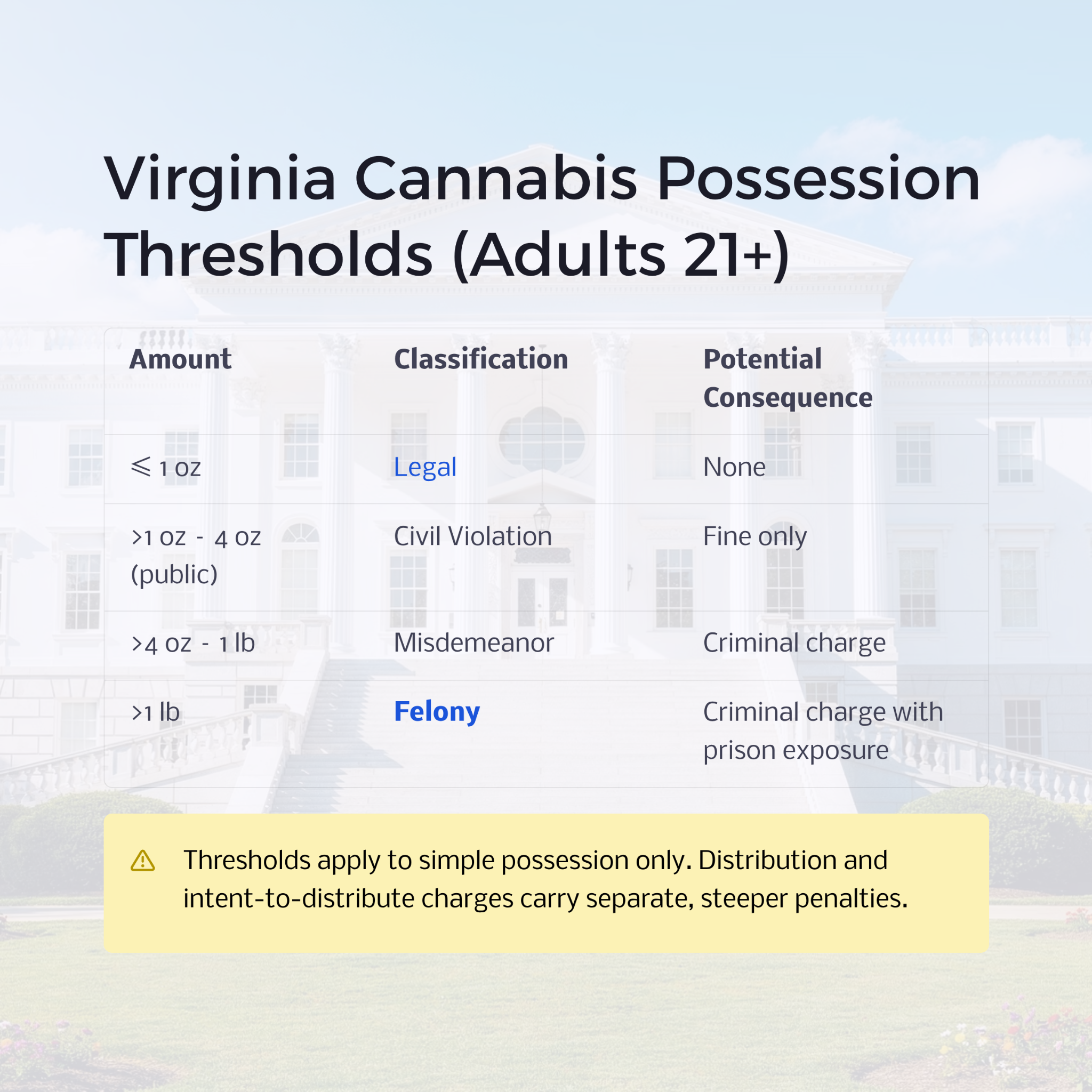
Marijuana law has changed. Adults 21 and older may legally possess up to one ounce of cannabis. Possession of more than one ounce but up to four ounces in public is a civil penalty. More than four ounces becomes a criminal matter, and more than a pound is a felony. Distribution and intent-to-distribute charges are still actively prosecuted.
Fairfax enforcement is active. In April 2026, the Fairfax County Police Department executed a search warrant that recovered more than 23 grams of suspected cocaine, 2 grams of fentanyl, and 40 Xanax bars from an alleged distribution operation. Cases like this typically involve surveillance, controlled buys, lab analysis, search warrants, informants, and complex evidentiary chains. They demand an attorney who has worked through that kind of evidence before.
Statewide, Virginia recorded a drug arrest rate of 192.2 per 100,000 people in 2024, according to the Department of Criminal Justice Services. That number is down 9% from 2023 but up 5% from 2022. Drug cases remain a substantial portion of Virginia’s criminal docket.

Prioritize Trial Experience Over Years on the Letterhead
Years of experience and trial experience are not the same thing. Plenty of attorneys advertise decades of practice without having tried a felony case in front of a jury. In Manuel Leiva’s view, that distinction matters more than almost any other when you are choosing a criminal defense attorney.
Trial experience drives outcomes even when the case never reaches a jury. Prosecutors evaluate plea offers partly based on whether the defense attorney is willing and able to try the case. An attorney with a history of taking serious felonies to trial gets better offers because the Commonwealth knows the case will get tried if the offer is inadequate. An attorney whose practice is built on quick pleas does not have that leverage.
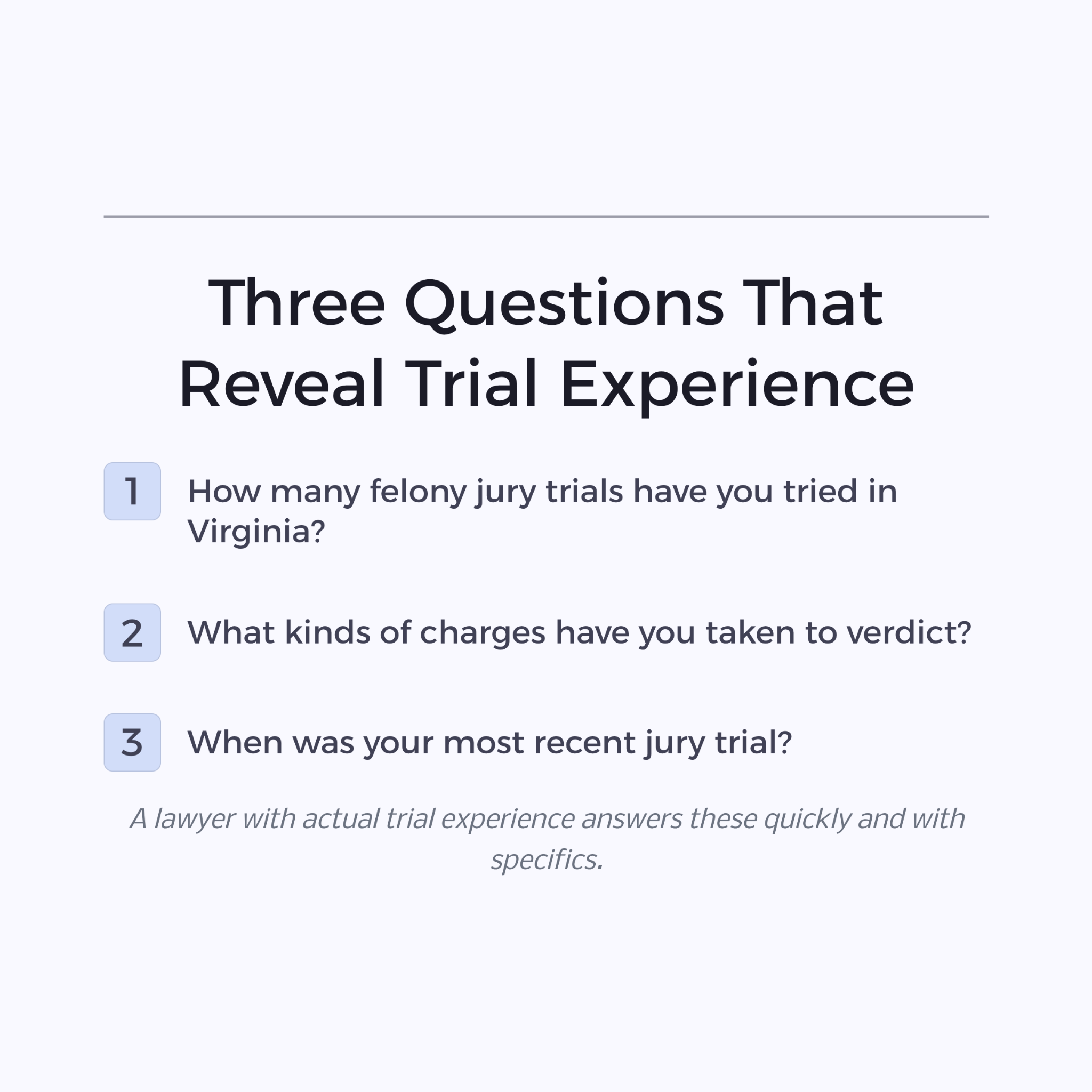
When you interview a Fairfax drug crime attorney, ask three direct questions:
- How many felony jury trials have you tried in Virginia?
- What kinds of charges have you taken to verdict?
- When was your most recent jury trial?
A lawyer who hesitates on these questions is telling you something. A lawyer with actual trial experience answers them quickly and with specifics. Manuel Leiva, for example, has tried cases ranging from traffic offenses to capital murder over a 25-plus-year career, beginning with his work as an Assistant Public Defender in Fairfax County and continuing through his private practice today.
Make Sure Criminal Defense at the Highest Level Is the Attorney’s Main Focus
A general practitioner who handles wills, divorces, and the occasional criminal case is not the right fit for a serious drug charge. Drug cases involve specific issues that require regular practice in criminal defense to handle well: search and seizure analysis, motion practice, suppression hearings, expert testimony on lab results, and sentencing guidelines.
Look for an attorney whose practice is built around criminal defense work. Ask what percentage of their caseload is criminal versus civil. Ask how many drug cases they handled in the last 12 months. Ask whether they have suppression motion experience and whether they have argued Fourth Amendment issues in front of a Virginia trial court.
Drug defense often turns on the legality of the stop, the search, or the warrant authorizing the search of property or cell phone data. If the search was unconstitutional, the evidence can be challenged under Fourth Amendment principles. Successful suppression often weakens the prosecution’s case substantially. An attorney who rarely litigates these issues is not the attorney you want filing your suppression motion.
Confirm Local Court Experience
Criminal procedure in Virginia is the same statewide, but how cases move through the system differs from one jurisdiction to the next. The Commonwealth’s Attorneys in Arlington, Alexandria, Fairfax, Loudoun, and Prince William each have their own charging preferences, plea practices, and tendencies on diversion. Each of those jurisdictions has judges with known approaches to drug cases. An attorney who practices in these jurisdictions regularly knows the local system and adjusts strategy accordingly.
Some questions to ask:
- How often do you appear in Fairfax General District Court and Fairfax Circuit Court?
- Are you familiar with the judges who currently handle drug cases in Fairfax?
- Have you negotiated with the prosecutors in the Fairfax Commonwealth’s Attorney’s Office on similar charges?
Local court knowledge is not a luxury. It is part of how good defense attorneys spot diversion opportunities, anticipate the Commonwealth’s positioning, and negotiate effectively. An out-of-area attorney is at a structural disadvantage in any Arlington, Alexandria, Fairfax, Loudoun, or Prince William courtroom.
Ask About Federal Drug Defense Capability
Federal drug cases are different from Virginia state prosecutions. Federal prosecutors have different evidence, different procedures, and a different sentencing scheme. Mandatory minimums under 21 U.S.C. § 841 can put a defendant in federal prison for years before a judge ever has discretion to consider individual circumstances. The U.S. Sentencing Guidelines drive most outcomes, and defendants without an attorney who understands them often end up with sentences that could have been challenged.
If your charge is federal, or might become federal, you need an attorney admitted to practice in the U.S. District Court for the Eastern District of Virginia. Ask whether they handle federal narcotics cases regularly. Ask whether they have negotiated cooperation agreements, argued at federal sentencing, or worked through multi-defendant indictments.
This is an area we have actively developed at The Leiva Law Firm. Our federal narcotics practice includes large cases involving extradited defendants and multi-jurisdictional investigations, including international narcotics matters being prosecuted in the Eastern District of Virginia.
Verify Credentials and Professional Standing
Credentials are not everything, but they are a useful filter when you are screening attorneys.
Virginia State Bar standing. Every licensed Virginia attorney is listed in the Virginia State Bar’s online directory. The directory shows current bar status, year of admission, and any public disciplinary history. Confirm that your attorney is in good standing before signing anything.
Peer recognition. Peer-rated organizations evaluate lawyers based on assessments from other attorneys who have observed their work. The most established is Martindale-Hubbell, whose AV Preeminent rating represents the highest peer evaluation tier. Magazine rankings such as Northern Virginia Magazine’s “Top Lawyers” list and Washingtonian’s annual “Top Lawyers” feature also reflect a combination of peer nomination and editorial vetting.
Client reviews. Avvo, Google, and similar platforms collect client reviews, but read them critically. A handful of perfect reviews on a brand-new profile means less than a long history of consistent feedback. Look at how the attorney responds to negative reviews, if any. A measured, professional response to criticism is often more telling than a wall of five-star reviews.
Questions to Ask in Your First Meeting
A good consultation tells you more than any website. Bring a list of questions and expect direct answers. If an attorney rushes you, dodges specifics, or promises an outcome, that is a signal.
Ask:
- How many years have you practiced criminal defense in Virginia, and how many drug cases like mine have you handled?
- Will you personally handle my case, or will another attorney or paralegal do most of the work?
- What are the realistic outcomes for a charge like mine in Arlington, Alexandria, Fairfax, Loudoun, or Prince William counties?
- What defenses might apply based on what you know so far?
- What is your approach to suppression motions and pretrial litigation?
- What is your fee structure, and what does the fee cover?
- How will we communicate? How quickly can I expect a response when I have questions?
- Have you tried a felony case to verdict in the last two years?
Notice what is missing from that list: a request to predict the outcome. No competent attorney will promise you a dismissal or a specific sentence at a first meeting. They have not seen the discovery, the bodycam footage, the lab reports, or the affidavit supporting the warrant. An attorney who guarantees a result before reviewing the file is either inexperienced or selling you something.
Compare Attorneys Side by Side
After a few consultations, write down what you learned. The factors below are a useful framework.
| What to evaluate | What strong candidates show |
| Trial experience | Multiple felony jury trials in Virginia and federal courts; recent trial activity |
| Practice focus | Criminal defense as the primary area, not a side practice |
| Drug case history | Familiarity with possession, distribution, and federal narcotics charges |
| Local court practice | Regular appearances in Arlington, Alexandria, Fairfax, Loudoun, and Prince William General District and Circuit Courts |
| Federal capability | Admitted in the Eastern District of Virginia; handles federal narcotics cases |
| Bar standing | Active Virginia State Bar membership; clean disciplinary record |
| Peer recognition | Martindale AV Preeminent, Top Lawyer listings, defense-bar involvement |
| Communication | Responsive, direct, willing to give you a written fee agreement |
| Strategy | Articulates specific issues in your case, not generic talking points |
Cost matters, but it should not be the only factor in a serious drug case. Drug convictions in Virginia carry consequences well beyond the criminal sentence, including loss of professional licenses, immigration consequences for non-citizens, federal student aid disqualification in some cases, and a permanent criminal record. The cost of an experienced attorney is small compared to the cost of an avoidable conviction.
Understand How Criminal Defense Fees Work
Most criminal defense attorneys in Arlington, Alexandria, Fairfax, Loudoun, and Prince William charge in one of three ways:
- Flat fee. A single agreed-upon amount covers the case from start to finish, or through a defined phase such as preliminary hearing or trial. Flat fees give cost certainty, and they are the most common structure for serious felony cases.
- Hourly billing. The attorney bills against time spent. Less common in criminal defense but used in some complex matters.
- Retainer. An up-front deposit billed against, usually combined with an hourly rate.
Whatever structure the attorney uses, get the fee agreement in writing before you commit. Virginia Rule of Professional Conduct 1.5 requires fee agreements to be reasonable and clearly explained. The agreement should specify what the fee covers (court appearances, motions, trial work, appeals if applicable), what is excluded (expert witnesses, investigators, transcript fees), and how additional costs are handled.
At our firm, criminal defense representation is provided on a flat fee basis, and the consultation for a serious felony charge is a paid in-depth review with Manuel Leiva. The paid consultation reflects the time it takes to give an honest, useful assessment of a serious case. You leave with a real evaluation, not a sales pitch.
For Spanish-Speaking Clients, Confirm Language Access
Northern Virginia has one of the largest Spanish-speaking populations in the country, and access to a defense attorney who is fluent in Spanish is not a small thing. Inadequate language access at any stage of a criminal case, including the consultation, the plea colloquy, or trial preparation, can compromise the defense and create issues for non-citizen defendants whose immigration status may already be at risk.
If Spanish is the language you are most comfortable in, confirm that the attorney handles cases in Spanish directly, not through a third-party interpreter who only appears at hearings. Manuel Leiva is fluent in Spanish, and our firm provides services in both English and Spanish, with a certified interpreter available for documents and written communication.
Trust What You See in the Consultation
By the end of the first meeting, you should have a clear sense of three things: whether the attorney understands your case, whether the attorney respects your time, and whether you can communicate with them honestly.
Watch for:
- Direct, specific answers to specific questions
- A willingness to identify weaknesses in your case as well as strengths
- A clear written fee agreement
- A realistic discussion of possible outcomes, with no guarantees
- A willingness to take the case to trial if the offer from the Commonwealth is inadequate
What to be cautious about:
- Promised outcomes (“I can definitely get this dismissed”)
- Vague answers about trial experience
- Pressure to sign on the spot
- An attorney who will not put fees in writing
- A practice that seems built around volume rather than individual attention
Common Questions About Hiring a Fairfax Drug Crime Lawyer
How much does a drug crime defense lawyer cost in Arlington, Alexandria, Fairfax, Loudoun, or Prince William?
Most Arlington, Alexandria, Fairfax, Loudoun, or Prince William criminal defense attorneys handle drug cases on a flat fee basis, with the amount depending on the severity of the charge, whether the case is in state or federal court, and whether it goes to trial. Misdemeanor flat fees are typically lower than felony flat fees, and federal cases generally carry the highest fees. Whatever the structure, get the fee agreement in writing before you commit.
What is the difference between state and federal drug charges in Virginia?
State drug charges are prosecuted in Virginia courts (such as Fairfax General District Court or Fairfax Circuit Court) under the Virginia Code. Federal drug charges are prosecuted in the U.S. District Court for the Eastern District of Virginia under federal law and rely heavily on the U.S. Sentencing Guidelines. Federal cases typically involve larger quantities, mandatory minimum sentences, and more complex multi-defendant indictments.
Do I need a lawyer for a first-offense marijuana charge in Virginia?
Possession of up to one ounce of cannabis is legal for adults 21 and older in Virginia. Possession of more than one ounce but up to four ounces in public is a civil penalty, while larger amounts and any distribution charge become criminal. Consulting a defense attorney is generally advisable for any criminal drug charge, including first offenses, because of the long-term consequences of a conviction on employment, housing, and immigration status.
How long do drug cases take in Arlington, Alexandria, Fairfax, Loudoun, or Prince William courts?
The timeline depends on the charge and the court. Misdemeanor drug cases in General District Court can resolve in a few months. Felony cases in Circuit Court generally take longer, often six months to a year. Federal cases in the Eastern District of Virginia frequently take up to a year or more, particularly multi-defendant indictments and cases involving forensic evidence.
A Final Word
A drug charge can affect your career, your immigration status, your housing, and your future. It deserves an attorney who treats it that way. The selection process described above is not complicated, but it takes some effort. The time you spend evaluating attorneys before you hire one is the most valuable preparation you can do.
If you are facing a drug charge in Fairfax or anywhere in Northern Virginia and would like to discuss your case with us, contact The Leiva Law Firm at (703) 352-6400 or through our website to schedule a consultation with Manuel Leiva. We handle state and federal drug cases throughout Fairfax County, Alexandria, Arlington, Loudoun, Prince William, and the Eastern District of Virginia, in English and Spanish.

