




Virginia Wrongful Death Statute: What Surviving Families Need to Know
Virginia’s wrongful death statute (Va. Code § 8.01-50) gives surviving families a legal path to recover damages when someone dies because of another person’s negligence, recklessness, or intentional misconduct. The statute defines who can file a claim, which family members are entitled to compensation, what types of damages are available, and how the recovery is distributed. Families have two years from the date of death to file.
At The Leiva Law Firm, attorney Manuel Leiva has spent over 25 years representing families in personal injury and wrongful death matters across Northern Virginia, from Fairfax to Arlington, Alexandria, Loudoun, and Prince William counties. Below, we break down what the statute actually says and what surviving families need to know at each stage.
What Is Virginia’s Wrongful Death Statute?
Virginia’s wrongful death statute creates a specific cause of action whenever a person’s death results from another party’s wrongful act orneglect. Under § 8.01-50, the responsible party “shall be liable to an action for damages.”
The statute applies broadly. A wrongful death claim can arise from a fatal car accident, a truck collision, medical negligence, a workplace incident, a defective product, or any other situation where someone’s carelessness or misconduct caused a death. The statute is civil, not criminal. Families can pursue a wrongful death lawsuit regardless of whether criminal charges are filed against the defendant.
Who Can File a Wrongful Death Claim in Virginia?
Only the personal representative of the deceased person’s estate can file a wrongful death lawsuit. This is one of the most important rules in the statute, and it catches many families off guard.
The personal representative is typically the executor named in the deceased person’s will or an administrator appointed by a Virginia probate court. Before any lawsuit can be filed, the estate must be opened through probate, and the court must issue Letters of Qualification (sometimes called Letters of Administration) to the representative.
Individual family members cannot file the claim on their own, even if they are a spouse, parent, or child of the deceased. The personal representative files on behalf of all eligible beneficiaries.
This procedural requirement has real consequences. In Idoux v. Helou, 279 Va. 548 (2010), the Virginia Supreme Court held that a wrongful death action filed against an estate without naming the qualified personal representative was a “nullity” that could not toll the statute of limitations. The case was time-barred.
The takeaway: identify and appoint a personal representative as quickly as possible after the death. Start the probate process early so you have time to investigate the claim and file before the deadline.
Who Receives the Wrongful Death Recovery?
The wrongful death statute does not follow the deceased person’s will or trust. Instead, Va. Code § 8.01-53 prescribes a strict statutory hierarchy that determines which family members receive the recovery. The personal representative distributes the award directly to these beneficiaries.
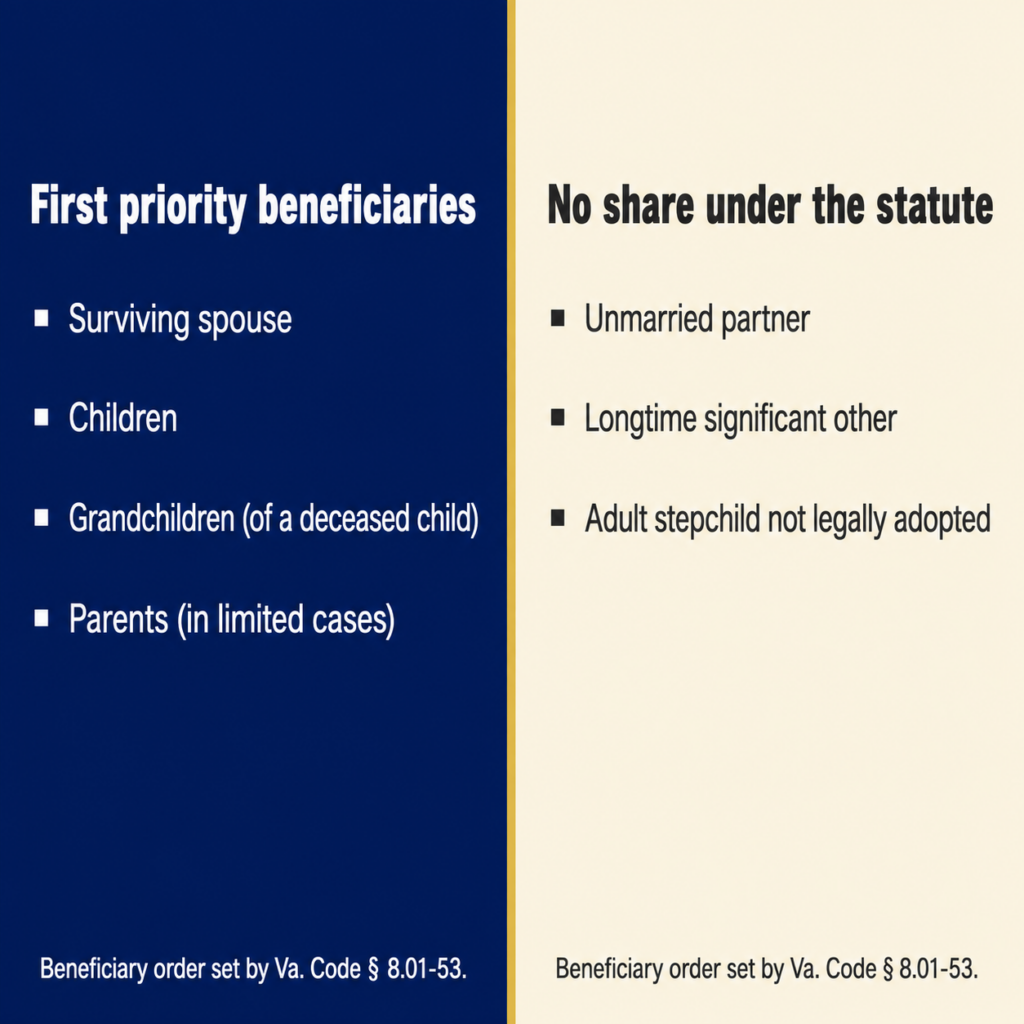
Priority order:
- First priority (spouse and descendants): The surviving spouse, children of the deceased, and grandchildren (children of any deceased child of the decedent). If any of these family members survive, parents of the deceased may also share in the recovery, but only if they regularly received financial support or services from the decedent within the 12 months before the death.
- Second priority (parents, siblings, dependents): If no spouse, children, or grandchildren survive, the award goes to the decedent’s parents, siblings, and any other relatives who were primarily dependent on the decedent and lived in the same household.
- Spouse and parents, no children: If the decedent leaves a surviving spouse and parent(s) but no children, the proceeds are divided between the spouse and parent(s). Other dependent relatives in the household may also share.
- No qualifying beneficiaries: If none of the above categories apply, the recovery is distributed according to Virginia’s general intestacy laws (Va. Code § 64.2-200).
This hierarchy is rigid. Siblings and parents receive nothing if a spouse or child exists. An unmarried partner, a longtime significant other, or an adult stepchild who was not legally adopted has no claim under the statute, regardless of how close the relationship was.
What Damages Can Surviving Families Recover?
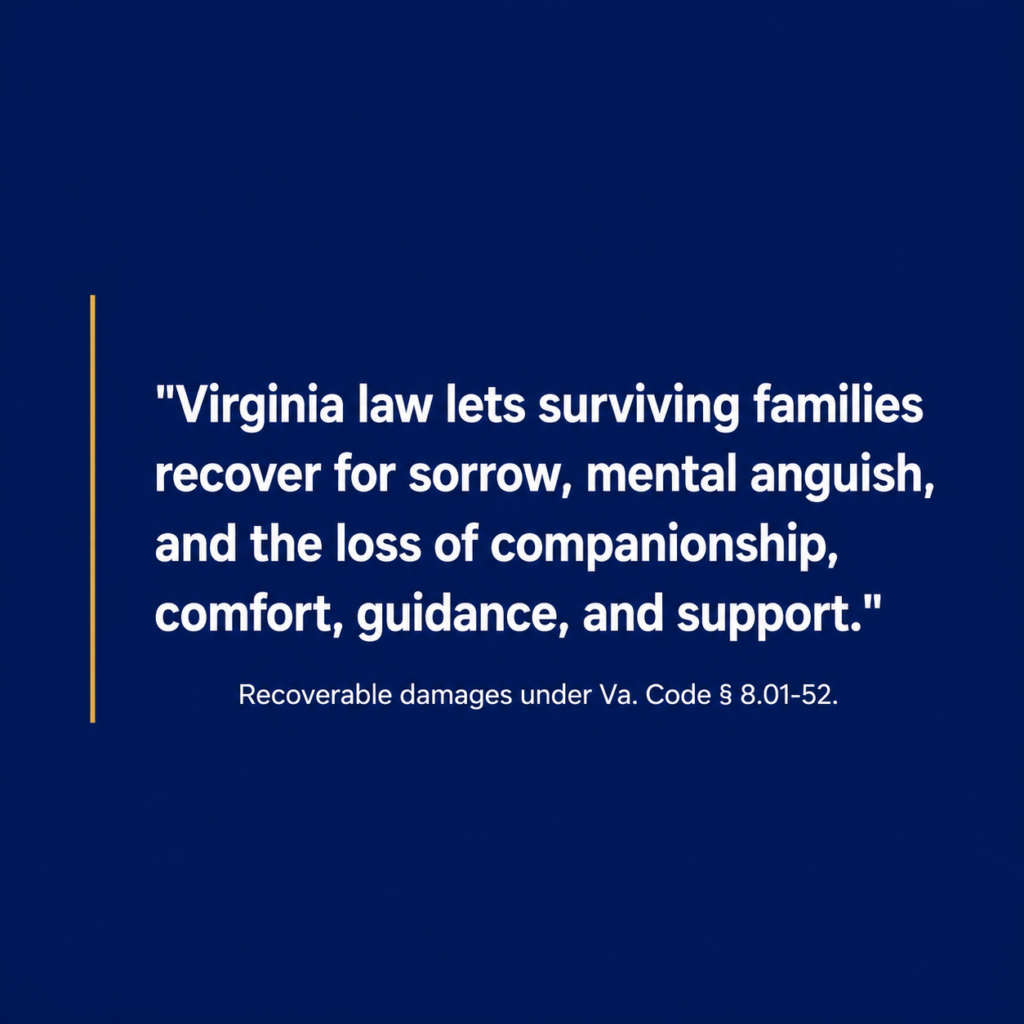
Va. Code § 8.01-52 lists the types of damages a jury or judge may include in a wrongful death award. These damages focus on the losses suffered by the surviving family members.
- Emotional and relational loss: Compensation for the survivors’ sorrow, mental anguish, and loss of companionship, comfort, guidance, and support. The statute specifically includes the loss of “kindly offices and advice” the deceased would have provided.
- Lost income and services: The financial support the deceased would have contributed to the family, plus the value of household services (childcare, homemaking, protection) the deceased would have provided.
- Medical and care expenses: Hospital, medical, and nursing costs incurred by the deceased person as a result of the injury that led to death.
- Funeral and burial costs: Reasonable funeral, burial, or cremation expenses.
- Punitive damages: If the defendant’s conduct was willful, wanton, or so reckless that it showed conscious disregard for others’ safety, the court may award punitive damages. This can apply in cases involving drunk driving fatalities or other egregious misconduct.
One important distinction: Virginia’s wrongful death damages compensate the surviving family, not the deceased. The statute does not cover the deceased person’s own pain and suffering before death. To recover those losses, the personal representative would need to file a separate survival action.
Virginia’s 2-Year Filing Deadline for Wrongful Death
Under Va. Code § 8.01-244(B), the personal representative must file the wrongful death lawsuit within two years of the date of the decedent’s death. Not the date of injury. The date of death.
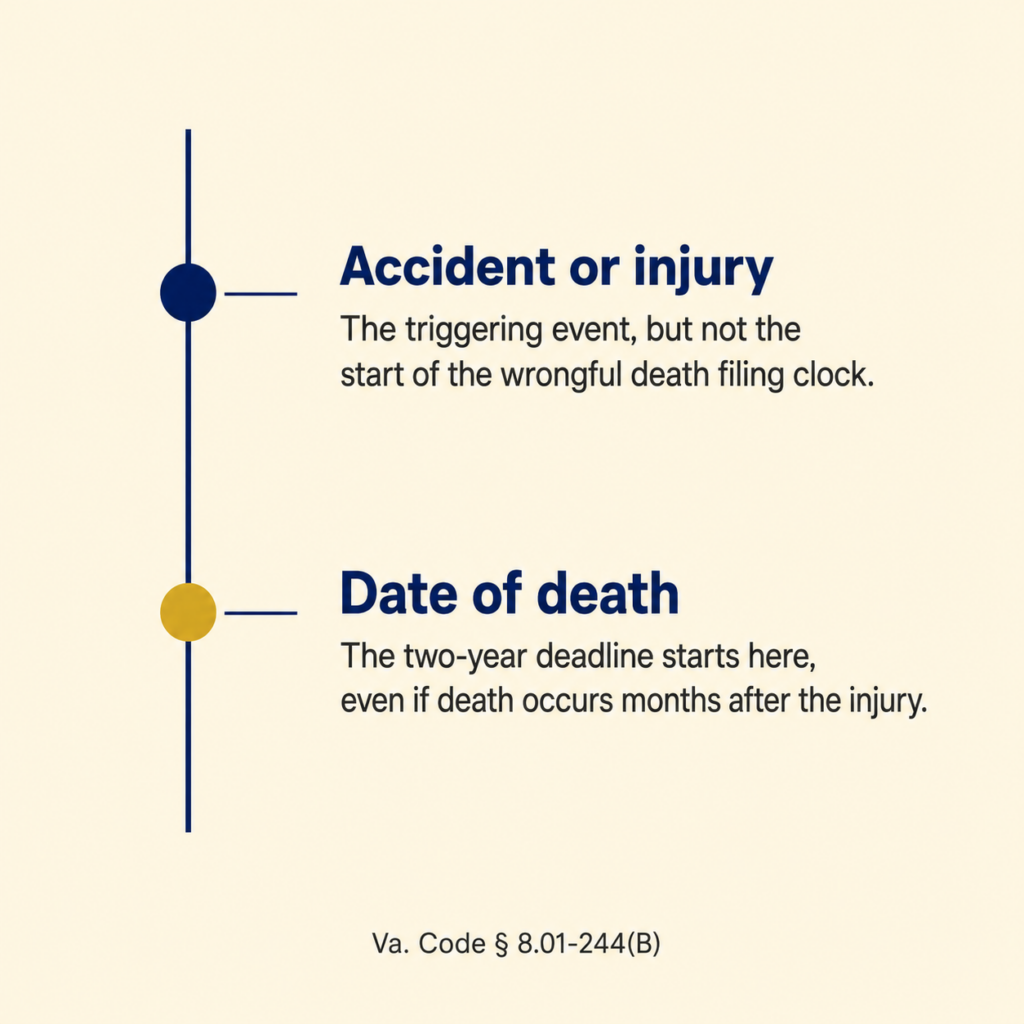
This distinction matters. If someone is critically injured in an accident and survives for six months before dying from those injuries, the two-year clock starts on the date they passed, not the date of the accident.
Missing the deadline is fatal to the claim. Virginia courts will dismiss a case filed even one day late. There are very limited exceptions:
- If a prior action was filed within the two-year window and then dismissed on the merits, the time spent in that earlier case does not count against the deadline.
- A voluntary nonsuit (voluntarily dismissing a case without a ruling on the merits) does not pause the clock.
Because families also need to open probate and appoint a personal representative before filing, the actual window for investigation and case preparation is often shorter than two years.
How Is a Wrongful Death Award Distributed?
After a wrongful death case resolves (whether through settlement or verdict), the personal representative pays any court costs and then divides the award among the statutory beneficiaries according to the priority order described above.
One critical protection: wrongful death proceeds are “free from all debts and liabilities of the decedent” under § 8.01-53. That means the recovery does not become part of the estate and is not subject to the deceased person’s creditors. The money goes directly to the surviving family members.
How the funds are split among co-beneficiaries is ultimately subject to court approval, but the plan must respect the statutory order. If there is a surviving spouse and children, they must share the proceeds. If only a spouse survives, that spouse receives everything. If only children survive, they divide the award among themselves. Parents and siblings share only if no spouse or children exist.
Wrongful Death Claim vs. Survival Action in Virginia
Many families do not realize that a wrongful death claim and a survival action are two separate legal claims. In practice, a personal representative often needs to consider both.
| Feature | Wrongful Death Claim | Survival Action |
| Who files | Personal representative of the estate | Personal representative of the estate |
| Who benefits | Statutory beneficiaries (spouse, children, etc.) | The decedent’s estate |
| Damages covered | Family’s losses (funeral costs, lost income, loss of companionship, sorrow) | Decedent’s own losses (medical bills, lost wages, pain and suffering before death) |
| Deadline to file | 2 years from the date of death | 2 years from the date of injury |
| Legal basis | New cause of action created by statute because the death occurred | Continuation of the decedent’s personal injury claim under Va. Code § 8.01-25 |
| Where proceeds go | Distributed by statute to survivors (not part of the estate) | Distributed through the estate (by will or intestacy) |
The wrongful death claim compensates the surviving family for what they lost. The survival action preserves the deceased person’s own claims for injuries they suffered before dying. Both may be filed by the same personal representative, but the damages recovered and the people who ultimately receive them are different.
Virginia’s Contributory Negligence Rule
Virginia follows a pure contributory negligence doctrine. This is one of the harshest fault rules in the country, and it applies to wrongful death cases.
If the deceased person was even partially at fault in causing the accident that led to their death, the surviving family recovers nothing. There is no 50/50 split. There is no proportional reduction. Any proven fault on the decedent’s part, no matter how small, completely bars the claim.
Defense lawyers know this and will look for any evidence that the deceased was negligent: speeding, not wearing a seatbelt, jaywalking, ignoring a safety warning, or any other failure to exercise reasonable care. In our wrongful death practice, contributory negligence is the single most common defense raised by insurance companies and opposing counsel. Because the stakes are this high, every wrongful death case in Virginia must be thoroughly investigated to establish that the deceased person was not at fault.
Only a handful of states still follow pure contributory negligence. Most states use comparative negligence systems that reduce (rather than eliminate) a plaintiff’s recovery based on their degree of fault. Virginia is not one of them.
Wrongful Death of an Unborn Child in Virginia
Virginia expressly covers the wrongful death of a fetus. Under § 8.01-50(B), if a fetus dies because of another person’s wrongful act, the natural mother may bring a wrongful death action against the responsible party.
“Fetal death” is defined as death of the fetus before complete expulsion or extraction from the mother, regardless of how far along the pregnancy was. This means that if a catastrophic accident or act of negligence causes the death of an unborn child at any stage of pregnancy, the mother has standing to file a wrongful death claim.
Damages in these cases are distributed to the fetus’s statutory beneficiaries as if the child had been born alive. The statute also clarifies that the mother herself cannot be held liable for a fetal death.
What Families Should Do After a Wrongful Death
If you have lost a family member because of someone else’s negligence, here are the steps that matter most in the early stages.
Start the Probate Process
A personal representative must be appointed before a lawsuit can be filed. The probate process takes weeks to months, and every day counts against the two-year deadline. Contact the circuit court in the county where the deceased resided.
Preserve Evidence
Accident reports, medical records, photographs, witness contact information, and any documentation related to the death should be gathered and stored immediately. Evidence can disappear quickly, especially in cases involving traumatic brain injuries or other severe harm where the circumstances of the accident are complex.
Understand the Full Picture
The personal representative may need to pursue both a wrongful death claim (for the family’s losses) and a survival action (for the deceased person’s own losses before death). These are separate claims with separate deadlines and separate categories of damages.
Talk to an Attorney Early
Virginia’s contributory negligence rule, the strict statute of limitations, and the procedural requirement to appoint a personal representative all create risks that are easier to manage with early legal guidance. We regularly see families lose valuable time because they did not realize how quickly the process needed to start.
Talk to a Wrongful Death Attorney in Northern Virginia
If your family has lost a loved one because of someone else’s negligence, The Leiva Law Firm represents surviving families in wrongful death cases across Fairfax, Arlington, Alexandria, Loudoun, Prince William, and the surrounding Northern Virginia area. Manuel Leiva handles wrongful death cases personally, with over 25 years of trial experience and a background in personal injury litigation from both the plaintiff and defense sides.
Personal injury consultations are free. Call us at (703) 352-6400 or contact us online to discuss your family’s situation.

