




How to Prove Negligent Security After an Assault in Virginia
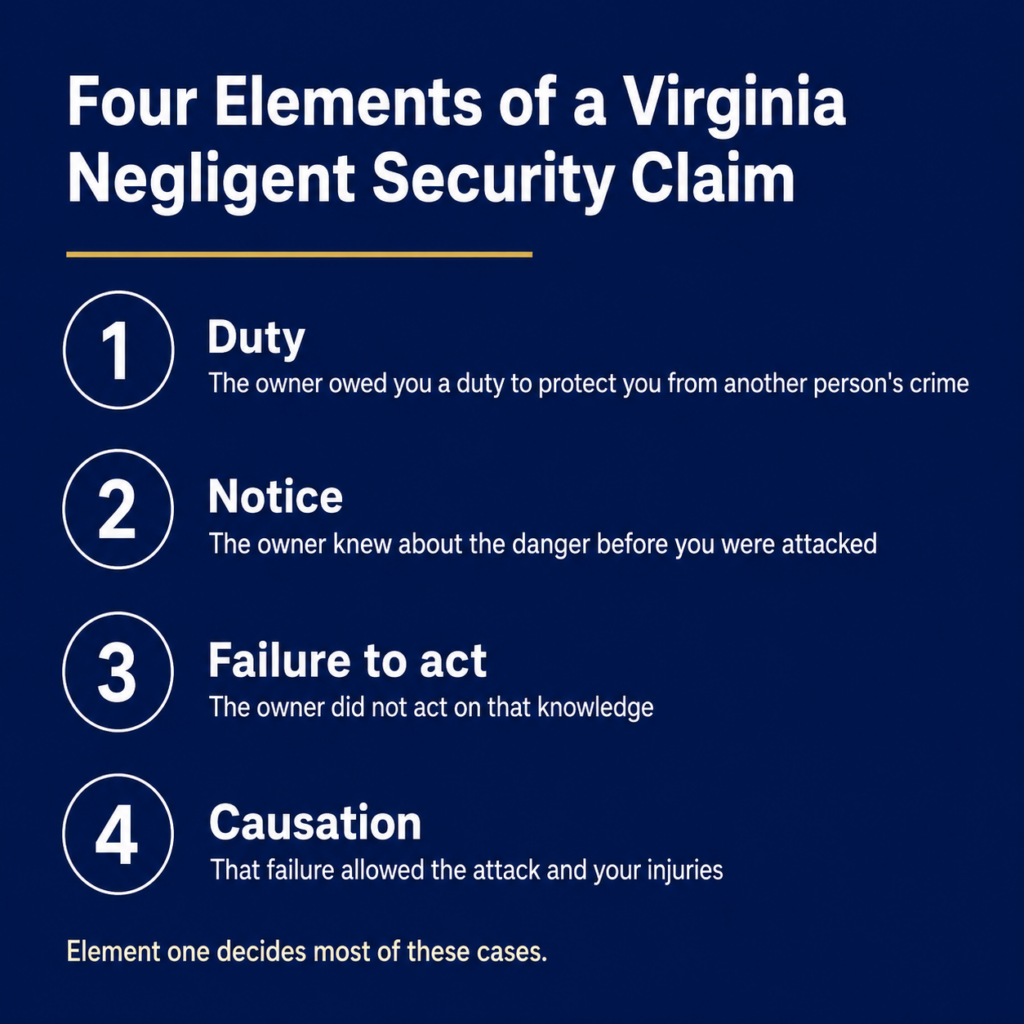
Proving negligent security in Virginia means proving four things. First, that the property owner owed you a duty to protect you from being attacked by another person. Second, that the owner knew about the danger before you were attacked. Third, that the owner did not act on that knowledge. And fourth, that the failure to act allowed the attack and the injuries you are dealing with now. How much the owner had to have known is fixed by Virginia law, and it depends on why you were on the property.
The first of those four decides most of these cases, and Virginia’s version of it is narrower than most people expect. A property owner in Virginia has no general obligation to keep you safe from another person’s crime. That is the starting point, and the Supreme Court of Virginia stated it in Commonwealth v. Peterson, decided in 2013: “as a general rule, a person does not have a duty to warn or protect another from the criminal acts of a third person.” A claim exists only where your situation fits one of the narrow exceptions to that rule.
Which exception fits your situation decides which evidence matters. It is also why what the owner knew before you were attacked matters more than the details of the attack itself.
At The Leiva Law Firm, we handle premises liability cases, including negligent security claims. Manuel Leiva has been licensed in Virginia since 1998 and has handled personal injury from both sides. Before founding the firm he defended physicians in medical malpractice suits, and he has represented plaintiffs in wrongful death actions.
Did the property owner owe you a duty in the first place?
In Virginia, a property owner or business owes you a duty to protect you from another person’s crime only if you were in one of a short list of recognized relationships with that owner. Whether one of those relationships existed decides whether there is a claim at all.
The relationships include common carrier and passenger, business owner and invitee, innkeeper and guest, and a person who has charge of someone who cannot look after themselves, such as a child left in another adult’s care. The Supreme Court of Virginia set them out in A.H. v. Church of God in Christ, Inc., decided in 2019. If your relationship with the property owner was not one of them, Virginia’s default rule applies: the owner owed you no duty to protect you from another person’s crime, and without a duty there is no negligent security claim against that owner.
Being someone’s tenant is not enough by itself
A lease does not put you in one of those relationships. Virginia does not treat landlord and tenant as a special relationship, and in Yuzefovsky v. St. John’s Wood Apartments, decided in 2001, the Supreme Court of Virginia said it has “consistently rejected the contention that the relationship of landlord and tenant, without more, constitutes a special relationship such that a duty of care may arise.” It affirmed the dismissal of the tenant’s negligence claim on that basis.
So a lease by itself does not create a duty to protect you, and a tenant’s claim has to rest on something else. Being attacked in a common area of the complex does not supply it either. A landlord who controls the common areas does have duties there, and in Gulf Reston, Inc. v. Rogers, decided in 1974, the Supreme Court of Virginia described what those duties cover: maintaining “the areas over which he has control in good repair and free of latent defects, rather than the duty to police.” The same decision found no relevant case “imposing a duty on a landlord to protect a tenant from isolated criminal acts of third persons merely because of the relationship of landlord and tenant.”
Yuzefovsky was itself a common area case. The tenant was confronted by an assailant carrying a sawed off shotgun in a walkway on the property, immediately next to his own apartment, and the Supreme Court of Virginia held that his negligence claims were properly dismissed.
Two routes remain for a tenant, and both come up regularly in apartment cases. The first is a duty the owner took on, which under the 2019 A.H. decision takes an express communication of a specifically described undertaking to protect you. The second is a misrepresentation about security by the leasing office or the property manager, which Yuzefovsky allowed a tenant to plead.
The notice standard is not the same for everyone
Being in one of those relationships is not the end of it. The owner still has to have known something about the danger, and Virginia sets that requirement at two different heights depending on the relationship. If you were a customer on business property, the owner has to have known of “an imminent probability of injury from a third party act.” If you were a hotel guest, a passenger, or in the care of someone responsible for you, it is enough that the danger was “known or reasonably foreseeable.” The 2019 A.H. decision is where those two standards are sorted out.
The customer’s standard is the harder of the two to meet. The “imminent probability” language comes from Wright v. Webb, decided by the Supreme Court of Virginia in 1987, which required that the owner know that “criminal assaults against persons are occurring, or are about to occur, on the premises which indicate an imminent probability of harm.” A hotel guest and a shopping center customer are held to different tests, so where you were and why you were there changes what you have to prove. Use the table below which describes where you were and the reason you were there.
| Where you were attacked | The relationship Virginia recognizes | What the owner has to have known |
|---|---|---|
| A store, mall, restaurant, or its parking lot, while you were there as a customer | Business owner and invitee | That criminal assaults were occurring or about to occur on the property, showing an imminent probability of injury |
| A hotel or motel where you were a registered guest | Innkeeper and guest | That the danger was known or reasonably foreseeable |
| A bus, train, or other public transportation | Common carrier and passenger | That the danger was known or reasonably foreseeable |
| The apartment complex where you rent | Landlord and tenant, which Virginia does not treat as a special relationship | The lease creates no duty, so no amount of owner knowledge is enough on the lease alone, and being attacked in a common area does not change that. Where a Virginia court has assumed a landlord and tenant special relationship for the sake of argument, it applied the imminent probability standard to decide whether a duty existed |
Invitee or licensee, and how that fits with the list above
This is the same classification doing two jobs, not a second test you also have to pass. “Invitee” is the word inside the relationship “business owner and invitee,” so whether you were an invitee decides whether you are in that relationship at all. It also decides the general level of care the owner owed you. An invitee is a customer or anyone else who is on the property for the owner’s business, and under Tate v. Rice, decided in 1984, an owner or occupier of land “must use ordinary care to keep his premises reasonably safe for an invitee, although he is not an insurer of the invitee’s safety.” In plain terms, the owner has to take reasonable care of the property, and the owner is not responsible for everything that happens on it.
A licensee is owed much less, and a licensee is not in the business relationship at all. A social guest is the usual example. Under the same decision, an owner is liable to a social guest or a licensee “only for injuries caused by active or affirmative negligence, or by wilful or wanton conduct.” That means something the owner actively did, rather than a dangerous condition the owner simply left alone. If you were on the property as a social guest rather than for the owner’s business, expect the owner’s insurer to argue you were a licensee rather than an invitee, because the two categories carry different duties.
When the property owner promised to protect you
A property owner can also create a duty by promising to protect you, and this route does not depend on which category you fall into. Under the 2019 A.H. decision, a defendant can expressly assume a duty by communicating a specifically described undertaking to protect someone. What counts is a specific promise communicated to you. A safety policy the company adopted internally is not by itself enough.
What the leasing office or the property manager told you is where this comes up. In Yuzefovsky, the leasing agent had told the tenant that the complex was crime free and had a police presence. The court treated those as statements of fact rather than opinion, so what the agent said was legally relevant. The tenant’s fraud claim was still dismissed, because he was attacked more than a year and a half after he was told, and that gap made the damages too remote from the statement. Virginia has not set a fixed cutoff for how recent a promise has to be. If a leasing office, a website, or a resident handbook promised you patrols, a manned gate, working cameras, or a courtesy officer, save that material now, and write down when you were told and when you were hurt.
What the owner had to have known, and what actually proves it
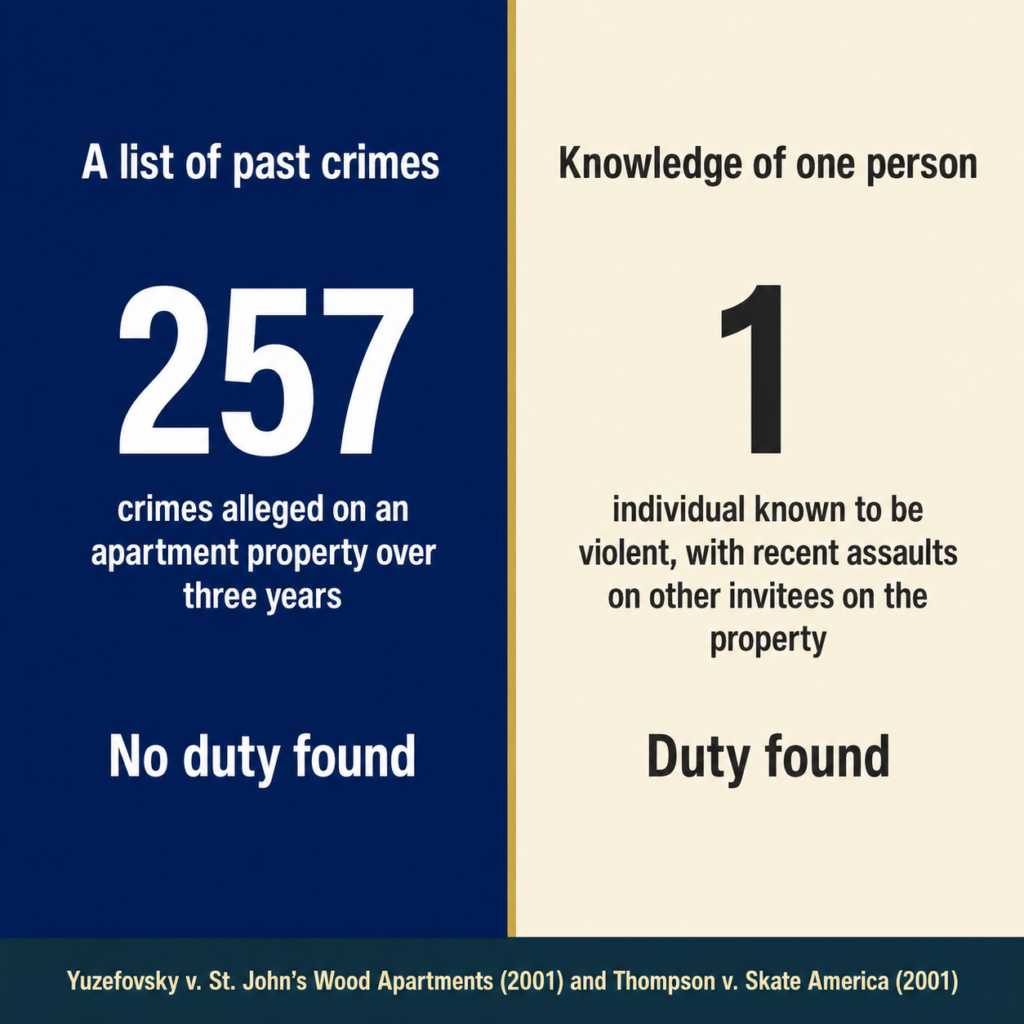
Notice is the element that decides most of these cases, and the kind of notice matters more than the amount. A long list of past crimes at the address, standing alone, has repeatedly failed to establish a duty in Virginia. Knowledge about one specific dangerous person has succeeded. The tenant in Yuzefovsky alleged 257 crimes were committed on the apartment property over three years, and that did not create a duty, because none of it showed that an assault on him was about to happen. In Thompson v. Skate America, Inc., also decided in 2001, the Supreme Court of Virginia found a duty where “a specific individual was known to Skate America to be violent and to have committed assaults on other invitees on its property in the recent past,” and it distinguished that from cases about general criminal activity by unknown people.
If the person who attacked you is known, the most useful questions are about him/her. Had that person been banned from the property before? Had staff called police on him/her? Had another tenant or customer reported the same person? Was that person an employee, a former employee, or someone the leasing office had already been warned about? Answers to those questions do more for a Virginia claim than a list of crime statistics for the address.
If your attacker was a stranger who ran off, or was never identified at all, those questions have no answers. Two other routes to notice remain, and neither one depends on knowing who attacked you. The first is what the owner knew about assaults on the property itself. The second is a promise the owner made about security, which creates a duty on its own. If you were a hotel guest or a passenger rather than a customer, the standard is lower: the danger only has to have been known or reasonably foreseeable.
The physical conditions on the property prove a different element than notice does. A gate that had been broken for months, a stairwell light that was out, a camera that recorded nothing, an empty guard post: none of that shows the owner knew an assault was coming. Those conditions show what the owner did or did not do about the danger, which is the third element. Notice and failure to act are proved with different material, and a claim needs both.
The evidence, where it lives, and how long it lasts
Almost none of the proof in a negligent security case belongs to you. It is held by the property owner, its management company, its security contractor, and the police.
| Evidence | What it proves | Who has it | How long it lasts |
|---|---|---|---|
| Security camera footage | How the attack happened, and whether gates, lighting, and guards were working | The property owner or its management company | Roughly one month on average before it is overwritten |
| Police incident report and call records | The basic facts of the attack, and what the property had reported to police before | The local police department, through a Virginia Freedom of Information Act request | Kept long term, but an open investigation file can be withheld |
| Complaints tenants or customers made to management | What the owner knew before you were hurt | The leasing office, the property manager, and their email | Depends on the company’s own document retention practice |
| The property’s own incident logs and security reports | Prior crimes on the property and prior warnings about a specific person | The owner, the management company, the contracted security firm | Depends on the company’s own retention practice |
| Lease, resident handbook, website pages, and marketing material describing security | Whether the owner promised protection, and what it promised | You may have some of it. The owner has the rest | Web pages get changed and taken down. Save copies now |
| Witness accounts | What happened, and what the conditions on the property were like | Neighbors, employees, other customers | Memories fade, employees quit, and tenants move |
| Medical records and photographs of your injuries | The nature and cost of the injuries | The hospital, your doctors, and your own phone | Records are kept for years. Photographs of visible injuries exist only if someone takes them now |
Two items on that list matter more than the rest. The first is the footage, because it is the only record that shows the conditions on the property at the moment you were attacked. The second is anything showing what the owner knew before your attack: a tenant’s email to the leasing office about the broken gate, a police call to the same parking lot two weeks earlier, an incident log entry about the same person. That is the material that proves the notice element.
An owner does not have to produce any of it because someone asked. Most of it comes out after a lawsuit/action is filed, at the stage where each side can be required to produce its records and to answer questions under oath. A preservation demand is what keeps the material in existence until then. It is not a request for the footage. It puts the owner under an obligation to hold on to the material until the point in the case where it can be required. Before an action is filed, an attorney can still ask, and an owner or its insurer sometimes produces something voluntarily.
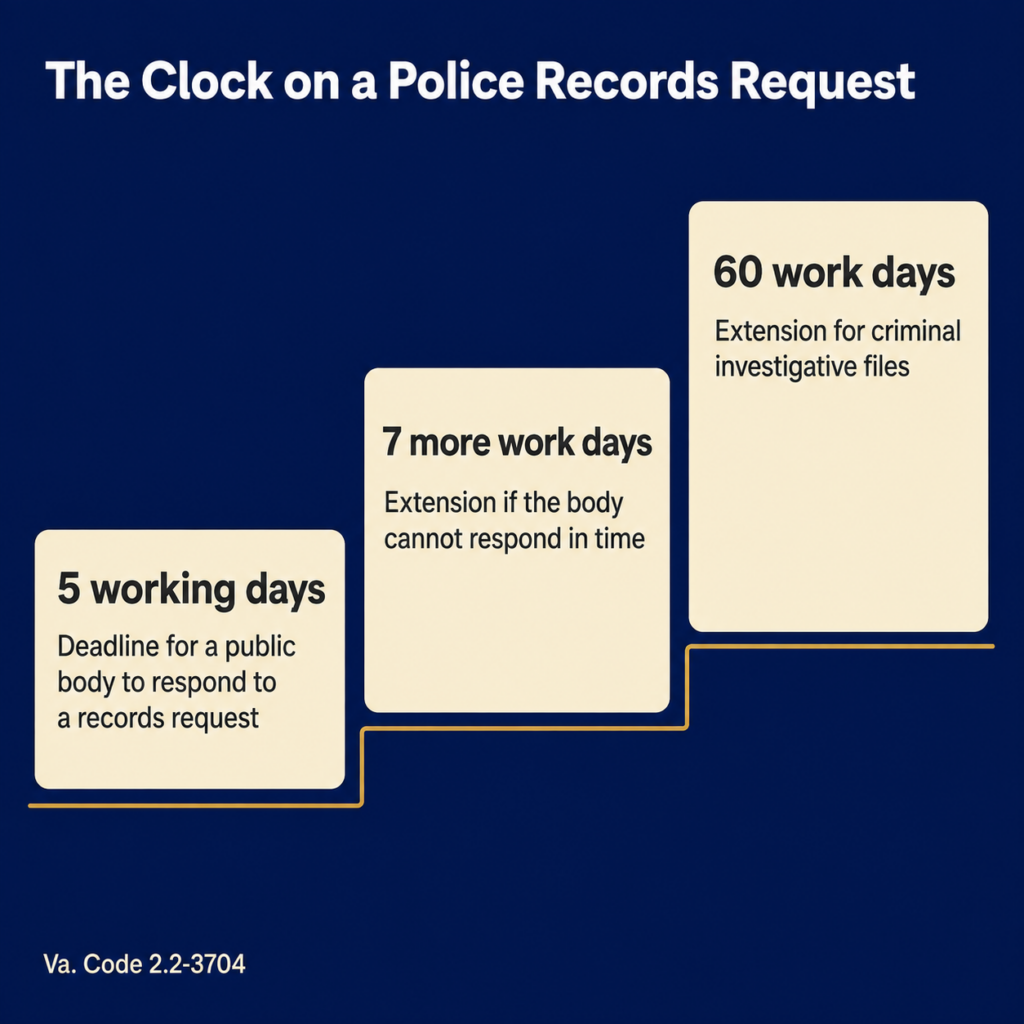
The police records are the exception. Pursuant to Va. Code § 2.2-3704, a public body has five working days to respond to a records request, and it can take seven additional work days if it cannot respond in time. For criminal investigative files, that extension runs to 60 work days, which is why the records request goes in early and the rest of the work goes on while it is pending. Police may withhold criminal investigative files at their discretion under Va. Code § 2.2-3706, which covers the notes, photographs, reports, and witness statements in an open case. They may not withhold everything, though. For a felony, Va. Code § 2.2-3706.1 requires release of basic criminal incident information: a general description of the reported criminal activity, the date and time, the general location, the investigating officer or point of contact, and a description of any injuries suffered or property damaged or stolen. While the criminal case is open, expect that summary rather than the full file.
Your medical records are what connect the attack to your injuries, so the treatment you had and the follow-up care you still need both belong in the file. An assault that causes a head injury or another lasting injury is handled as a catastrophic injury or traumatic brain injury case.
Moving before the evidence is gone
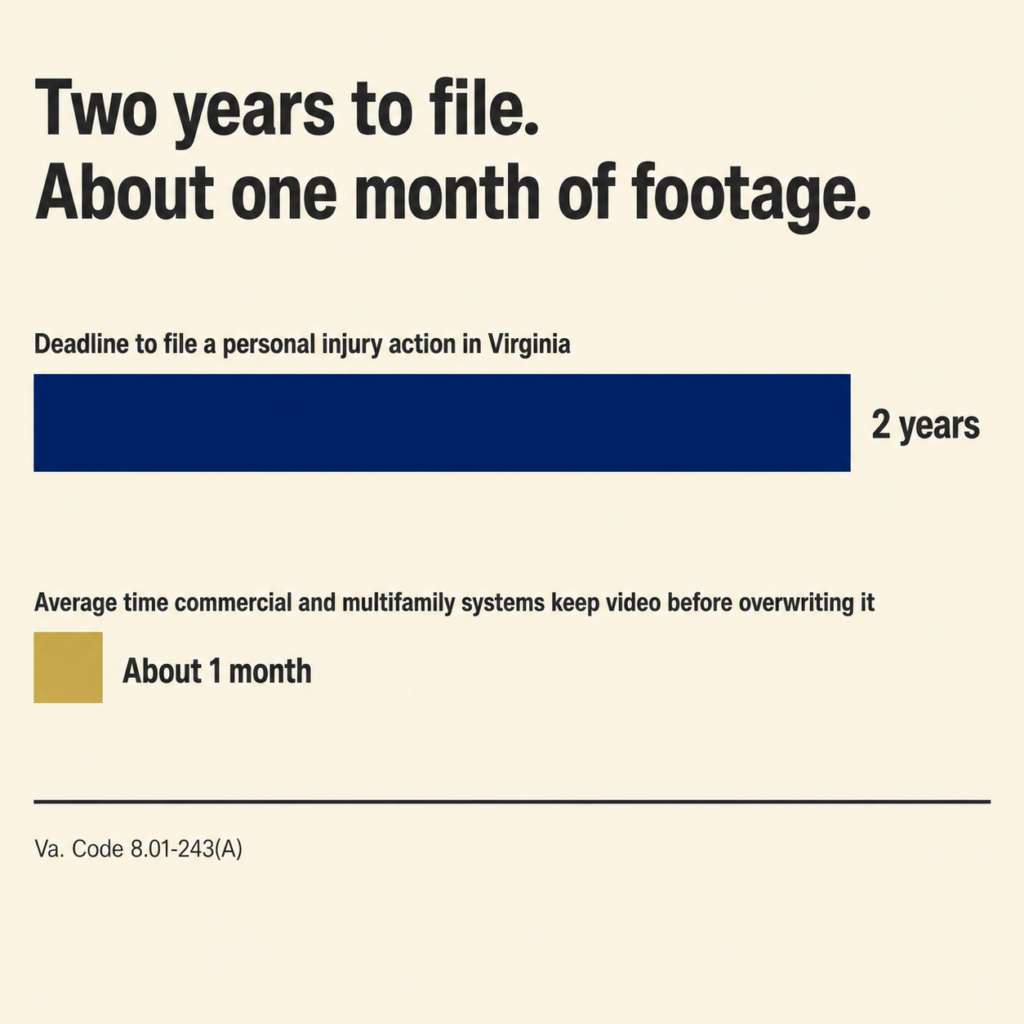
Security video is recorded over on a schedule. Commercial and multifamily camera systems keep about one month of footage on average before overwriting it, and some systems keep considerably less. Nobody at the property has to decide to delete anything. The system reaches the end of its storage and writes over the oldest recording.
A written preservation demand is what stops that evidence from being deleted or destroyed. A preservation letter should be sent to the property owner, the management company, and the security contractor identifying the date, the time, the cameras, and the records at issue, and directing that they be preserved. Its legal effect comes from Va. Code § 8.01-379.2:1, Virginia’s spoliation statute, which imposes a duty to preserve evidence that may be relevant to reasonably foreseeable litigation. Because the demand is in writing and dated, there is a record of when the owner was told that litigation was foreseeable.
What the statute gives you depends on how deliberate the destruction was. If evidence is lost because a party failed to take reasonable steps to preserve it and another party is prejudiced, the court may order measures no greater than necessary to cure that prejudice. The harsher remedies require a finding that the party acted recklessly or with intent to deprive the other side of the evidence. Only then may the court presume the evidence was unfavorable to that party, instruct the jury that it may or shall presume the same, or dismiss the action or enter a default judgment. Routine overwriting that happened before anyone asked for the video is treated differently from a deliberate deletion after a preservation demand arrived.
Most of the work in the first weeks belongs to a lawyer rather than to you. Identifying the owner, the management company, and the security contractor takes investigative work, because they are often three separate companies and the demand has to reach whichever one holds the recording. Sending those demands and filing the records request are the lawyer’s tasks as well.

Three things are worth doing in the next few days, because witnesses move, conditions get repaired, and web pages change:
- Write down every witness name and phone number while those people still work or live at the property.
- Photograph any condition that is still there, such as a broken gate, a dark stairwell, or a camera that does not work. Those conditions are proof of what the owner failed to do, and they get repaired.
- Save the lease, the resident handbook, and screenshots of any page or brochure that described security on the property, since web pages get changed.
Who the claim is filed against, and who pays
The owner of the property is usually not the only potential defendant. The property owner, the management company that runs the place day to day, and any security firm under contract are separate entities, with separate insurance and separate obligations.
If the person who attacked you worked at the property, there is a second and separate claim to look at. Virginia allows a claim against an employer for putting an unfit person into a job where they could foreseeably hurt someone. The Supreme Court of Virginia recognized it in J. v. Victory Tabernacle Baptist Church, decided in 1988, holding that “negligent hiring is a doctrine of primary liability” under which “the employer is principally liable for negligently placing an unfit person in an employment situation involving an unreasonable risk of harm to others.” That claim asks whether the employer should have put this person in the job at all. It does not require proof that an assault was imminently probable on the property.
Which defendants are in the case decides whether there is anyone who can actually pay. A judgment against an attacker with no assets and no insurance collects nothing. A property owner with liability insurance has a policy that will pay the judgment. Naming one does not cost you the other, because under Va. Code § 8.01-443 a judgment against one of several joint wrongdoers does not bar an action against the others. You are paid only once, though, no matter how many defendants are in the case. What you recover from the defendant who pays covers medical costs, lost income, and the effect the injuries have had on your life, which our premises liability page explains in more detail.
What the property owner will argue back
Two Virginia defenses can end a claim outright, and both are worth understanding before anyone asks you for a statement. Each one is a complete bar to recovery, which means that if the property owner proves it, you recover nothing at all rather than a reduced amount.
The first is contributory negligence. If the property owner proves that you were negligent too, and that your negligence helped cause your injury, the claim is barred. The owner carries the burden of proving it. In Ponirakis v. Choi, decided in 2001, the Supreme Court of Virginia held that “the defendant has the burden of proving contributory negligence by the greater weight of the evidence,” and that the plaintiff’s negligence “must be concurrent with the defendant’s negligence” to bar recovery. Concurrent means you and the owner were both negligent.
The second is assumption of risk, and it is measured by what you personally understood rather than by what a reasonable person would have realized. In Thurmond v. Prince William Professional Baseball Club, Inc., decided by the Supreme Court of Virginia in 2003, the court held that the defense “requires use of a subjective standard, which addresses whether a particular plaintiff fully understood the nature and extent of a known danger and voluntarily exposed herself to that danger,” and that voluntarily assuming the risk of injury from a known danger “operates as a complete bar to recovery.” The question is what you actually knew and understood at the time.
Both defenses are usually proved using the injured person’s own statements. A recorded statement to the property owner’s insurer becomes evidence of what you knew about the danger and what you did about it, and those are the two facts each of these defenses needs. The insurance carrier will also be putting a value on the claim, and part of its assessment is whether your attorney will try the case if the offer is inadequate. Manuel Leiva has 25+ years of trial experience, tries cases in Arlington, Alexandria, Fairfax, Loudoun, and Prince William, and handles these cases personally.
How long you have to file
In Virginia, an action for personal injuries must be filed within two years, whatever legal theory it rests on. That comes from Va. Code § 8.01-243(A). The two years starts from the date the injury was sustained, not from the date you worked out who was responsible, because Va. Code § 8.01-230 fixes the starting point at the date of the injury to the person. If the assault killed the person injured, the claim is a wrongful death action, and under Va. Code § 8.01-244(B) it must be brought within two years of the date of death by the personal representative of the estate rather than by family members in their own names.
Two years is the deadline for filing. It is not how long the evidence lasts, and the video usually runs out long before the two years do. If your assault was months ago, the filing deadline has not moved, and the parts of the record that last longer than video still exist. Police records, complaints tenants made to management, the property’s incident logs, the lease and the marketing material, medical records, and the witnesses you can still name do not disappear on a one month cycle. A preservation demand still matters for whatever the property has kept, and an attorney can ask what that is rather than assuming it is all gone.
Does the criminal case against your attacker change anything?
No. The criminal case and your civil claim are separate proceedings, with different parties and different burdens of proof. The prosecution has to prove guilt beyond a reasonable doubt. Your claim is governed by the ordinary civil standard, a preponderance of the evidence, which the Supreme Court of Virginia described in Ballagh v. Fauber Enterprises, Inc., decided in June 2015, as “the ordinary burden in civil actions.” A preponderance of the evidence means more likely than not, which is a lower standard of proof than the one a prosecutor has to meet.
So a conviction is not required, an acquittal does not end the civil claim, and no charge at all does not end it either. In Selected Risks Insurance Co. v. Dean, decided in 1987, the Supreme Court of Virginia stated that “a judgment of conviction or acquittal in a criminal prosecution does not establish in a subsequent civil action the truth of the facts on which it was rendered.”
The two proceedings do overlap in practical ways, and the criminal file is the main one. Because we work in both criminal and civil courts, we understand how a criminal prosecution and a civil claim interact, and what that means for the records your claim depends on.
Frequently asked questions
Does my civil claim have to wait for the criminal case to finish?
No. The two proceedings are separate, and the two year period for filing your civil action runs from the date you were injured under Va. Code § 8.01-230, not from the date the criminal case ends. The overlap is in records rather than in timing: while the criminal investigation is open, police may withhold the investigative file under Va. Code § 2.2-3706, so some material arrives later than the rest.
Who has to prove what in a negligent security claim?
You prove the four elements of the claim by a preponderance of the evidence, which Ballagh v. Fauber Enterprises, Inc. describes as the ordinary burden in a Virginia civil action. The property owner carries the burden on its own defenses. Under Ponirakis v. Choi, “the defendant has the burden of proving contributory negligence by the greater weight of the evidence.”
Can I bring a claim against both the property owner and the management company?
Yes. They are separate entities with separate insurance, and under Va. Code § 8.01-443 a judgment against one of several joint wrongdoers does not bar an action against any or all of the others. You collect once, though, because full satisfaction of any one judgment, accepted as such, discharges all of the joint wrongdoers except as to costs.
What if I was assaulted more than two years ago?
The period for filing a personal injury action in Virginia is two years under Va. Code § 8.01-243(A), and under Va. Code § 8.01-230 it runs from the date the injury was sustained rather than from the date you learned who was responsible. Because the clock starts on the date of the injury, the date your own two years began is worth confirming with an attorney rather than assuming.
Does the two year deadline change if the person who was attacked died?
The period is still two years, but it runs from a different date and is filed by a different person. Under Va. Code § 8.01-244(B), a wrongful death action must be brought within two years after the death of the injured person, and the personal representative of the estate files it, not the family members individually.
Talk to us about what happened
If you or someone in your family was attacked on property that belongs to somebody else, we will look at what happened, tell you honestly whether the facts fit one of Virginia’s exceptions, and tell you what proof the claim would need. If it happened this week, the preservation letters are the first thing that needs to go out. If it happened months ago, there is still a record to find.
Call The Leiva Law Firm and speak with Manuel Leiva directly. Personal injury consultations are free, we work on a contingency fee, and we handle these cases throughout Arlington, Alexandria, Fairfax, Loudoun, and Prince William. Contact us to get started.

