



Common DUI Defenses in Virginia: What Actually Works
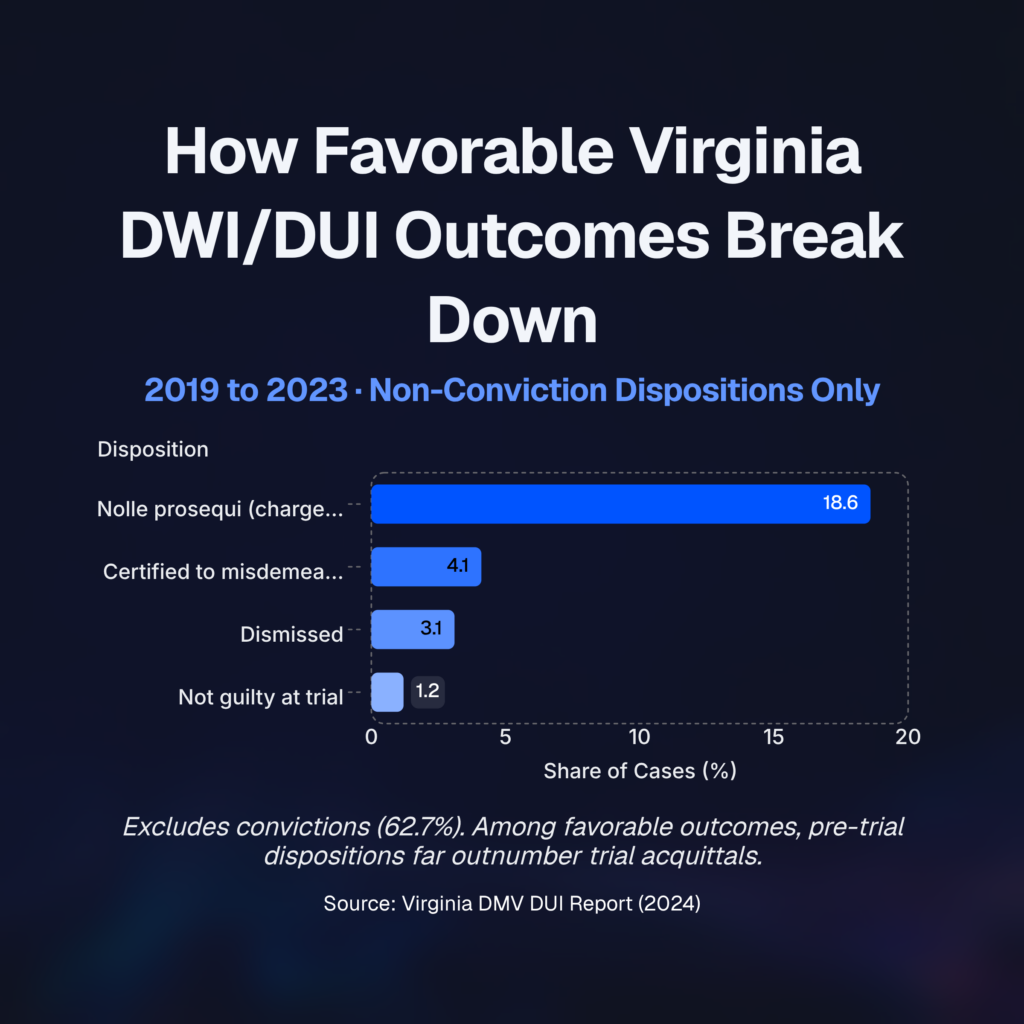
The defenses that actually work in Virginia DWI/DUI cases come down to attacking the evidence and the procedure: challenging the legality of the stop, probable cause for the arrest, raising calibration and maintenance issues with the intoxilizer breath testing machine, exposing flaws in field sobriety test administration, and identifying gaps in the prosecution’s proof of actual driving. Outright acquittals at trial are possible with the right investigation and preparation. According to the Virginia DMV’s five-year report, only 1.2% of DUI charges from 2019 to 2023 ended in a not guilty verdict. Most successful outcomes come from suppression motions, negotiated reductions to reckless driving, or dismissals when the prosecution’s evidence breaks down.
We have over 25 years of trial experience defending Virginia DWI/DUI cases at The Leiva Law Firm, including a third-offense matter that was dismissed entirely after a successful suppression motion based on an illegal stop. The defenses below are the ones that move the needle in real Virginia courts. Some work often. Some work rarely. None of them works without an attorney who knows where to push.
How Virginia Defines DUI Under §18.2-266
Under Va. Code §18.2-266, it is unlawful to drive or operate any motor vehicle on a Virginia highway with a blood alcohol concentration of 0.08% or higher, or while impaired by alcohol or drugs to a degree that affects driving ability. The law defines “operator” broadly. Under Va. Code §46.2-100, a person can be charged with DUI even when sitting in a parked car with the engine running, because they are in “actual physical control” of the vehicle.
A first-offense DUI in Virginia is a Class 1 misdemeanor with a mandatory minimum fine of $250. Penalties escalate quickly for repeat offenses, high BAC readings, accidents, or DUI with a minor in the vehicle.
The Real Numbers: How Virginia DWI/DUI Cases Actually End
Before discussing defenses, it helps to look at how DWI/DUI cases in Virginia actually resolve. The Virginia DMV’s five-year report covers 150,932 DUI charges from 2019 through 2023.
| Outcome | Cases | Percentage |
| Guilty (conviction or plea) | 94,667 | 62.7% |
| Nolle prosequi (charges dropped) | 28,048 | 18.6% |
| Certified to misdemeanor | 6,152 | 4.1% |
| Dismissed | 4,692 | 3.1% |
| Not guilty (acquittal) | 1,780 | 1.2% |
Source: Virginia DMV DUI Report (2024)
The takeaway: when Virginia DWI/DUI cases get beaten, they usually get beaten before trial. That happens through suppression motions that strip the prosecution of its evidence, plea negotiations that reduce the charge to reckless driving, or nolle prosequi when the prosecutor concludes the case is too weak to take forward.
Challenging the Traffic Stop
A traffic stop in Virginia requires reasonable articulable suspicion. An arrest for DWI/DUI requires probable cause. If either is missing, the evidence that follows can be suppressed.
This is one of the more productive defense angles, but it has limits. In Park v. Commonwealth (Va. Ct. App. 2022), the court held that a single-car crash, by itself, does not automatically supply probable cause to arrest. The court still upheld the arrest in that case because the officer observed multiple impairment cues: a strong odor of alcohol, slurred speech, bloodshot eyes, and confused behavior.
The Virginia Supreme Court reinforced the same principle in Commonwealth v. Richerson (2026), confirming that a DWI/DUI conviction can be sustained on observational evidence alone, without any chemical test, when the totality of an officer’s observations supports a finding of impairment.
The practical question for any Virginia DWI/DUI defense: was there a real, legal basis for the stop? Was the arrest supported by something more than a single observation or hunch? Body cam footage, dashcam video, and the officer’s report often tell a different story than the charging criminal complaint, affidavit, and/or police report. Bodycam and videocam footage are extremely important because cases get dismissed at the suppression stage when the video evidence contradicts the officer’s account of erratic driving or impairment cues.
Are Field Sobriety Tests Required in Virginia?
No. Virginia field sobriety tests are voluntary, and refusing them is not evidence of guilt. This is one of the most important things any Virginia driver should know.
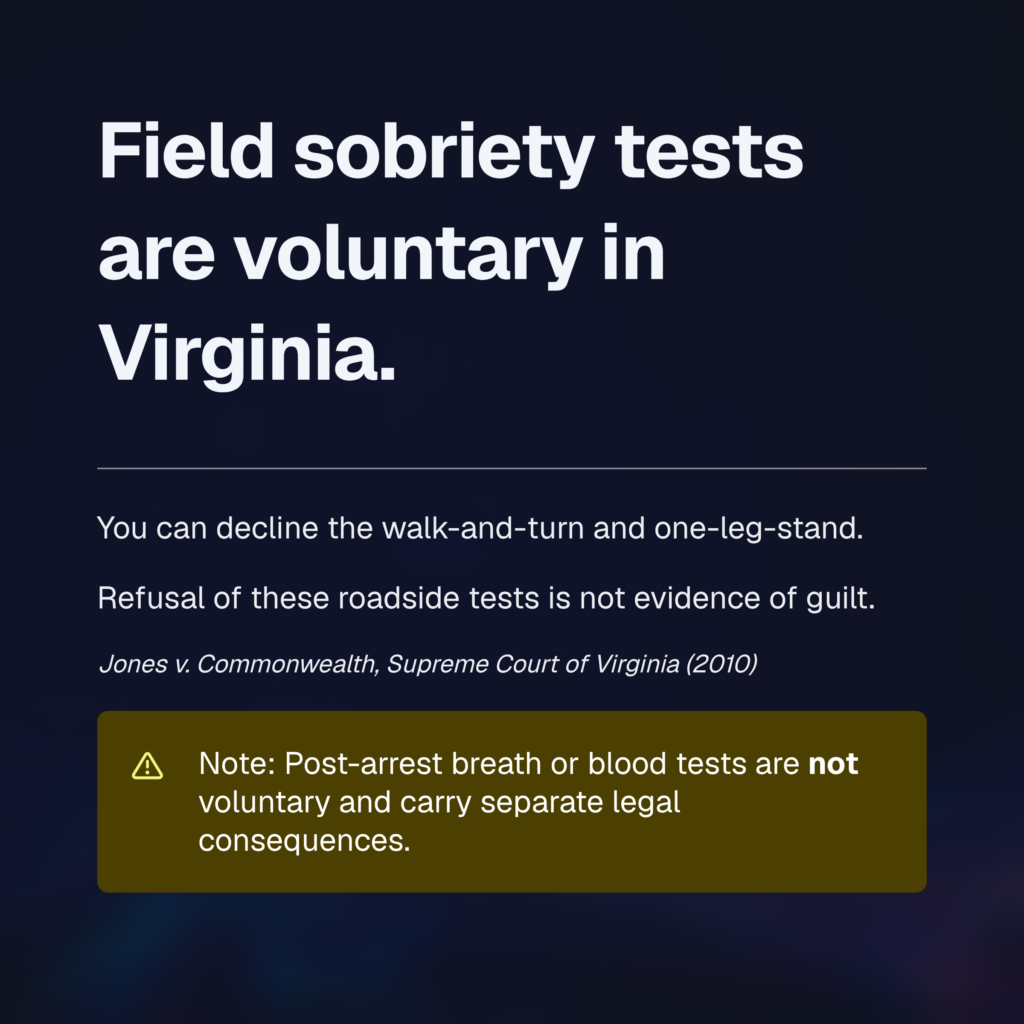
In Jones v. Commonwealth (2010), the Virginia Supreme Court ruled that a suspect’s refusal to perform field sobriety tests is not evidence of guilt. The court explained that a refusal cannot be equated with consciousness of guilt, because there are many innocent reasons someone might decline: fatigue, injury, language barriers, neurological conditions, or simple uncertainty about whether the test is mandatory.
That ruling matters at trial. If a prosecutor tries to argue that a defendant’s refusal to take the walk-and-turn or one-leg-stand shows guilt, the defense can shut that argument down with Jones.
When field tests are administered, they remain open to challenge. Standardized field sobriety tests have well-documented reliability problems. Confounding factors that can cause a sober person to fail include:
- Age (performance declines significantly over 60)
- Weight and physical condition
- Footwear, especially heeled shoes, boots, or work footwear
- Uneven or sloped pavement
- Weather and lighting conditions
- Inner ear or neurological conditions
- Back, knee, or hip injuries
Defense attorneys cross-examine officers on test administration, the conditions on the roadside, and the suspect’s pre-existing physical or medical issues. A flawed field test does not have to be silently accepted as evidence of impairment. The defense can use the same test to argue the prosecution is relying on unreliable data.
Breath Test and Blood Test Defenses
Once arrested, Virginia drivers are subject to implied consent under Va. Code §18.2-268.2. They must submit to a breath or blood test. Most cases involve the Intoxilyzer breath test. Defense challenges focus on three areas: machine calibration, procedural compliance, and operator error.

Breathalyzer Calibration and Maintenance
Virginia regulations require the Intoxilyzer to be maintained, certified, and calibrated to specific tolerances. We routinely subpoena the calibration logs and maintenance records for the specific machine used in a client’s case. If the records show the device was outside tolerance on the relevant date, or if a certification lapsed, the breath result can be excluded, and at a minimum, challenged.
Procedural Compliance and the Right to Observe
Virginia law requires officers to allow a suspect to observe the testing process and obtain a copy of the result. If the procedure was not followed correctly, admissibility can be challenged. Defense attorneys examine the testing room video, time stamps, and the officer’s testimony for inconsistencies. A 20-minute observation period violation, a result printout that does not match the form, or an officer who left the room during the observation period are the kinds of details that can keep a breath test out of evidence.
Blood Test Chain of Custody
Blood tests carry their own vulnerabilities. The collection method, the storage temperature, the time between collection and analysis, and the lab’s handling all create points where the chain of custody can be challenged. If the prosecution cannot account for the sample at every stage, the result may be inadmissible.
The Implied Consent Trap
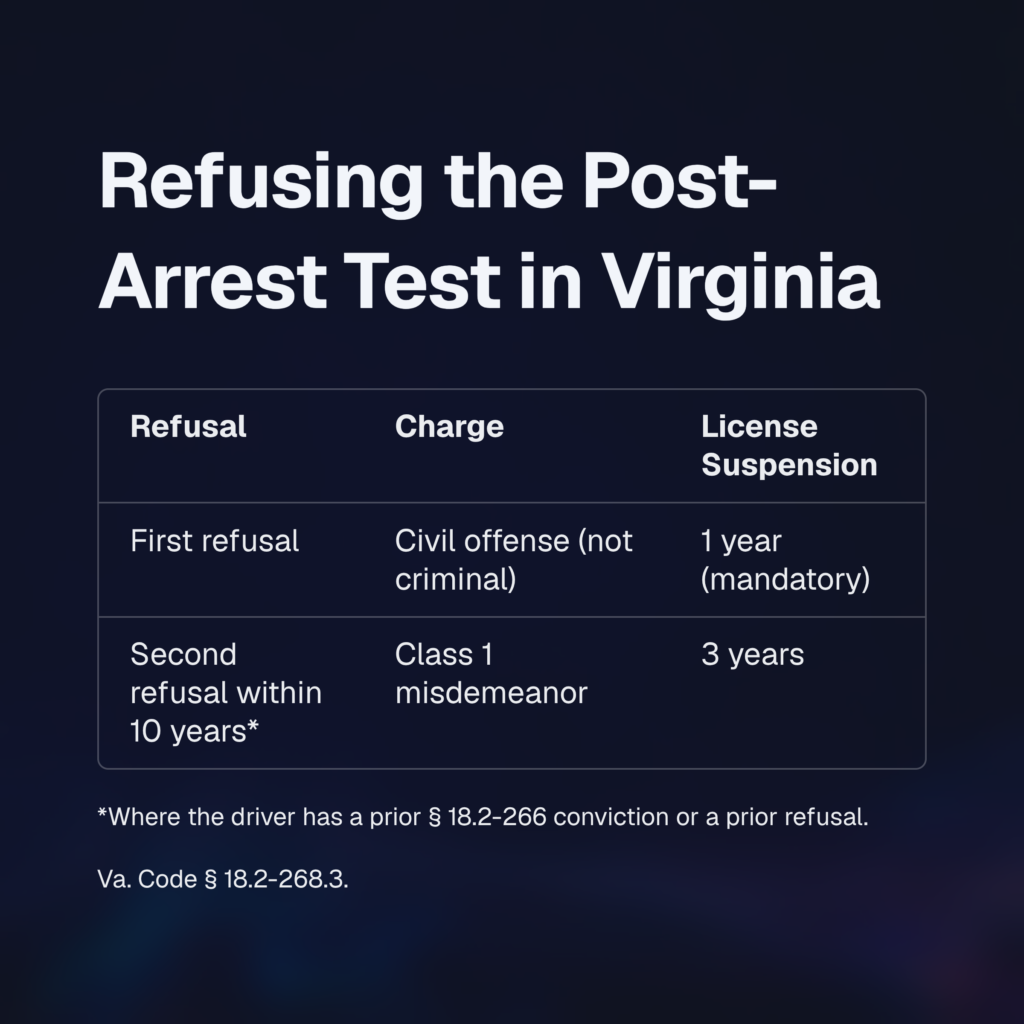
Under Va. Code §18.2-268.3, a first refusal is a separate civil offense that triggers a mandatory one-year license suspension on top of any DWI/DUI penalties. A second refusal within ten years (where the driver has a prior 18.2-266 conviction or a prior refusal) is a Class 1 misdemeanor with a three-year license suspension.
Refusal also gets used at trial. Officers must read an “Implied Consent ” form that warns the suspect that their refusal can be admitted as evidence and the penalties associated with a refusal.
The Court of Appeals addressed this directly in Park. The defendant argued that he should not be convicted of refusal because his elevated BAC came from drinking after the accident (the “rising blood alcohol” theory). The court held that this might be a defense to a DWI/DUI charge, but it is not a lawful reason to refuse the test. The defendant in Park had his refusal conviction affirmed even though the underlying DWI/DUI was challenged.
The exception: when the implied consent procedure itself was not followed. If the officer failed to read the Implied Consent form, gave incomplete warnings, or arrested the driver without a proper basis, those defects can be raised. The threshold for setting aside a refusal is high, and most procedural defects are not fatal.
Was the Defendant Actually Driving?
The prosecution must prove the defendant was driving or operating the vehicle. This sounds straightforward, but it often is not.
Cases where this defense becomes meaningful:
- The officer arrived at the scene of an accident after the fact and did not see anyone driving
- Multiple people were in the vehicle, and identification of the driver is disputed
- The defendant was found asleep in a parked vehicle with the keys removed from the ignition
- A passenger or third party was actually operating the vehicle
In each of these scenarios, defense counsel pushes the prosecution to identify the specific evidence connecting the defendant to actual driving. If that evidence is circumstantial or contradicted by witness statements, the case can collapse on its own.
The Rising Blood Alcohol Defense
This defense argues that the defendant’s BAC was below the legal limit at the time of driving but rose above 0.08% by the time of testing, because alcohol consumed shortly before driving had not yet been fully absorbed. It is a substantive defense to the DWI/DUI charge, supported by toxicology testimony from a qualified expert who can model the absorption curve.
Rising BAC rarely wins on its own, but it can shift the case toward a reckless driving plea or a not-guilty verdict when the timing facts are favorable. The Park decision confirmed that rising BAC is a defense to the DWI/DUI charge but not a defense to the refusal charge.
What “Winning” a Virginia DUI Case Often Looks Like
For most Virginia DWI/DUI defendants, the strategic goal is the best available outcome given the facts. That outcome usually takes one of these forms:
- Suppression of the breath test or arrest evidence, leading to dismissal or amendment of the charge
- Reduction to reckless driving, which avoids the mandatory DWI/DUI penalties (license loss, ignition interlock, ASAP enrollment)
- Nolle prosequi, where the prosecutor drops the charge based on weakness in the evidence
- Negotiated entry into the Virginia Alcohol Safety Action Program (VASAP), often combined with reduced jail time or suspended sentencing
- Acquittal at trial, when the case has the right facts and the defense has done the work to expose them
Each of these outcomes requires different work. Suppression requires motion practice and a hearing. Reductions require credible trial readiness. Prosecutors do not give meaningful concessions to attorneys they know will not try the case. Acquittals require trial skills that, frankly, most attorneys do not have. That track record matters when the prosecutor decides what offer to put on the table.
What This Means If You Are Facing a DWI/DUI Charge in Virginia
The defenses that actually work in Virginia DWI/DUI cases come from detailed factual investigation, knowledge of Virginia case law, willingness to file and argue suppression motions, and credibility with prosecutors and judges. The right defense for any individual case depends on the specific facts: the stop, the officer’s report, the testing procedure, the chain of evidence, and the client’s own circumstances.
If you have been charged with DWI/DUI in Northern Virginia, contact The Leiva Law Firm to discuss the specifics of your case with an attorney who has tried cases at every level of severity in Virginia’s courts. You can also learn more about our criminal defense practice and the full range of charges we handle.

