




How to Win a Medical Malpractice Case in Virginia
Winning a medical malpractice case in Virginia requires more procedural precision than almost any other type of personal injury claim. Before you can even file a lawsuit, you need a written expert opinion confirming that your healthcare provider deviated from the standard of care. You have two years from the date of injury to file. And even if a jury awards you millions, Virginia imposes a hard cap on total recoverable damages, currently $2.70 million for injuries occurring between July 1, 2025 and June 30, 2026.
At The Leiva Law Firm, we handle medical malpractice cases involving death caused by medical negligence. Our founder, Manuel Leiva, has over 25 years of trial experience. Before representing plaintiffs, he defended physicians against malpractice lawsuits at a private litigation firm. That perspective shapes how we build cases: we know the defense playbook because we used to run it.
This guide walks through what Virginia law requires at each stage of a malpractice claim, what strategies position your case for the strongest outcome, and where cases most commonly fall apart.
What Qualifies as Medical Malpractice in Virginia
Under Virginia Code § 8.01-581.1, a medical malpractice claim is any tort action for personal injury or wrongful death based on healthcare services. To prevail, a plaintiff must prove four elements by a preponderance of the evidence (meaning “more likely than not”):
- The healthcare provider owed a duty of care to the patient
- The provider breached the applicable standard of care
- That breach directly caused the patient’s injury or death
- The patient suffered compensable damages as a result
Each of these elements must be supported by expert testimony. If any one of them fails, the case fails. The standard is not perfection. A bad outcome alone does not equal malpractice. The question is whether the provider’s conduct fell below what a reasonably prudent practitioner in the same field would have done under similar circumstances.
The Certificate of Merit Requirement
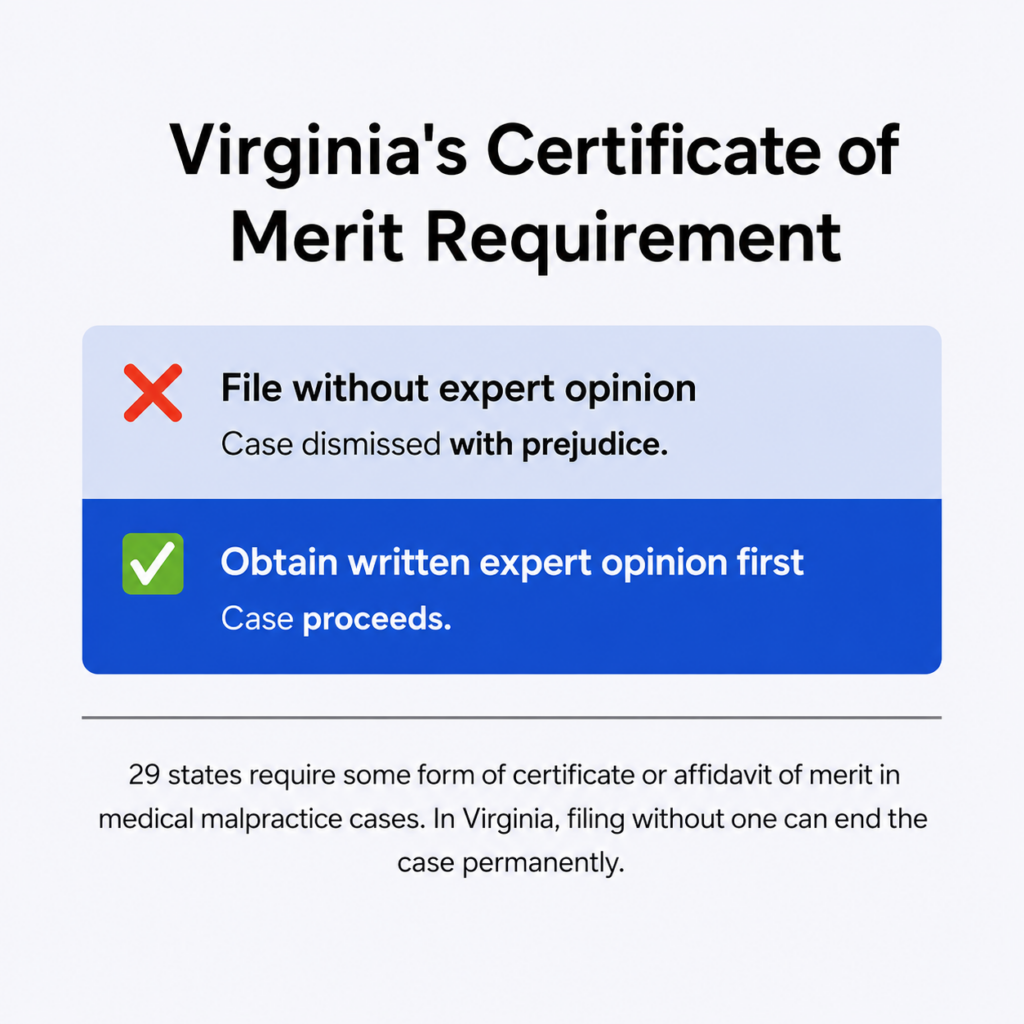
Virginia is a “certificate of merit” state. Under Va. Code § 8.01-20.1, every malpractice complaint filed in Virginia is treated as a certification that the plaintiff has obtained a written expert opinion stating that the defendant deviated from the standard of care and that the deviation caused the injuries claimed.
This is not a formality. If you file a lawsuit without having obtained this expert opinion first, the court can dismiss your case with prejudice, meaning you cannot refile it. The case is over before it starts.
There is one narrow exception: when the negligence is so obvious that a layperson would recognize it without medical training. The classic example is a surgeon leaving an instrument inside a patient. But these “common knowledge” cases are rare. For the vast majority of malpractice claims, you need a qualified expert opinion in hand before serving the complaint.
Virginia’s Two-Year Statute of Limitations
Under Va. Code § 8.01-243(A), the lawsuit must be filed within two years of the date of injury or death. Miss this deadline and the court will bar your claim entirely, regardless of how strong your evidence is.
Virginia does recognize a limited “discovery rule” that can extend the deadline in specific situations:
- A foreign object (such as a surgical instrument) is discovered inside the patient after the procedure
- The healthcare provider committed fraud or concealment that delayed discovery of the injury
- A cancer was misdiagnosed, and the correct diagnosis was discovered later
Even with these extensions, Virginia imposes an absolute outer limit: no malpractice suit may be filed more than 10 years after the act or omission occurred. Special tolling rules apply for minors and individuals who are legally incompetent under Va. Code § 8.01-229.
How Virginia Defines the Standard of Care
The standard of care in Virginia malpractice cases is defined by Va. Code § 8.01-581.20(a) as “that degree of skill and diligence practiced by a reasonably prudent practitioner in the field” in Virginia.
Two important details:
Virginia applies a statewide standard by default. A local standard only replaces the statewide one if the defendant can prove that local resources make a different standard more appropriate. In practice, this means your expert does not need to be from the same city or region as the defendant.
Expert qualifications are strict. The expert must be familiar with the applicable standard of care and must have actively practiced in the relevant discipline (or a closely related one) within one year of the incident. A retired physician who has not practiced recently will not qualify. If the defendant is board-certified in a particular area, the plaintiff’s expert generally must hold comparable credentials.
Building Evidence for a Virginia Malpractice Case
A successful malpractice case is built on documentation and expert analysis. The key components include:
Medical records. These are the foundation. Every treatment note, lab result, imaging study, surgical report, discharge summary, and nursing note is potentially relevant. Your attorney should obtain the complete medical record from every provider involved in the patient’s care.
Expert witness testimony. Virginia limits each side to two expert witnesses per medical discipline at trial, plus any treating physicians. Choosing the right experts is critical. They must meet the strict qualification requirements under § 8.01-581.20, they must be credible on the stand, and they must be able to explain complex medical concepts in terms a jury can follow.
Depositions. Under Va. Code § 8.01-399 and applicable court rules, depositions of treating providers allow disclosure of treatment records and factual observations, though confidential communications remain privileged. Depositions are where you lock in testimony, expose inconsistencies, and build the factual record for trial.
Causation evidence. Proving the provider was negligent is only half the equation. You also need to prove that the negligence caused the injury, not that it merely preceded it. This requires “but-for” causation (the injury would not have occurred but for the provider’s breach) and proximate cause, both typically established through expert testimony.
One additional rule worth knowing: Virginia’s “apology law” under Va. Code § 8.01-581.20:1 prevents a provider’s expression of sympathy from being used as an admission of fault at trial. However, any factual statements of fault made alongside the apology are not protected. If a surgeon says “I’m sorry this happened,” that is inadmissible. If the surgeon says “I’m sorry, I cut the wrong artery,” the second part comes in.
The Medical Malpractice Review Panel
Virginia law provides for an optional Medical Malpractice Review Panel that either side can request within 30 days of the defendant’s answer to the complaint. When a panel is requested, litigation is stayed while the panel reviews the case.
The panel consists of three members: two physicians and one attorney. After reviewing the evidence, the panel issues an advisory opinion on whether negligence occurred.
Two critical points about the panel:
The opinion is not binding on the jury. Virginia’s model jury instructions explicitly state that the panel’s recommendation “is not binding upon you.” The opinion is also privileged and not admissible as evidence of liability.
The panel can still be strategically valuable. Plaintiffs sometimes use it to preview the strengths and weaknesses of their case before committing to a full trial. A favorable panel opinion can also prompt settlement negotiations. On the defense side, requesting a panel can delay trial or obtain an independent expert evaluation at no cost.
Whether to request or participate in a panel is a strategic decision that depends on the specific facts of your case and the strength of your expert evidence.
Virginia’s Damage Cap on Malpractice Recoveries
Virginia is one of a small number of states that caps total damages in medical malpractice cases, including both economic and non-economic damages. Under Va. Code § 8.01-581.15, the cap is tied to the date the malpractice occurred, not the date the lawsuit is filed or the verdict is reached.
The current schedule:
| Malpractice Date Range | Total Damage Cap |
| July 1, 2024 through June 30, 2025 | $2.65 million |
| July 1, 2025 through June 30, 2026 | $2.70 million |
| July 1, 2026 through June 30, 2027 | $2.75 million |
| July 1, 2027 through June 30, 2028 | $2.80 million |
| July 1, 2028 through June 30, 2029 | $2.85 million |
| July 1, 2029 through June 30, 2030 | $2.90 million |
| July 1, 2030 through June 30, 2031 | $2.95 million |
| July 1, 2031 onward | $3.00 million |
This means that even if a jury awards $5 million, the judgment will be reduced to the statutory cap. Punitive damages, available only in rare cases involving gross negligence or willful misconduct, are separately capped at $350,000.
The cap makes thorough documentation of economic losses especially important. Medical bills, lost wages, future care costs, and rehabilitation expenses should all be calculated with precision, because the cap creates a ceiling that forces every dollar of recovery to count.
It is worth noting that Virginia’s 2026 General Assembly considered legislation that would have raised the cap to $6 million. The final bill that passed instead requires hospitals and insurers to report claims data to the legislature by September 2026, which may set the stage for future reforms.
Contributory Negligence: Virginia’s Strictest Defense
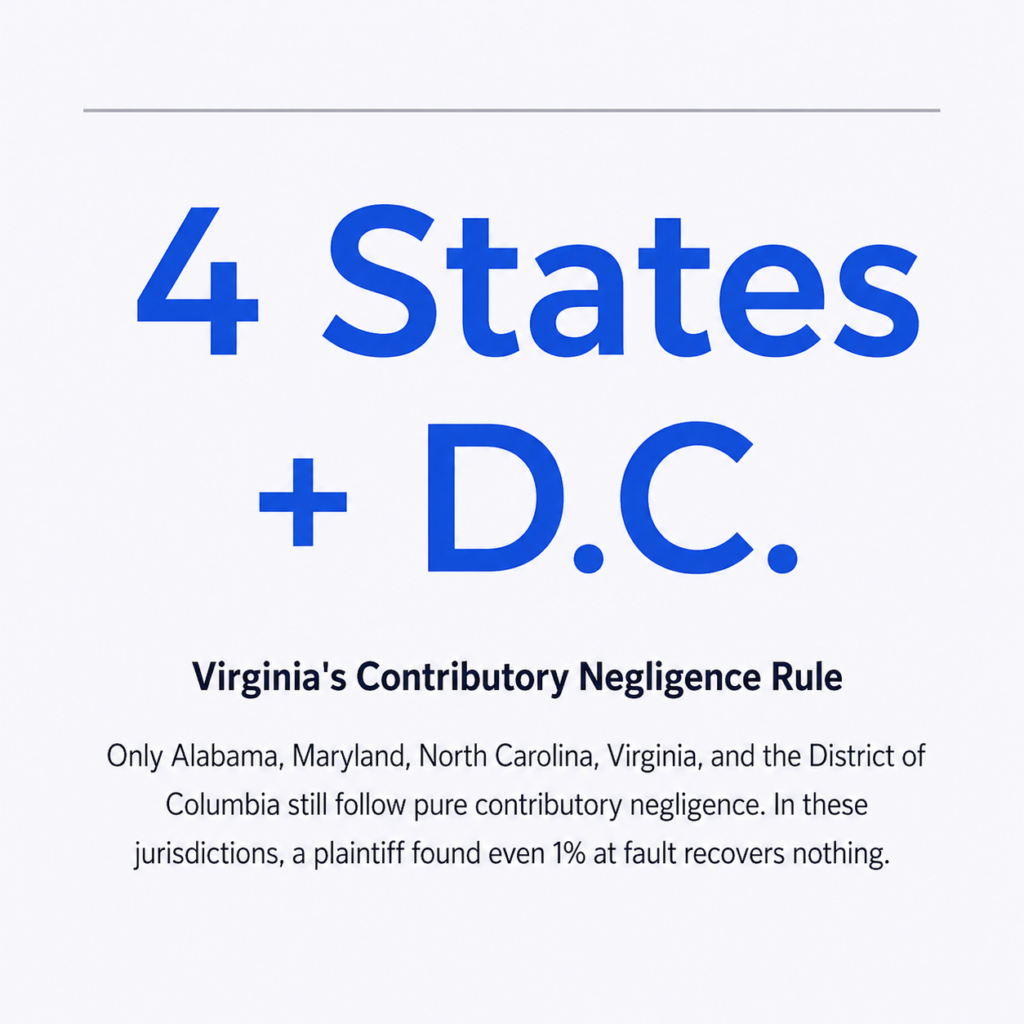
Virginia is one of only a handful of jurisdictions that still follows pure contributory negligence. Under this rule, if the plaintiff is found to be even 1% at fault for their own injury, recovery is completely barred. There is no proportional reduction. Any fault at all eliminates the claim.
In most medical malpractice cases, contributory negligence is difficult for the defense to prove. But it is not impossible. If a patient ignored clear discharge instructions, failed to follow a prescribed medication regimen, or concealed relevant medical history, the defense may argue that the patient’s own conduct contributed to the injury.
Plaintiffs and their attorneys need to be prepared to demonstrate that the patient complied with medical instructions and that any actions the patient took (or failed to take) were not a proximate cause of the harm.
What Makes or Breaks a Virginia Malpractice Case
After handling medical malpractice cases from both the defense and plaintiff sides, certain patterns emerge in what separates cases that succeed from those that do not.
Expert selection is the single most important decision. A case can have strong facts and still lose if the expert is not credible, not qualified under Virginia’s statutory requirements, or cannot communicate clearly to a jury. Conversely, a borderline case with an exceptional expert can achieve a favorable result.
Procedural compliance is mandatory, not optional. The certificate of merit must be obtained before filing. The statute of limitations must be respected. Expert qualifications must meet statutory thresholds. Virginia courts enforce these requirements strictly, and failing to meet any one of them can end a case regardless of the underlying merits.
Early case evaluation matters. Not every bad medical outcome is malpractice. A candid assessment of whether the evidence supports each element, including duty, breach, causation, and damages, saves time, money, and emotional energy. At The Leiva Law Firm, we provide honest assessments during the consultation process. If a case has merit, we say so. If it does not, we say that too.
Understanding the defense perspective is an advantage. Knowing how defense attorneys and insurance companies evaluate malpractice claims, what arguments they prioritize, and where their strategies are vulnerable makes for a stronger plaintiff’s case. Having litigated medical malpractice from both sides, we approach plaintiff cases with insight into what the other side is planning before they execute it.
For cases involving wrongful death due to medical negligence, the stakes are particularly high. Surviving family members deserve compensation that accounts for the full scope of their loss, from funeral costs and lost financial support to the emotional toll of losing a loved one. Virginia’s damage cap makes it essential that every element of the claim is documented, supported by qualified experts, and presented with the precision the law requires. You can see examples of personal injury outcomes we have achieved on our case results page.
When to Talk to a Malpractice Attorney
If you believe a healthcare provider’s negligence caused a death or catastrophic injury, the two-year statute of limitations makes early action important. Medical records need to be preserved, expert opinions need to be obtained, and the certificate of merit requirement means the legal groundwork begins before the lawsuit is even filed.
The Leiva Law Firm represents individuals and families in medical malpractice cases involving death caused by medical negligence. Manuel Leiva has over 25 years of trial experience and has litigated malpractice from both the defense and plaintiff sides, giving him a perspective that most plaintiff’s attorneys do not have.
Personal injury consultations, including medical malpractice cases, are free and carry no obligation. Call (703) 352-6400 or visit our contact page to schedule a consultation.

