



What to Do If You Get a Reckless Driving Ticket in Virginia
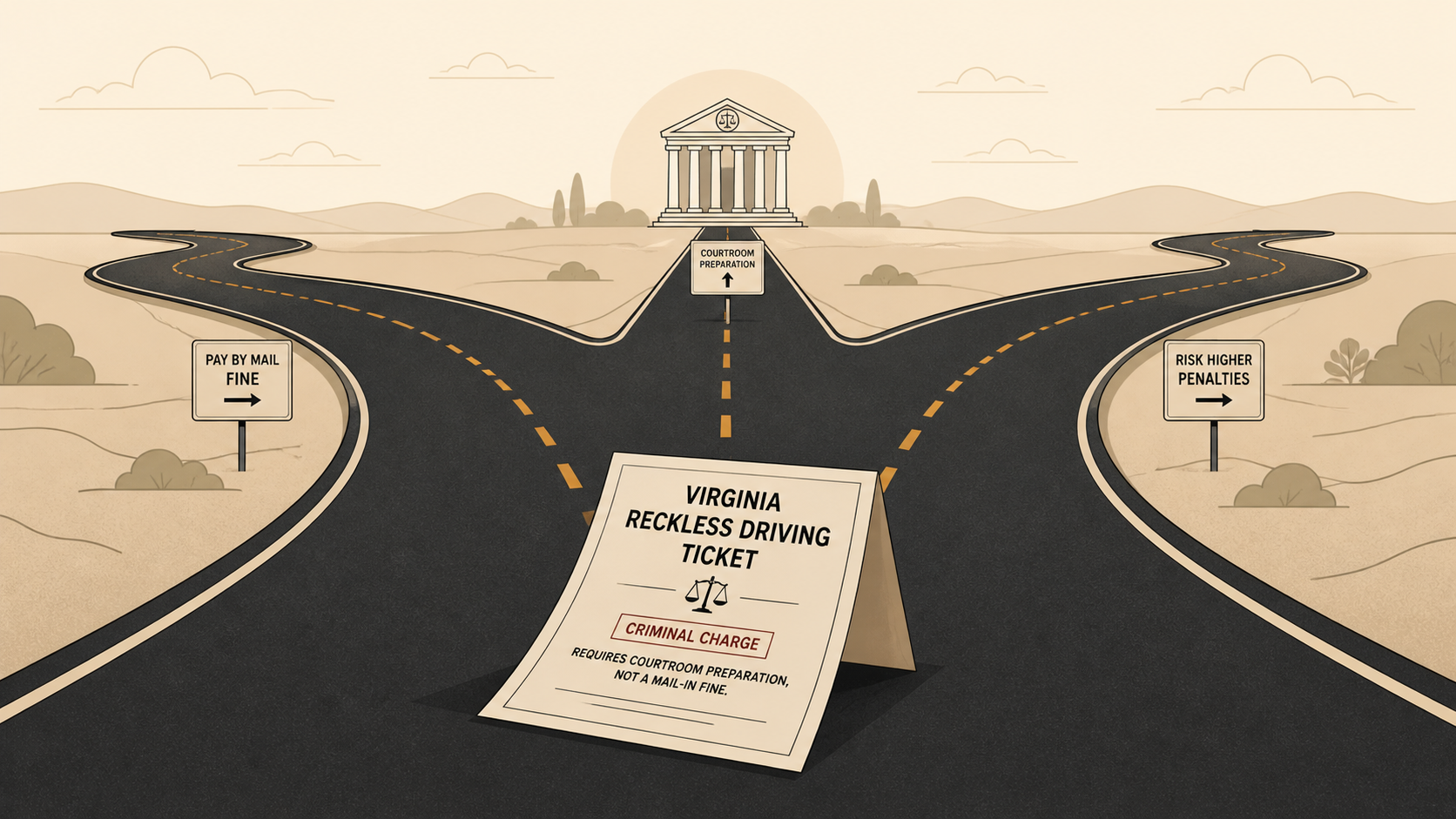
If you just received a reckless driving ticket in Virginia, the most important thing to understand is that you cannot simply pay it and move on. Unlike a standard speeding ticket, reckless driving in Virginia is a Class 1 misdemeanor. That is the same criminal classification as DWI/DUI, assault and battery, and petit larceny. You are required to appear in court, and a conviction creates a permanent criminal record.
At The Leiva Law Firm, we have represented hundreds of clients facing reckless driving charges across Northern Virginia’s courts over more than 25 years of trial experience. What we consistently see is that people who treat this charge like a traffic ticket make mistakes that are difficult to undo. The steps you take between now and your court date can meaningfully affect the outcome of your case.
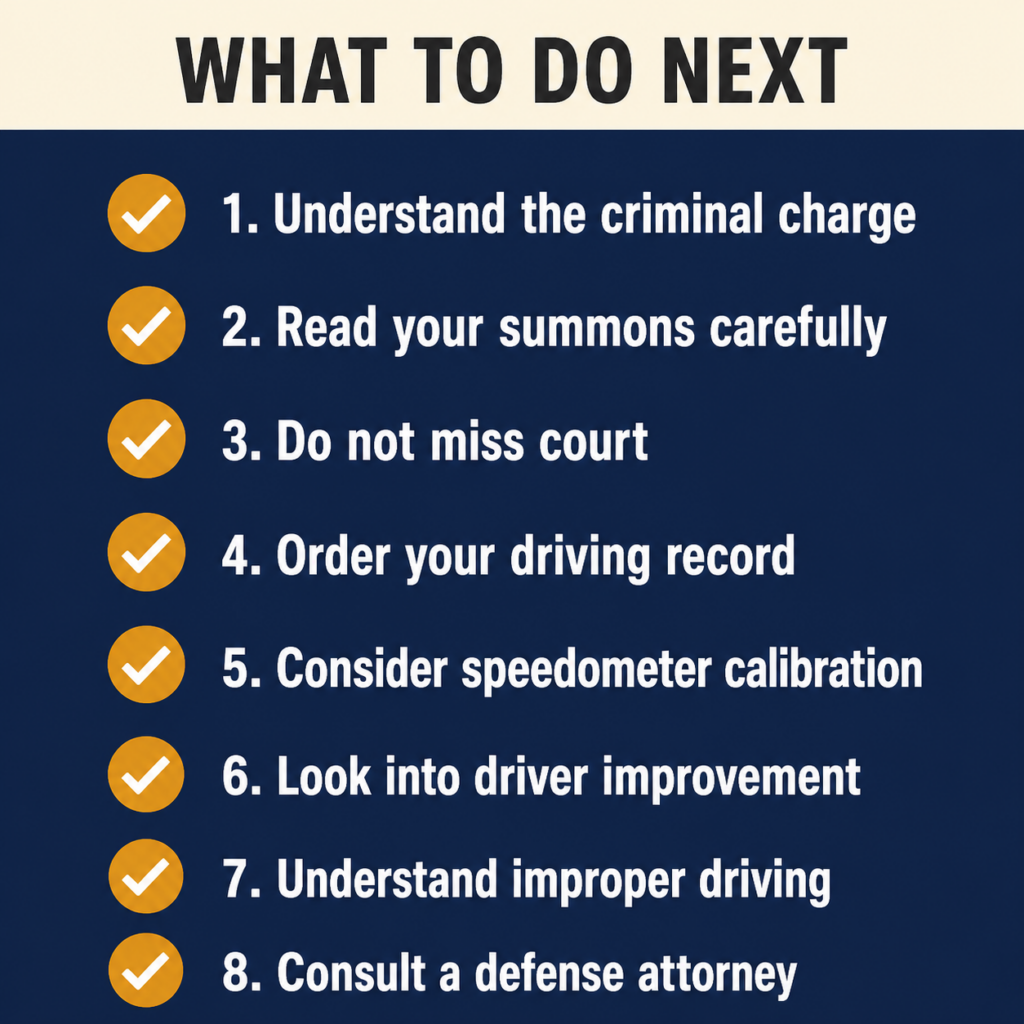
Here is what you need to do:
- Understand that this is a criminal charge, not a traffic infraction
- Read your summons carefully and note your court date
- Do not miss your court date under any circumstances
- Order a certified copy of your driving record
- Consider getting a speedometer calibration
- Look into completing a driver improvement clinic (with caveats)
- Understand what an improper driving reduction is and what it requires
- Consult with a criminal defense attorney
The sections below walk through each of these steps and the legal context behind them.
Reckless Driving in Virginia Is a Criminal Charge
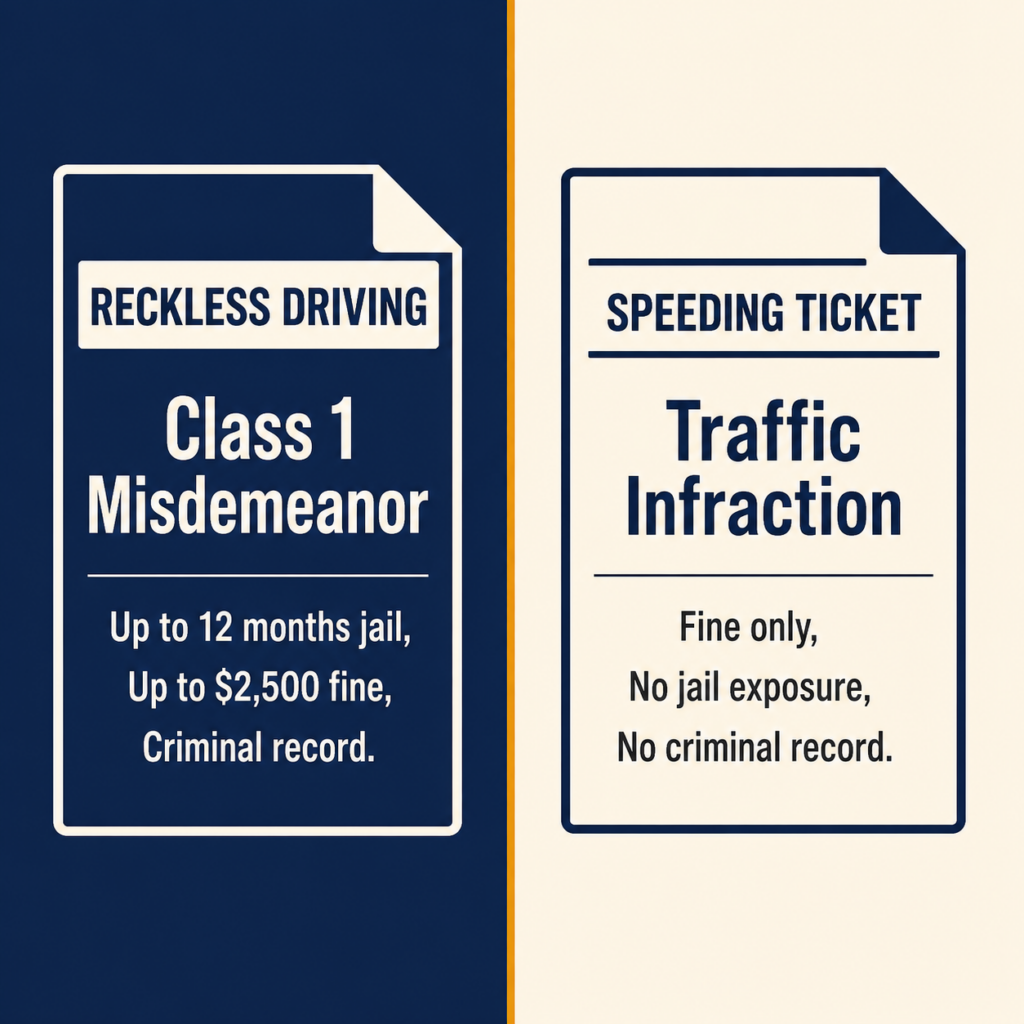
This is where most people’s understanding breaks down. The piece of paper looks like a speeding ticket. The officer may not have used the word “criminal.” But under Virginia law, reckless driving is a Class 1 misdemeanor under Va. Code § 46.2-868.
The maximum penalties for a Class 1 misdemeanor in Virginia are up to 12 months in jail and a fine of up to $2,500, either or both (Va. Code § 18.2-11) and your privilege to drive can be suspended for up to 6 months. Not every reckless driving case results in jail time, but the charge carries that exposure, and the court takes it seriously.
A conviction also means:
- A criminal record that shows up on background checks
- Six demerit points on your Virginia driving record
- The conviction stays on your DMV record for 11 years
- Likely increases to your auto insurance premiums
The Virginia Judicial System’s statewide payment page states it plainly: you may not prepay if the charge is for reckless driving. This is not optional. You must appear in court.
What “Reckless Driving by Speed” Actually Means
The most common reckless driving charge in Virginia is reckless driving by speed under Va. Code § 46.2-862. You can be charged if you were driving:
- 20 mph or more over the posted speed limit, or
- In excess of 85 mph, regardless of the speed limit
The 85 mph threshold was updated in 2020 from the previous 80 mph limit. Some online sources still reference the old number, but the current statute is 85 mph.
Reckless driving in Virginia is not limited to speed. Article 7 of Title 46.2 includes more than 15 separate reckless driving offenses, including passing on a curve, following too closely, failing to signal, racing, and driving with faulty brakes. If your charge is for something other than speed, the same criminal classification and court process apply.
Read Your Virginia Uniform Summons Carefully
The document the officer handed you is a Virginia Uniform Summons. It contains several pieces of information you need:
- The court name appears at the top. This is the court where your case will be heard.
- The description of the charge follows the words “DESCRIBE CHARGE” on the front.
- The notice of your rights and obligations appears on the back.
- The date and time you are required to appear
Read the entire summons, front and back. If anything is unclear, particularly the court location or the specific statute cited, that is something to address with an attorney before your court date.
Do Not Miss Your Court Date
The consequences of failing to appear are severe and immediate.
Under Va. Code § 19.2-128, willful failure to appear after release on summons is itself a punishable offense. If you do not show up, the court may:
- Issue an arrest warrant
- Try your case in your absence (in absentia), which typically results in a conviction
- Impose harsher penalties than you might have received had you appeared
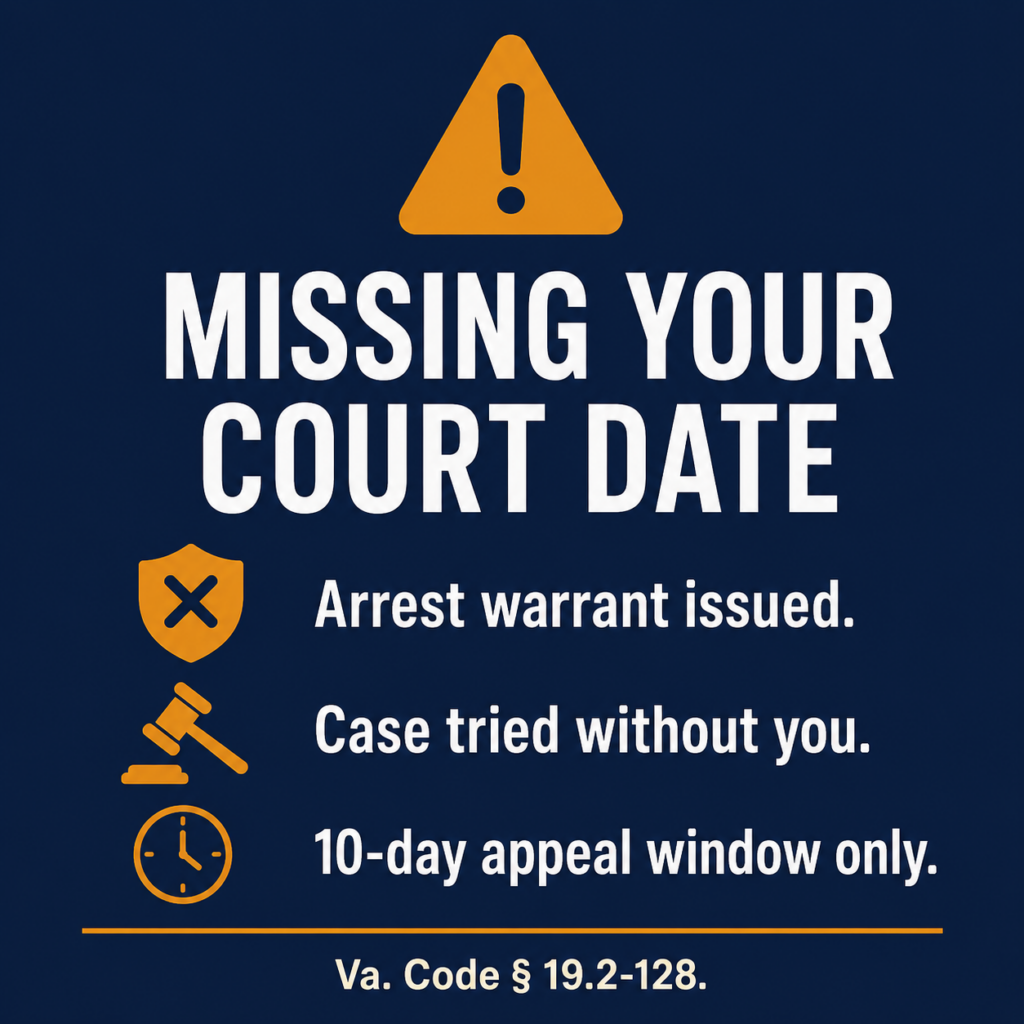
In Fairfax County, the court’s own guidance notes that if your case was tried in your absence, the only path to a new trial is to file an appeal within 10 calendar days. That is a very short window.
If you have a scheduling conflict or live out of state, the right approach is to contact the court or retain an attorney who can request a continuance or file a motion to address your appearance. Do not simply skip the date and assume you can sort it out later.
Steps to Take Before Your Court Date
The period between receiving the summons and appearing in court is where preparation matters most. Several concrete steps can strengthen your position.
Order a Certified Copy of Your Driving Record
Virginia DMV offers several types of driving transcripts. The driver/personal-use transcript contains up to 11 years of history and can be ordered online, by mail (using DMV form CRD-93), or in person. Mailed transcripts are official copies and can be certified for an additional fee.
If you have a clean record or a record with very few infractions, bringing a certified copy to court documents that history for the judge. A clean driving record is one of the factors courts consider when deciding how to handle a reckless driving case.
If you are an out-of-state driver, you should obtain the equivalent official driving record from your home state’s DMV.
Consider a Speedometer Calibration
Virginia has a specific evidentiary statute for speedometer calibration evidence. Under Va. Code § 46.2-942, in a prosecution for exceeding a speed limit, the court shall receive a sworn report of the results of a speedometer calibration test, and that report is considered by the court or jury in both determining guilt or innocence and in fixing punishment.
A calibration is most useful when the speed at issue is close to the reckless driving threshold. If you were clocked at 87 mph in a 65 zone and your speedometer was reading 83, that two-to-three mph difference could matter. If you were going 105 mph, a calibration is unlikely to change the analysis.
The calibration should be performed by a shop that can produce a sworn or notarized report suitable for court. Have it done as soon as reasonably possible after the ticket.
Driver Improvement Clinics
Virginia DMV offers eight-hour driver improvement clinics, available both in-person and online, generally costing no more than $100. Completing a clinic may generate five safe-driving points in some circumstances.
However, court acceptance of pre-court driver improvement completion varies. Virginia DMV itself advises drivers to contact the court to ensure it will accept an online course. Whether a particular judge views a voluntarily completed course favorably before trial depends on the court and the jurisdiction.
If you are considering this step, talk to an attorney who practices in the specific court where your case will be heard before you enroll. Not every judge sees it the same way, and enrolling in the wrong course (or at the wrong time) can occasionally backfire.
Community Service and Character References
Completing community service before your court date can demonstrate accountability.
Character reference letters from employers, community members, or others who can speak to your character and driving habits are also used in reckless driving cases. These are standard mitigation tools. No court is required to give them weight, but they are commonly submitted as part of a defense presentation.
Improper Driving: The Reduction Most People Are Looking For
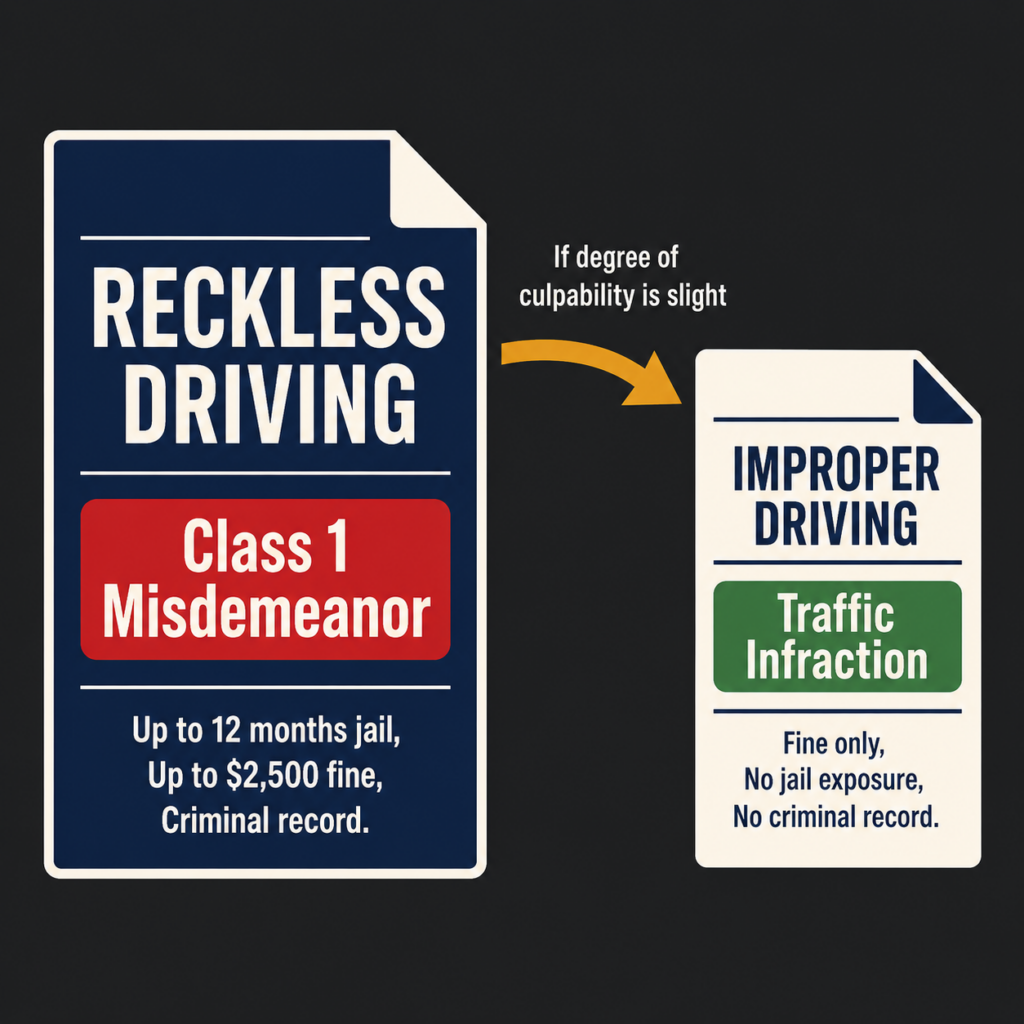
For many first-offense reckless driving cases, the most realistic favorable outcome is a reduction to improper driving under Va. Code § 46.2-869.
Under this statute, if the degree of culpability is slight, the jury or the court trying the case without a jury may find the defendant not guilty of reckless driving but guilty of improper driving instead. A prosecutor may also reduce the charge to improper driving before the court decides the case.
The difference is significant:
| Reckless Driving | Improper Driving | |
|---|---|---|
| Classification | Class 1 misdemeanor (criminal) | Traffic infraction (not criminal) |
| Maximum jail time | Up to 12 months | None |
| Maximum fine | $2,500 | $500 |
| DMV demerit points | 6 points | 3 points |
| Criminal record | Yes | No |
A reduction to improper driving is not automatic and is not a right. The statute uses the phrase “degree of culpability is slight,” which means the court looks at the totality of the circumstances: how fast you were going, the conditions at the time, your driving history, what steps you have taken since the citation, and how close the case is to marginal recklessness versus obvious danger.
This is where preparation matters. A clean driving record, a speedometer calibration showing a meaningful discrepancy, and evidence of proactive steps (driver improvement, community service) all contribute to the argument that the culpability was slight.
What About Expungement?
Under current Virginia law (as of early 2026), Va. Code § 19.2-392.2 does not provide a straightforward path to expunge an ordinary reckless driving conviction. Expungement under the current statute generally applies to cases that resulted in acquittal, dismissal, or nolle prosequi.
Virginia’s record-sealing framework is changing. Beginning July 1, 2026, new provisions under Va. Code § 19.2-392.12 will allow petition-based sealing of many misdemeanor convictions after meeting waiting-period and other requirements. Ordinary reckless driving does not appear on the list of excluded offenses under the new statute, which means sealing may eventually become an option for reckless driving convictions. The statute requires a seven-year clean record and a finding of “manifest injustice” for misdemeanor sealing petitions.
The most accurate answer today is that a reckless driving conviction cannot currently be expunged in most circumstances, but the sealing framework taking effect in mid-2026 may change that.
Out-of-State Drivers Charged with Reckless Driving in Virginia
If you are an out-of-state driver who was ticketed for reckless driving in Virginia (a common scenario on I-95 and I-66, where speed limits and Virginia’s 85 mph threshold catch many drivers off guard), you face the same criminal exposure as a Virginia resident. The charge is a Virginia misdemeanor prosecuted in Virginia court.
What you need to know:
- You may need to appear in person. Whether you can avoid a personal court appearance depends on court approval and local practice. Virginia provides a Motion to Waive Court Appearance form (DC-344) under Va. Code § 19.2-266.3, but the waiver requires a court order. It is not automatic.
- Virginia counsel can help. An attorney licensed in Virginia can enter a written appearance and handle many aspects of the case. For out-of-state defendants, retaining local counsel is often the most practical path.
- The conviction may follow you home. Virginia DMV assigns demerit points for out-of-state convictions, and interstate DMV record-sharing means your home state will likely learn about a Virginia conviction. The exact effect on your home-state license and insurance depends on your state’s laws.
DMV and Insurance Consequences
Even without jail time, a reckless driving conviction carries long-term administrative consequences.
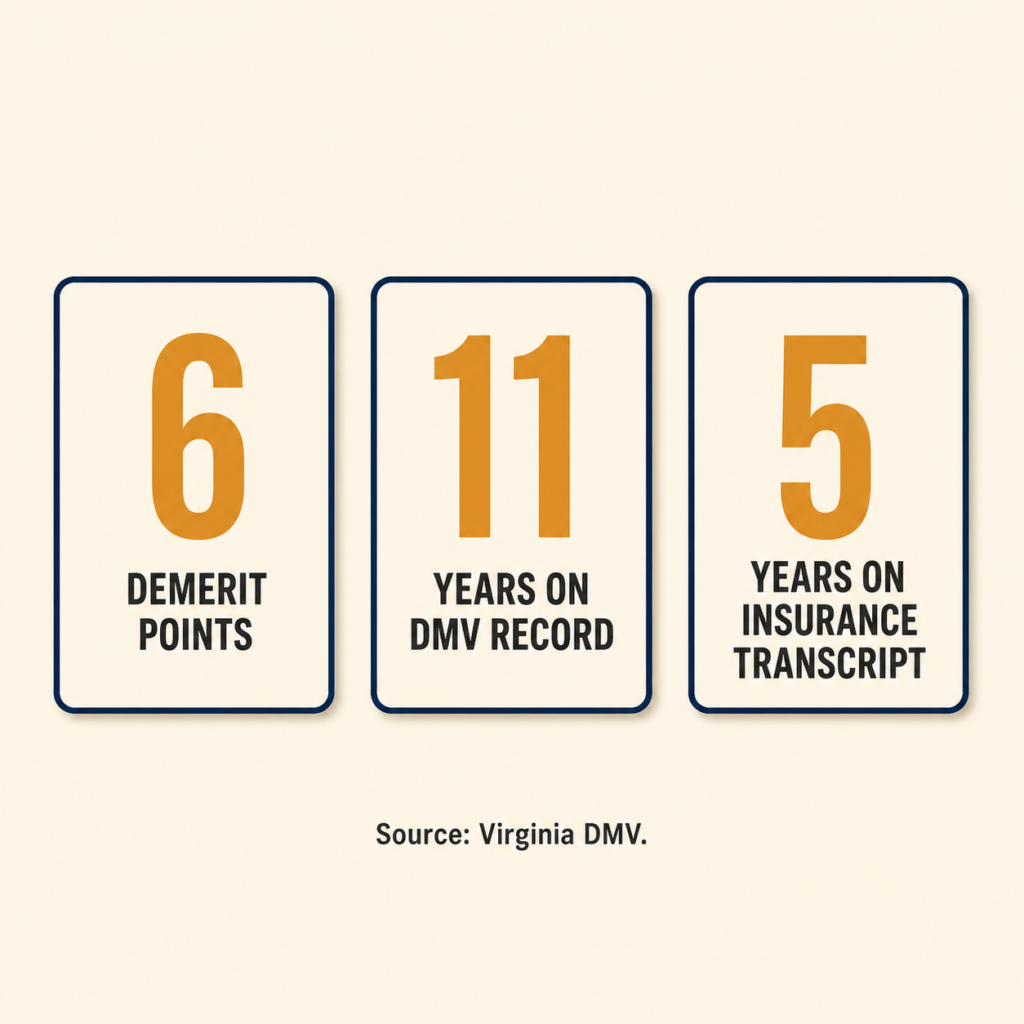
DMV record: A reckless driving conviction stays on your Virginia DMV record for 11 years. The six demerit points assigned to the conviction remain active for two years from the date of the offense.
License suspension: Under Va. Code § 46.2-392, the court has discretion to suspend your driver’s license for a period of not less than 10 days and not more than six months upon conviction.
Insurance: Virginia DMV maintains a driver/insurance transcript that contains up to five years of driving history. A reckless driving conviction on this transcript will be visible to insurers. While no official statewide figure quantifies the typical premium increase, a criminal traffic conviction is among the most significant negative factors in auto insurance underwriting.
There Is No “First Offender” Program for Reckless Driving
Virginia has first-offender deferred disposition programs for certain offenses, but reckless driving is not one of them. The first-offender probation statute (Va. Code § 19.2-303.2) applies to certain misdemeanor crimes against property, not to reckless driving.
This misconception is worth addressing directly: there is no standard statewide program where you complete a class and the reckless driving charge disappears. The path to a favorable outcome runs through the courtroom, which is why preparation and, in many cases, legal representation matter.
When Should You Hire a Lawyer for a Reckless Driving Charge?
A reckless driving charge is a criminal case. You have the right to represent yourself, but the stakes and the complexity of the process are real.
An experienced criminal defense attorney can:
- Evaluate the specific facts of your stop, including the officer’s basis for reasonable articulable suspicion and the method used to determine your speed
- Review the evidence, including bodycam footage, dashcam footage, the criminal complaint, and the calibration records for the speed-detection device
- Advise on the practices of the specific court and jurisdiction where your case will be heard
- Present mitigation evidence (driving record, speedometer calibration, driver improvement, community service, character references) in the format the court expects
- Negotiate with the prosecutor for a reduction to improper driving or other favorable disposition
- Try the case if it cannot be resolved through negotiation
The Northern Virginia court system includes General District Courts, Circuit Courts, and Juvenile and Domestic Relations Courts across Fairfax County, Alexandria, Arlington, Falls Church, Loudoun County, Prince William County, and Stafford County. Reckless driving outcomes vary by jurisdiction and by judge. An attorney who practices regularly in these courts understands those differences.
At The Leiva Law Firm, Manuel Leiva handles cases personally, from the initial consultation through court. The firm handles reckless driving and traffic offenses across Northern Virginia, and the same courtroom experience built over 25+ years of trying cases from traffic offenses to serious felonies applies to every reckless driving case we take on. Services are available in both English and Spanish.
To discuss your reckless driving charge, contact The Leiva Law Firm at (703) 352-6400.

